
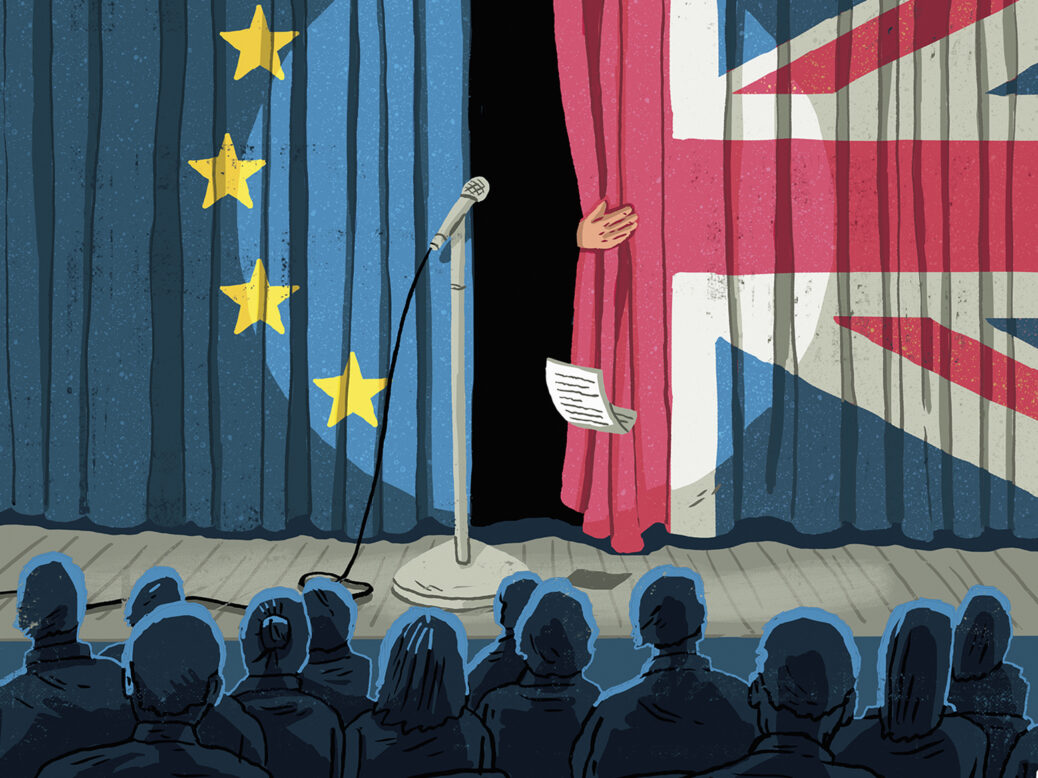
A new prime minister will soon walk towards the door of 10 Downing Street in an atmosphere they will never again experience: surrounded by expectation and anticipation, with the true pressures of power yet to come. In the first 12 years of my journalistic life I saw such a moment just twice: then came the decade of churn still unfolding.
On stage at a Bloomberg event to mark the ten-year anniversary of the Brexit vote, I asked Alastair Campbell and Jacob Rees-Mogg about its impact. Had Brexit damaged the fortunes of both their parties? Rees-Mogg went back to 1990s Euroscepticism, divisions that “made room for Reform to grow out of the Conservative Party”. Campbell, too, acknowledged Labour’s struggle, criticising Starmer’s idea of “making Brexit work”.
This was a more contained moment in a fiery discussion, giving me instant 2016 vibes. Good luck to the leader willing to reopen such questions on a bigger stage, I thought. Nevertheless, two aspects of the event gave me heart. One was the audience engagement in this political duel. The other was the interaction afterwards: Campbell and Rees-Mogg were surprisingly amicable. Future appearances on each other’s shows, perhaps?
“Go think harder, nerds”
That half-hour became a bonus episode of my podcast, but the usual format is a 40-minute, one-to-one conversation. Interviews of that length were rarely part of my Today programme experience, and present both challenge and opportunity. Challenge because making every moment worthy of the listener’s time requires significant preparation; opportunity because you can run with a particularly good anecdote or observation without watching the clock.

Some guests I have met or interviewed before – such as Riz Ahmed, whose recent film Hamlet has not yet got the attention it deserves – while others are a revelation. One such was Meredith Whittaker, who runs the foundation behind the Signal messaging app. She came into the studio the day after Starmer announced plans to get tough on tech, including “device controls” to prevent children sharing or receiving nude images. This would require “dangerous mass surveillance” easily weaponised by governments, Whittaker argued. Was it really impossible, I pressed, for clever people in tech to find a way to protect children? She wasn’t having it: “This isn’t a question of ‘Go think harder, nerds’.”
California, here we come
Over in California, the place that spawned most of the world’s top “nerds”, a Brit is hoping to become the first Republican governor since Arnold Schwarzenegger. A former Brit, I should say, as Steve Hilton renounced his citizenship before entering the race, telling me on the podcast that he wanted California’s voters to know he was “all in”. His look has certainly changed since his Downing Street days under David Cameron: the T-shirted aide once called a “beach bum” by a visiting Obama staffer now wears a jacket. I couldn’t resist asking if there was anything he missed about the UK. Not really, he said – mindful, I imagine, of saying anything that could be cast as anti-American. Not even a pint? (High journalism, this.) Yes, OK, he conceded. The pub, it would appear, is a safe space.
Global-ish strategy
As June heat records were broken I found myself listening, appropriately, to the UN secretary-general, António Guterres, deliver a climate speech in London. The setting was Guildhall, where the thick stone of a structure dating from pre-industrial times protected us from high temperatures. Guterres, who will step down at the end of the year, took a seat on stage for questions afterwards. How could his climate call to action be achieved without American buy-in, I asked? “The US government does not control the world,” he replied.
Won’t fool the Daughters of the Revolution
Just in time for the 250th anniversary of the Declaration of Independence, the paperwork has arrived to formally make me a Daughter of the American Revolution (DAR), thanks to ancestors I discovered through appearing on the BBC’s Who Do You Think You Are?. The DAR was founded in 1890 by female descendants of revolutionary soldiers angered at the exclusion of women from existing patriotic groups. My link was to the Farley family of Massachusetts and a father who fought the British along with all four of his sons. Documenting every generation of the family since was not easy, but I was helped by a wonderful volunteer from the DAR’s UK chapter, Diana Frances Diggines. This Fourth of July, I’ll be thinking of her, of the spirit that builds nations and what it takes to renew them in our contentious times.
The Mishal Husain Show is available on podcast platforms, bloomberg.com or the Bloomberg app
[Further reading: Everyone wants to be Eve Babitz]
Content from our partners


Related

This article appears in the 01 Jul 2026 issue of the New Statesman, Happy Birthday America
Join the debate
Subscribe here to comment