
Telling friends I am headed to Odesa for a June break feels faintly ridiculous – like saying I’ve booked a trip canal boating down the Somme for the summer of 1916. I have been to Ukraine twice before, but not since Russia’s invasion. At the airport I text a friend who is based in Kyiv and admit to being nervous. “Stansted?” he replies. “No wonder you’re scared. But don’t worry, you’ll be in Ukraine soon.”
It’s Tuesday night and I have just flown from London to Chișinău, capital of Moldova, before getting a bus for five hours in the night to the war-afflicted Ukraine. I’m rigid with nerves as we approach the border. My attention flits anxiously between the black-clad border guards with sniffer dogs and the middle-aged local woman next to me who is buying large knickers and a step ladder on her phone.
Smells like victory?
Odesa is a city on Ukraine’s Black Sea coast, a key port city renowned for its cultural significance. I expected Ukraine today to be run-down and its people weary. In Odesa, it is nothing of the sort. The city centre is a Unesco World Heritage Site and home to extraordinarily well-kept neo-baroque buildings. The main road is lined with fancy restaurants and cafés. Locals take me to a bar, Flacon, which claims to be the world’s first perfume-led cocktail lounge. Even a war can’t stop the hipsters.
It turns out holidaying in Odesa is not as ridiculous as first thought: Ukrainians flock here for its beaches and its relative security. Its hotel capacity is up 40 per cent year on year. I can see why. The place is Vienna with a nudist beach.

Picking your battles
I am at lunch in Kyiv with Andri (not his real name), who is in his mid-thirties, gay and has a well-paid job in the defence industry. My main purpose for visiting is for Ukraine’s tenth Pride march in Kyiv. When I first visited in 2016, it was incredibly dangerous: a neo-Nazi threw a nail bomb at the parade, seriously injuring a police officer, and thugs filled condoms with excrement to fling at activists.
“Things have got better,” Andri says, which is a view shared by all the pro-LGBT Ukrainians I speak to. “But when we win the war there will be problems nobody is thinking about now. The far right are on the front line now. One day they will come home and things will get less safe for gay people. I don’t expect this to be a priority, though. We can only fight one war at a time.”
Words and actions
President Zelensky spoke in support of LGBT rights days before the Pride march. “We are all here together, we are defending the state,” he told a fringe event at the G7 summit. “We are the same and we have absolutely the same rights, regardless of any prejudices held by people from the 15th century. We are modern people.”
The absence of legal equality is a major flash point for Ukraine’s gay soldiers. They are risking their lives fighting for the freedom of their country, but when they finish serving, they are sent home to be denied many freedoms. “It’s frustrating that I give my youth, my best years, to a country that does not reciprocate the same things towards me,” a 31-year-old veteran tells me. “Right now I do not feel totally safe. When we come back from the war, we want to have the same rights: to share a partner, to raise kids. It’s important to me.”
A different war
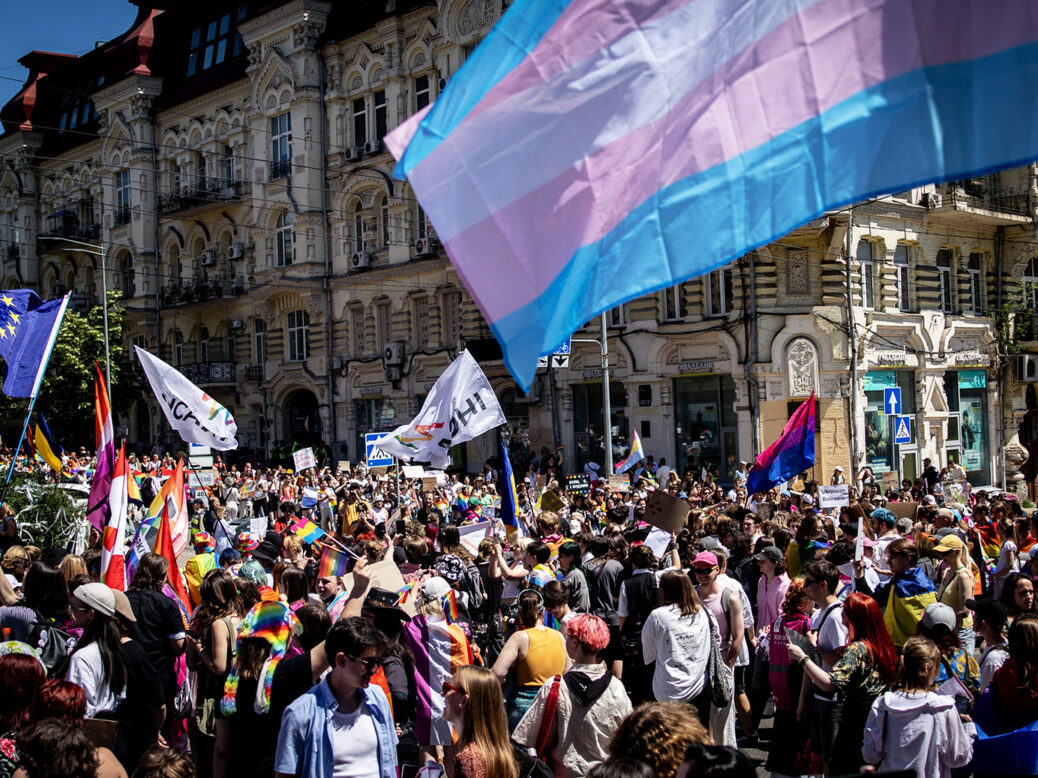
It’s a bright, Sunday morning in Kyiv. Many city-centre roads are cordoned off. Ten-foot-high fences and hundreds of police officers surround the area of the Pride march in a major effort to prevent violent clashes between queer activists and the far right.
An estimated 5,000 people have turned up – by far Ukraine’s biggest ever LGBT-rights event. At the front stand activists in military fatigues carrying photos of soldiers who have been killed. The cacophony of chatter and chants suddenly cuts out. Before anyone marches: a minute’s silence for the fallen.
A young woman tells me why she is here. “Human rights are always worth fighting for, even when fighting for our country,” she says. “Among young people, things are getting better.” These Ukrainians are fighting on two fronts: for the freedom of their country, and for the freedom to be themselves.
After an hour marching, air-raid sirens ring out. Russian drones are in the south of Kyiv and police order marchers into the Metro station, which is operating as a bomb shelter. “Slava Ukraini! Heroyam slava!” they chant as the rainbows and placards disappear from view. It translates to, “Glory to Ukraine! Glory to the heroes!” Heroes indeed.
Benjamin Butterworth is a journalist and broadcaster
[Further reading: A night with the Tartan Army at Scotland’s biggest fan zone]
Content from our partners
Related
Join the debate
Subscribe here to comment