
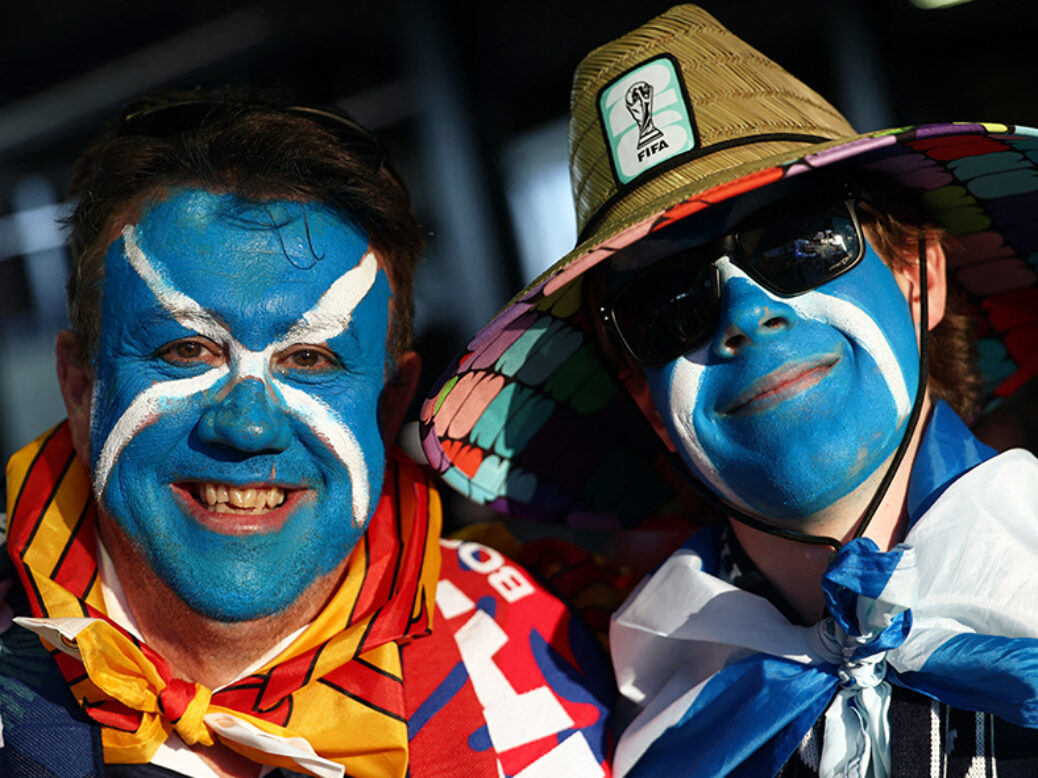
Writing this before 24 June, I anticipate staying up well past midnight, cheering on the Scotland football team as they play against Brazil. I was fortunate to see Scotland beat Haiti 1-0 in Boston, which was Scotland’s first World Cup tournament victory since 1990, when I saw them beat Sweden in Genoa.
The Haiti match showed Scotland at its best: more than 50,000 supporters charmed Boston, New York and America’s east coast, even though only some of them could get tickets for the stadium. The pre-match banter was a joy – although one Hibernian supporter joked the atmosphere was almost as good as at a reserve match at Hibs’ Easter Road ground. In Boston, the Scots were welcomed by the mayor; took over Fenway Park stadium as guests of the Red Sox baseball team; and not only drank Boston as dry as it was in the prohibition years, but also organised the clean-up afterwards. Once again, Scotland’s fans showed they are second to none at making friends with strangers. The camaraderie made the hours-long queue for entry to the stadium – and the $18 drinks – bearable.
I have now attended all four of the World Cup finals in which Scotland have featured in the past 45 years: Spain, 1982; Italy, 1990; France, 1998; and now the US. Fifteen years ago I promised my youngest that if we ever qualified again, I would take him to the game – and it has taken that long to get there.
I felt the stadium erupt when John McGinn scored Scotland’s goal against Haiti. He comes from a remarkable family: his parents, both teachers, have three sons, all of whom are professional footballers. The Scottish supporters chanted the McGinn name, and I thought how proud his parents, seated not far from me, must be.

Wednesday’s game is the third time the tournament draw has pitted us against the mighty Brazil. In Seville in 1982, I was standing behind the goal into which David Narey (later to play for my team, Raith Rovers) scored, putting Scotland one up – before we lost by 4-1. In Paris 1998, I was one row back from the Duke of Edinburgh when the national anthems were played before Scotland took on Brazil in the opening match of the World Cup. The duke was standing to attention, waiting for “God Save the Queen” to be played after the Brazilian anthem. “What’s that?” I heard him say when instead, to his surprise and dismay, the band played “Flower of Scotland”.
Sport has always been my passion. Yet one of my first memories is of humiliation: as a ten-year-old listening to the radio in shock at Scotland’s 9-3 defeat by England in April 1961. So ashamed were we, as proud patriotic Scots, that the hapless goalkeeper Frank Haffey emigrated to Australia. It’s said that when, 30 years later, Denis Law, one of our football giants, met him there, Haffey’s first question was, “Is it safe to come back?” And the answer was, “No!”
A similar feeling of national mortification must have been present when, ten years earlier, in 1951, Scotland’s rugby 15 were beaten 44-0 by South Africa. The self-deprecating, but also self-pitying, joke then was that we were fortunate to score nil.
Sport has played such an important, indeed outsized, part in carrying the weight of Scottish nationhood that when we beat England in 1967, the year after England won the World Cup, well known Scots including a former MP colleague invaded the Wembley pitch. Some still keep small pieces of that turf as mementos, and others have splinters of wood from the goalposts that fans broke into pieces.
Ticket prices for this year’s World Cup are a scandal. Multiple outlets report Fifa listing premium tickets for the final for as much as $32,970. Only a few hundred seats were given to national footballing bodies at $60 each, and England’s cheapest ticket for the final through its supporters’ club costs $4,185. The equivalent ticket for Euro 2024 in Berlin was €96, a 38-fold difference. As someone who was fortunate enough to get a ticket, I feel for long-time supporters who were unable to afford to go. Football will die if we price true fans out of the game.
These prices represent an even greater scandal when we consider how little Fifa channels into grassroots football in the poorest countries. I’ve made more visits to African countries than the combined total of all American presidents in the past 100 years, so I can say with confidence that almost everywhere in Africa, there are schoolkids playing the sport in their bare feet with a makeshift ball. Starting years ago, in my capacity as a UN special envoy for education, I made many visits to Fifa’s HQ in Zurich to try to persuade the world’s football bosses to provide $1bn for schools’ football and for their kids’ education – with sadly, so far, very limited results.
President Trump did not attend America’s opening match nor, despite having a Scottish mother, any of the Scottish games. Instead, he hosted a $45m cage fight on the White House lawn, with ringside tickets reputedly selling for $1.5m. We can only hope that Fifa wasn’t taking notes.
All eyes are now on Miami. I understand a coterie of Scottish ministers and officials are travelling from Boston to attend. Perhaps this is the time for them to put the SNP-Murrell campervan to use.
[Further reading: The twilight of our European dream]
Content from our partners

Related
Join the debate
Subscribe here to comment