
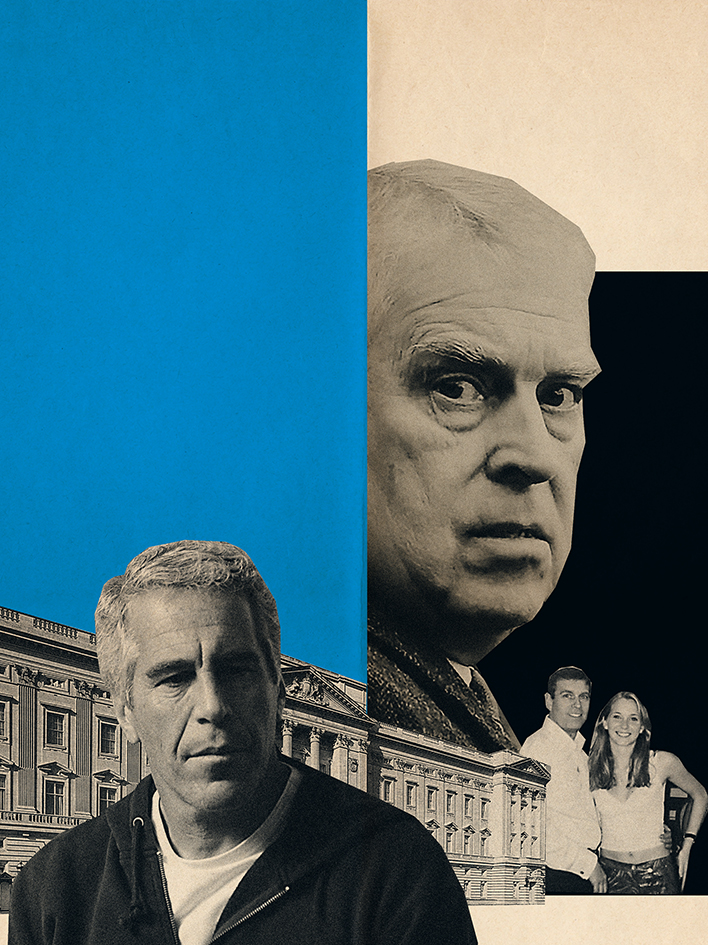
Will anyone in Britain ever be charged in relation to the sexual violence perpetrated and orchestrated on British soil by the paedophile Jeffrey Epstein? Nothing less than the prosecution of those who aided and abetted Epstein will do justice to those who suffered grievous, unconscionable sexual abuse.
The very fact that the former prince Andrew – who strenuously denies any wrongdoing – has been questioned by the police has given new hope to victims. It has led to the belief that action is now underway on this side of the Atlantic. However, the misconduct in public office that is being investigated has focused more on the potential passing of confidential government documents to unauthorised recipients than on the more serious alleged crimes of trafficking and sexual abuse revealed in the Epstein files.
Epstein’s law-breaking was made possible by a ring of abusers, enablers and traffickers, not just elsewhere but within our country. Since the article I wrote for the New Statesman in February, in which I called for Andrew to be interviewed by police, more information has been uncovered by the BBC, Guardian, Mail and Telegraph, and more has been shared with me. What has been discovered demands that the police inquiry immediately be widened to investigate a number of alleged incidents across Britain, involving the abuse of girls and women, including at royal residences. A spokesperson for the Metropolitan Police told the NS it was “aware of reporting regarding properties in London linked to Jeffrey Epstein and allegations that women living in them were victims of sexual abuse”. It added that no complaints had been made to the force by the women involved.
The American lawyer Brad Edwards, who represents Epstein’s victims, says some of his clients were abused in the UK. Because of the way Epstein’s trafficking ring operated, evidence could be assembled from drivers, airline and airport staff, ticketing agents and credit card companies. Testimonies should also be secured from estate agents, banks, border officials and royal protection officers.

The British authorities should re-interview Andrew, not just over possible breaches of the Official Secrets Act, but over his use of public funds, and especially over incidents in which women allegedly brought to him at Sandringham, Buckingham Palace, Windsor and other locations, may have been trafficked into the country by Epstein.
The first such incident occurred in early December 2000, when a flight with Epstein on board came from Paris to Luton Airport and then flew on to RAF Marham. Among the people who left the plane at Marham were three women, one of whom was Ghislaine Maxwell, all of whom were driven on to Sandringham. At the end of the visit, a private plane left the country, bound for Canada. All these flights are detailed in the Epstein files.
The files confirm that two RAF bases were used by Epstein: RAF Marham, about 16 miles from Sandringham, and RAF Horsham, which was then the private part of what is now Norwich International Airport. The Norfolk Constabulary Police should have interviewed the drivers, flight attendants, airport and palace staff, as well as the two other women on those flights, about this incident.
The answer given by the Ministry of Defence (MoD) to an enquiry by the BBC about Epstein’s use of RAF Marham has been nothing short of evasive: “It is standard practice for spare capacity at RAF airfields in the UK to be used for private or commercial aircraft, subject to fees which cover all costs.” The MoD explained that “such use is not automatic and will only be approved when there is no adverse impact to military aircraft and where approval would not interfere with the security or smooth running of the airfield”. The MoD claims no records exist that could account for these flights, and no information on who came through the air base is available.
Yet it seems from the Epstein files that Andrew himself arranged authorisation for the flight to arrive at RAF Marham and for the later flight to leave through the RAF at Norwich. Confirmation that Andrew organised the use of the bases is found in emails exchanged between the late Thomas Mulligan (of the PR firm Sitrick and Company) and Epstein’s publicist, Mike Sitrick, as reported by the Telegraph. In 2011 Mulligan and Sitrick discussed what to do with questions sent by the Telegraph’s Jon Swaine, who asked, “How did Epstein get permission to land at military bases? Did anyone, namely Prince Andrew, help him get permission?”
This question is then forwarded from Ghislaine Maxwell to Epstein with her comment: “I think that’s crap and not true and you should say so,” to which Epstein responds: “Just spoke to Larry… it’s true.” The Larry who confirmed Andrew’s role was Epstein’s chief pilot, who arranged many of his landings and logistics. Ghislaine then responds: “Shit.”
Many will now have seen the photo, taken inside Sandringham, that shows the then prince reclining across the legs of five people whose faces have been redacted, with his head near a woman’s lap. The date of this photograph is unconfirmed: it is for the police to ascertain whether the photos were taken that week in December 2000, or whether their enquiries should target another liaison.
What has become clear is that Epstein’s “Lolita Express” operated by bringing women into Britain, usually from eastern Europe, often through airports in the east of England. As these were private planes and because of his claim that the women were in transit, they were not subjected to the normal passport or customs checks when they arrived in the UK.
In breach of the declaration that these were passengers in transit, the women stayed on in the UK and were trafficked by cars or through other flights. Their onward flights to the US, their supposed destination, were cancelled. Such was the organisation of the operation that American Express was able, on behalf of Epstein, to secure refunds for the unused tickets.
We do not know how many girls came into the country under another ruse, which was to sign them up for English as a foreign language courses. The Epstein files reveal that American visas were granted for both “models” and “English-language students”. Epstein, as the BBC has revealed, paid for at least five women – some of whom were in the UK on student visas – to study in London. In one email a woman brought into the country by Epstein asks for visa advice for another Russian woman to come to stay.
There is evidence as late as 2018 of at least one woman being enrolled in a college course in London. Yet to be investigated in detail is a receipt for the payment of fees by Epstein’s office as recently as 2017-18 – after Epstein’s first conviction, but before he was charged with sex trafficking of minors – to St Giles International College, London.
The UK was also a stopping-off point for girls and women to be trafficked into France. Records in the Epstein files reveal journeys from UK airports through the Eurostar to Paris. Indeed, Epstein complained in one email that Paris airport’s landing fees and fuel charges were substantially in excess of the UK charges; this is why he tended to favour British airports such as Stansted’s private facility. One of the Paris-bound girls is listed as a “youth traveller” on her ticket, meaning she was under 25, and could have been under 18. There is a record of a £773 return fare paid for between 28 February and 1 March 2015.
I believe there are nine police constabularies that should be asked to provide information on Epstein flights. The Met has confirmed it is now undertaking “an assessment of information which indicates that London airports may have been used as transit points in the facilitation of sexual exploitation and human trafficking”. But there were at least 120 recorded flights involving Epstein that appear also to involve airports in Edinburgh, Belfast, Liverpool, Birmingham and Norwich, as well as Gatwick, Heathrow, Luton and Stansted.
Another liaison, not dissimilar to the Sandringham party of December 2000, occurred in September 2010, after Epstein had been released from prison following his conviction for procuring a minor for prostitution. On 27 September, Epstein emailed the then prince, saying he would be bringing three women to Buckingham Palace that evening to “add some life” to their planned get-together.
In a follow-up email ten minutes later, Epstein said there would now be four: “Add one more… [REDACTED] romanian,” he wrote, “very cute.” If one is in any doubt about what may have transpired at the palace that evening, the next day Epstein wrote to one of the women: “You were perfect and Andrew thought beautiful. No man looks at your clothes, they see through them, what should we do next.”
At least one woman has followed Virginia Giuffre (née Roberts) in coming forward, making allegations that she was abused in the UK; Thames Valley Police is investigating this complaint. Her evidence, and other incidents if investigated, can help in filling in the missing pieces of the jigsaw of events surrounding Epstein’s trafficking in and through the UK.
The investigation into Andrew should also consider his use of public funds. Police must now interview officials and ask for records from three government departments, the Ministry of Defence, the Department for Business and Trade, and the Foreign Office, all involved in managing his trips while serving as UK trade envoy. While serving as trade envoy, the former prince regularly used RAF flights. We must now question whether public funds were used in pursuit not just of his public duties, but of his alleged private liaisons and even private business arrangements.
One pattern seems to have been that Andrew would make an appointment in his capacity as trade envoy, for a meeting, say, in the Middle East on a Monday. He would ask the Ministry of Defence, through the Department for Transport, to organise his flights on RAF 32 Squadron for the Thursday or Friday before the meeting, to allow him to party over a weekend in favoured places such as Kazakhstan and Azerbaijan.
By 2008, when these trips, registered with the Department for Transport, were found to be costing the taxpayer huge sums of money – and some involving days of travel far beyond the requirements of his official duties – the Treasury questioned the escalating bills. Andrew was interviewed, at my request when I was prime minister, by a minister from the Business Department about the unacceptable costs he was incurring. I was told that his response was to ask whether the government seriously believed that he should have to travel on commercial flights.
He was given new rules of procedure, including using ordinary airlines, other than when such flights were unavailable. In 2008, as part of his brief, the then minister of state for justice, Michael Wills, was asked to explain whether any public funds were being used to cover Andrew’s golfing rounds, and correctly asked his department to prepare a reply. Twice he was sent back answers that were evasive. He later found that he had been removed from his responsibilities for relations with the Palace – something I was unaware of at the time. But the records of the expenses Andrew incurred will still be available and should now be requisitioned as part of the investigations.
“Over the last few years, I have been increasingly frustrated at the government’s lack of action and inability to see the need for replacement of the aircraft of the current Royal Flight,” Andrew complained to Mansour Ojjeh, president of the travel agency Tag Group, who then owned Farnborough Airport. Indeed, when I was chancellor, I received a request at Andrew’s instigation for a Royal Fleet, solely available for the use of the royal family, separate from the RAF. Emails in the Epstein files show the then prince claiming credit for having secured the privatisation of helicopters used by the royal family. Now, Andrew wanted the same arrangement for airplanes.
The then prince’s proposal was that the government pay for the royal family franchising its own fleet of planes. The costs seemed prohibitive. I turned down his proposal and reported directly to the Queen that the country could not afford such a plan.
“The fixed-wing element has been, as I say, frustrating in the extreme,” Andrew wrote. “In order to do something, I went to discuss with a number of private providers the possibility of finding an alternative solution. Cutting a long story short, I have contracted with David Rowland for use of his aircraft (which I helped him purchase from Bombardier).”
Andrew is talking here not only about using his influence on a private company while still trade envoy to help a business friend purchase an airplane, but also, when in public office, making use of the £7,600-an-hour airplane of David Rowland, apparently without registering any potential conflict of interest.
At least five journeys were made on Rowland’s plane while Andrew was still on official royal duties, according to documents revealed by the Daily Mail. It was assured by Buckingham Palace that the costs were not paid by the government. But the emails I have seen suggest Andrew used his position to promote Rowland’s business while still envoy. In 2009, Andrew opened a Rowland bank in Luxembourg, and on another occasion, in 2010, performed the official opening at a Rowland bank in the United Arab Emirates (UAE).
Rowland was, as he called him, his “trusted moneyman”, and Rowland’s bank seems to have extended loans to Andrew’s ex-wife, Sarah Ferguson.
In October 2010, Andrew wrote to Epstein saying of Rowland: “He is actively seeking high net worth individuals for his Private Bank. Perhaps this is an avenue for your undecided Chinese?”
“His bank just might be the place,” Epstein replied. “I guess I should learn more.”
Again, while trade envoy, in February 2010, Andrew asked his staff to obtain from the Treasury a report on the Icelandic banking crisis. It was of interest to Rowland because part of the Kaupthing Bank, which had been raided by the authorities, had been acquired by his Banque Havilland after the Icelandic institution collapsed. Within two hours of Andrew receiving the confidential document from the Treasury, he had passed it to Jonathan Rowland, David’s son and business partner. It was “an update note on the latest position between the UK and Iceland on the matter of the deposits and the deposit guarantee scheme”. Andrew made it clear that the businessman might use the private information to bid for assets: “The essence is that Amanda [an adviser] is getting signals that we should allow the democratic process to happen before you make your move. Interested in your opinion?”
This was the same Jonathan Rowland who wrote to the Saudi Prince Salman saying that “Prince Andrew HRH suggested that you might like to become our partner in Saudi… our proposals are that His Royal Highness considers becoming an equity partner… (as is HRH Duke of York)… obviously with our close links to HRH DOY we have opportunities that others are unable to execute”.
Jonathan Rowland has subsequently denied that he ever provided money in exchange for access to contacts, but did not deny to the BBC that he or his father or their bank, Banque Havilland, might have paid or lent money to Andrew or Sarah Ferguson.
In fact, in messages from April 2011, three months before the former prince quit as trade envoy, Rowland requested the use of Buckingham Palace to impress potential Chinese banking clients. “We are in Shanghai and just met with Bank Communications Chairman,” Rowland wrote to Andrew. “We are trying to sign a deal to be their partner in Europe. Would it be OK to invite them to meet you at BP [Buckingham Palace] next time they come to the UK?”
“YES,” Andrew agreed almost instantly, suggesting that Royal Lodge, in Windsor Great Park, might be a more discreet location. “Let me check and get back, as RL [Royal Lodge] might be better and more private.” Jonathan Rowland did not respond to a request for comment.
The Rowlands, it seems, were not alone in benefiting from Andrew’s access to information. In November 2010, as the files reveal, Andrew passed on to Epstein reports from his visits as envoy to Hong Kong, Singapore, Vietnam and China. He received them from his assistant at 2.57pm and five minutes later, at 3.02pm, he had passed them on to Epstein.
When Andrew visited the UAE with the Queen in 2010, he asked the ruler to meet Epstein as a potential financial adviser. “You are in big time,” Andrew emailed Epstein on November 24. “I would suggest you telling Abdullah,” said Epstein, citing what he considered to be his qualifications to be hired as a financial adviser: “1, trust 2, financial expertise 3, funder of extreme science (way out there), 4, fun.”
Another email containing a confidential document, “Helmand Investment Opportunities Brief Final.doc”, was sent to Epstein on Christmas Eve 2010: “Attached is a confidential brief produced by the Provincial Reconstruction Team in Helmand Province for International Investment Opportunities,” wrote Andrew.
In an email sent in May 2010, while on a trade envoy visit to Singapore, the then prince raised the prospect of a new UK venture with the German-French businessman David Stern. Stern was a key adviser to Andrew and a go-between with Epstein. He later became director of Andrew’s company, Pitch@Palace, a competition for start-ups, whose registered office was within Buckingham Palace.
Stern must now be interviewed by police. In July 2011, he wrote in an email sent to Epstein that “working with you [Epstein] is more important than the advisor role [for Andrew]”. In another, he referred to Epstein as his “boss”. For years, as the Guardian detailed, Stern continued to have direct contact with Epstein, apparently on behalf of Andrew, and even after the former prince said all contact with Epstein had been severed.
“I am having a series of discussions re The Green Park Group (GPG) when I get back and would be delighted to further our discussions, especially as I know you will have spoken to the GURU,” said one Andrew email from May 2010. “It might be that he and you are the Ghost for me in the upside of this entity. I am free on Monday 7th from about 1800 in London or RL [Royal Lodge] if either suits you?” The question Andrew should be asked directly is whether Epstein was indeed the “GURU” referred to and why Andrew was asking both Epstein and Stern to “ghost” for him on apparent business deals while still trade envoy.
An email from Stern to Epstein in September 2010 confirms the depth of the commercial relationship: “PA [Prince Andrew] has asked me to see a guy who has access to Nigeria oil and, when selling it to China (or somebody else), F [Fergie] can make around $6m. This seems very fishy (as my boss JEE [Epstein] would say).”
Again, when Andrew was still envoy, we find Epstein messaging Stern to suggest setting up a wealth-management business in London, targeting Chinese clients. “We very discreetly make PA [Prince Andrew] part of it and use his ‘aura and access’, you make/decide on the investments, and I manage the day-to-day operations/Chinese client management and acquisition…” David Stern did not respond to a request for comment.
These communications were about private work when the guidelines for the role of a trade envoy make clear, as the BBC has noted, that it “carries with it a duty of confidentiality in relation to information received” and that this “may include sensitive, commercial, or political information… In addition, the Official Secrets Acts 1911 and 1989 will apply.”
If, as the Epstein emails suggest, the former prince was passing government documents to friends, seemingly going beyond seeking advice on how to discharge his public role, then an investigation is called for – not just into the possible disclosure of official secrets, but into the use of public funds.
Our investigatory authorities will now have to perform better than they have done since 2015, when Virginia Giuffre first made a complaint to the Met.
The Met confirmed in March that it had interviewed Giuffre on three occasions following her allegations, twice in 2015 and once in 2016. But the force states “it was clear that any investigation into human trafficking would be largely focused on activities outside the UK and perpetrators based overseas, and therefore international authorities were best placed to progress these allegations. A decision was then made in November 2016 not to proceed to a full criminal investigation.”
And even when, in 2019, 2021 and 2022, new information emerged from the US federal prosecutions of Epstein and later of Maxwell, as well as from civil cases and media interviews given by victims, the police continued to state that “the position remained unchanged”.
As recently as February 2026, even as they invited accusers to come forward, the police have made such statements, saying that “while we are aware of the extensive media reporting and commentary about this matter, as of today, no new criminal allegations have been made to the Met regarding sexual offences said to have occurred within our jurisdiction”.
When pressed further in the past week by the BBC, the Met has added that it had discharged its obligations under Article 4 of the European Convention, which upholds the right to protection against trafficking.
Yet all this time, as he came into the UK, Epstein’s passport had on it a statement from the US authorities that “the bearer was convicted of a sex offense against a minor, and is a covered sex offender”. From the latter part of 2015, the Met had the power, under Theresa May’s new anti-slavery legislation, to make a prevention order – to stop Epstein coming into the country – or an order declaring him to be “a risk”.
“His ability to enter the UK and to exploit went unchallenged – that is simply unacceptable,” Kevin Hyland, the former anti-slavery commissioner, told me. “It seems unbelievable that a convicted paedophile continually entered the UK, and continued exploitation for over four years after his activities were reported to police. There were many lines of enquiry open to the Met, and even if the case was being conducted with agencies outside the UK, there was still a duty to investigate the London allegations and to implement measures to prevent further offending.”
The issue is now in the hands of the National Police Chiefs’ Council, led by chief constable Gavin Stephens, with a national review group chaired by assistant commissioner Louisa Rolfe, who are said to be coordinating enquiries and assessing allegations. It has not yet acquired the status of a formal investigation. “This is very unusual: either you are investigating a possible crime or not,” says Hyland, who also has experience, while in the Met, of dealing with trafficking investigations. “The police should announce this is a full and formal investigation. There have been many, in fact endless, commitments in the UK to protect women and girls from gender-based violence. An investigation is the only way to establish if there are more victims, who was involved and how long this went on for.”
A spokesperson for the Metropolitan Police told the NS that in 2015, responding to a letter from lawyers acting for Giuffre, the force “followed reasonable lines of enquiry to investigate [her] complaints”. “No allegation of criminal conduct was made against any UK‑based individual within those interviews and therefore no investigation was commenced.” They added that the Met has not received further complaints regarding offences alleged to have taken place in London and that any new allegations would “be carefully assessed in line with our established procedures and UK law”.
British authorities must also answer questions about what went wrong when, in 2019 and later, the US Department of Justice (DoJ) sought to interview the then prince. In January 2020, an attorney for the District of New York wrote to Andrew’s lawyer, Gary Bloxsome of Blackfords: “On November 20, 2019, Prince Andrew publicly offered to cooperate with our investigation into Jeffrey Epstein’s crimes… To date, Prince Andrew has provided zero cooperation.” This led the US DoJ attaché to write in June 2020 to the Home Office, saying the possibility of a voluntary interview, done outside the context of a mutual legal assistance (MLA) request was effectively nil. “In short, efforts to obtain a truly voluntary interview have been exhausted… We again request that the UKCA [UK Crime Agency] move forward without further delay.”
This was answered by what the US DoJ considered a foot-dragging response from the UK Home Office. The frustrated attaché confided to a colleague that in a follow-up phone call the UK official had told him: “They expect that once they approve the MLA and refer it to the police that Blackfords will file a judicial review action… [and] will argue that since they have offered voluntary cooperation as recently as early June, the Home Office failed to properly apply its internal guidelines.”
The US attaché says he pushed back hard, saying: “There is nothing in our MLA treaty which requires this… If there is now a requirement that we exhaust all informal avenues before sending an MLA request, that conflicts with our treaty and would affect many UK and US cases going forward.” The UK official responded that they were simply preparing for what they anticipated would be inevitable judicial review litigation on this matter, and that they wanted to eliminate any argument.
In September 2020, nine months after the first request, there was still no progress. The US Attorney’s Office again wrote to Andrew’s lawyer, stating that “we understand that your client has declined to sit for a voluntary interview and provide oral answers in real time to our office. Because the written statement you propose to provide will not assist our investigation, we intend to move forward with our MLA request seeking a compelled interview of your client.”
The files indicate that after the impasse in September 2020, there was still no progress, but a prior email of June suggests there may have been an attempt, yet to be explained, at resolving this at a political level. A DoJ official forwarded a Home Office email referring to “the US Attorney General and the Home Secretary [being] keen to meet in person”. As he noted, the whole process was “unusual”.
We know that more DoJ files related to Epstein have yet to be released. The department’s inspector general, who is investigating whether the agency is complying with the law, may help explain why the process ended with no interview. But an investigation needs now to be undertaken here at home into why the request for a voluntary interview was persistently thwarted and why the authorities were, in the end, unwilling to follow through on established procedures for when cooperation is denied.
This is all the more necessary because the private correspondence between Andrew and Epstein shows that as early as the first complaint by Giuffre, Andrew appears to have known there may have been a problem. An email of January 2015 from his go-between, David Stern, was sent to Epstein stating: “PA [Prince Andrew’s] office is asking if your lawyers can give a heads-up in future so they are aware/can prepare etc?”
“im told that vr [Virginia Roberts] will make more statements on tuesday, so PA should not make any befroe that,” Epstein emailed back on 18 January.
Stern replied less than an hour later, saying that the former prince would tell a reception at that year’s Davos conference the following week that Giuffre’s allegations were “all lies”: “No more statements at all. Once at his Davos reception he will say: all lies, we made a statement, that’s it. Nothing more to say. BBC etc will be there.” So much for the prince’s later statements that there had been no contact with Epstein since 2010.
The King has said that no one should be above the law, and alongside the police investigation, a select committee in parliament should examine how public funds were used, and whether a cover-up took place that prevented Andrew from being interviewed by US investigators. The palace told the NS that the King does not wish to comment further while the investigation continues, and directed us to its statement of October 2025: “Their Majesties wish to make clear that their thoughts and utmost sympathies have been, and will remain with, the victims and survivors of any and all forms of abuse.”
Liam Byrne, chair of the Business and Trade Select Committee, has told me that he will be asking questions about Andrew’s activities as trade envoy. Karen Bradley, chair of the Home Affairs Select Committee and a champion of her government’s anti-slavery legislation, is considering whether her committee should also take action.
It is remarkable that, with the exception of the Maxwell prosecution, Epstein’s victims are still being denied justice in the US and in parts of Europe. It would be a damning indictment of the quality of British justice – and our claim to lead the world in the exposure and prosecution of modern slavery – if, through our failure to follow up on what we already know, we did not get to the truth.
There should be no safe haven nor hiding place, in the UK or anywhere else, for those who are guilty of the abuse of power.
[Further reading: Inside the scandal of the century]
Content from our partners


Related
Join the debate
Subscribe here to comment