
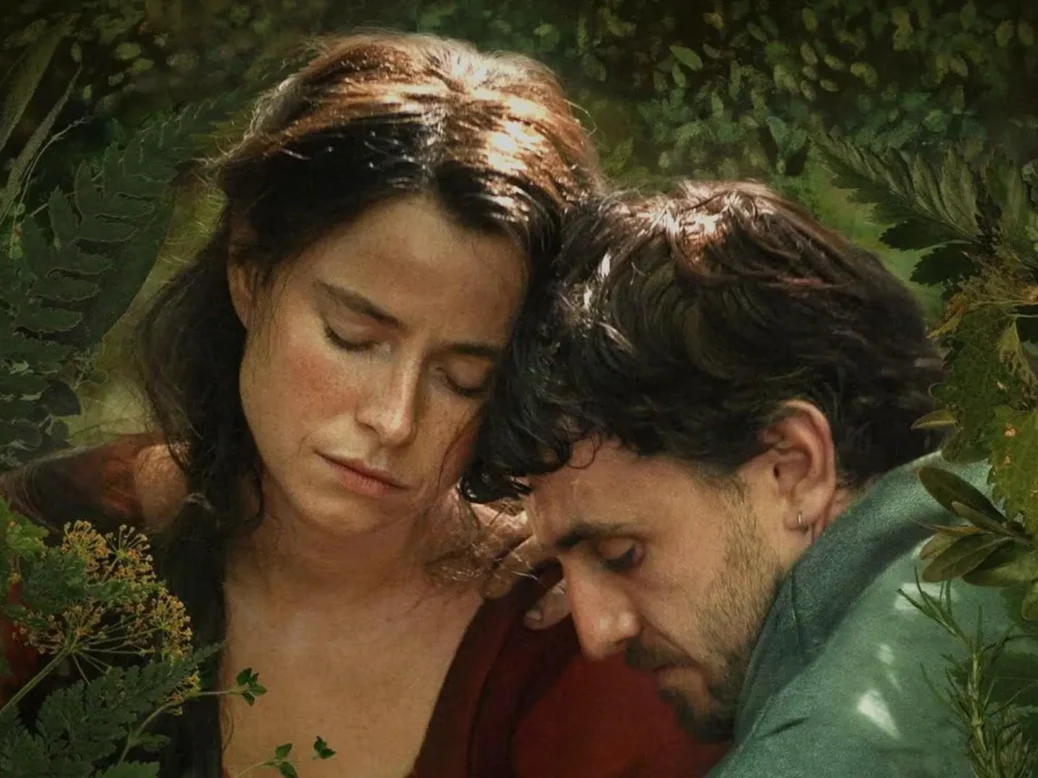
We have a new interpretation of Shakespeare. For her portrayal of William Shakespeare’s wife in the new film Hamnet, Jessie Buckley has won a Golden Globe and is the bookies’ favourite to win Best Actress at the Oscars. But what about Paul Mescal’s portrayal of the man himself?
Principally because Maggie O’Farrell’s screenplay (co-written with director Chloé Zhao) is centred on Agnes (Anne), the script gives us a mere cypher, not so much Shakespeare as his absence. He is a recessive presence, thinly sketched, speaking little. His genius is not dramatised but assumed, deferred and ultimately explained away as the sublimation of loss. The death of his only son Hamnet becomes the master key to his creativity. Hamlet is posited as the inevitable product of paternal sorrow – despite the fact that it is a play about a son mourning a father, not vice-versa. And that it was actually Shakespeare’s reworking of an old play that held the stage long before the demise of young Hamnet. The film is a prime example of the very 21st-century idea of art as autobiography, literature as consolation. One can almost hear the therapist’s couch creak beneath the weight of so much symbolic transference.
The problem is not that Shakespeare is assumed to have felt grief – of course he did – but that Hamnet reduces him to grief, as though a single emotional note could account for the riotous variety of 38 plays. Here genius is something that happens to Shakespeare, not something he actively does. The film flatters our desire for emotional uplift while evacuating the sharp intelligence, irony, and sheer mischief that pulse through the work. One of the greatest readers of the plays, Dr Samuel Johnson in the 18th century, believed that Shakespeare’s natural disposition led him to comedy, not tragedy:
“In his comick scenes, he seems to produce without labour, what no labour can improve. In tragedy he is always struggling after some occasion to be comic, but in comedy he seems to repose, or to luxuriate, as in a mode of thinking congenial to his nature. In his tragick scenes there is always something wanting, but his comedy often surpasses expectation or desire… His tragedy seems to be skill, his comedy to be instinct.”

The fundamental problem with Paul Mescal’s Shakespeare – who recites “To be or not to be” as he considers jumping into the Thames – is that he never looks like a man who can make you laugh.
A few weeks ago, reflecting on the achievement of the late Tom Stoppard, I rewatched Shakespeare in Love, the film for which he transformed an indifferent draft script by another screenwriter. How superbly it has stood up after nearly 30 years. Because wit was the primary instrument of his own writing, Stoppard understood that Shakespeare was funny before he was profound, and erotic before he was elegiac. Its great audacity lies in suggesting that genius looks less like solemn inspiration than energetic improvisation under pressure – deadlines, rivals, money troubles, and lust included. Tom Stoppard and Marc Norman’s screenplay grasps what theatrical genius demands: that we see Shakespeare working. When Joseph Fiennes’s Will tests out terrible ideas (“Romeo and Ethel the Pirate’s Daughter”), then scribbles desperately after a night of inspiration, we witness the sweat and grind of creation.
The film’s supreme joke – that Romeo and Juliet emerges from theatrical chaos and romantic misunderstanding – feels truer to the historical Shakespeare than any number of hushed close-ups. This Shakespeare steals plots, borrows phrases from tavern conversations, and transforms experience through craft. When Viola asks what will happen in the play, Will admits he doesn’t know – “It’s a mystery” – which is both a joke about writer’s block and a profound truth about the creative process. Creativity here is social, collaborative, comic. Words are tested aloud, jokes land or fail, scenes are reshaped in rehearsal. The wit of Shakespeare in Love lies in its refusal to genuflect. It honours Shakespeare precisely by allowing him to be human – ambitious, occasionally blocked, and perpetually alert to language’s music.
The portrayal of Shakespeare in the BBC’s Upstart Crow pushes this demystification further and, paradoxically, becomes one of the most truthful Shakespearean portraits on screen. Ben Elton’s sitcom revels in anachronism, yet its comedy is rooted in serious scholarly insight: that Shakespeare lived in a world of argument, gossip, bad reviews, and ideological friction. David Mitchell’s Shakespeare is vain, defensive, clever, and perpetually misunderstood. He worries about posterity, resents Marlowe’s success, and is forever irritated by the gap between his sense of his own genius and its reception.
What Upstart Crow gets brilliantly right is Shakespeare’s mind. The jokes are not merely about Elizabethan life but about language, rhetoric, and meaning’s slipperiness. Shakespeare’s verbal dexterity is dramatised as comic excess: puns pile upon puns, metaphors metastasise, ideas spiral delightfully out of control. This jobbing playwright commuting between London and Stratford, juggling theatrical success with domestic responsibility, captures the truth that Shakespeare’s genius was born not of silence and suffering but of argument and play. For me, the episode that turns on Hamnet’s death (“Go on and I will follow”) is more moving than the new film precisely because it follows Shakespeare himself in mingling comedy with tragedy. As Dr Johnson put it:
“Shakespeare’s plays are not in the rigorous and critical sense either tragedies or comedies, but compositions of a distinct kind; exhibiting the real state of sublunary nature, which partakes of good and evil, joy and sorrow, mingled with endless variety of proportion and innumerable modes of combination; and expressing the course of the world, in which the loss of one is the gain of another; in which, at the same time, the reveller is hasting to his wine, and the mourner burying his friend.”
Even All Is True, Kenneth Branagh’s film that also takes its cue from Hamnet’s death, fares better than Hamnet. Branagh’s portrayal of Shakespeare in retirement is reflective and wounded, but also irascible, self-aware, and capable of wit. The film understands that grief does not erase personality; it refracts it. If it sometimes leans too heavily on elegy, it nevertheless allows Shakespeare a moody variety and a moral complexity that Hamnet steadfastly withholds.
The crucial difference lies in their attitude toward genius itself. Hamnet treats genius as pain’s by-product, something extracted from suffering like oil from rock. Shakespeare in Love and Upstart Crow treat it as an activity: a way of thinking, speaking, and responding to the world. This matters profoundly because Shakespeare’s plays are not monuments to sorrow; they are engines of thought. Even the tragedies fizz with jokes, wordplay, and intellectual daring. To represent Shakespeare without humour is to misrepresent him fundamentally.
There is also, one suspects, a gendered piety at work in Hamnet. By shifting imaginative focus from Shakespeare’s creative life toward sanctified domestic grief, the film participates in a contemporary urge to moralise the past, to make great men acceptable by rendering them emotionally muted and narratively secondary. The result is not corrective but reductive. Shakespeare’s mind was capacious enough to accommodate contradiction and collaboration. He does not need to be diminished for his wife to be heard. His genius lay in his openness – to multiple voices, texts, ways of being. That openness is what Shakespeare in Love and Upstart Crow celebrate: a writer alive to the world’s noise. Hamnet, by contrast, closes Shakespeare down. It hushes him, sentimentalises him and evacuates precisely what made him dangerous: the restless intelligence that could never settle into pieties.
[Further reading: Chloé Zhao’s Hamnet melts the heart]
Content from our partners



Related

Join the debate
Subscribe here to commentVery true. Upstart Crow was so witty and so deep. I thought it the best thing I’ve ever seen on TV about Wm Shakespeare.