
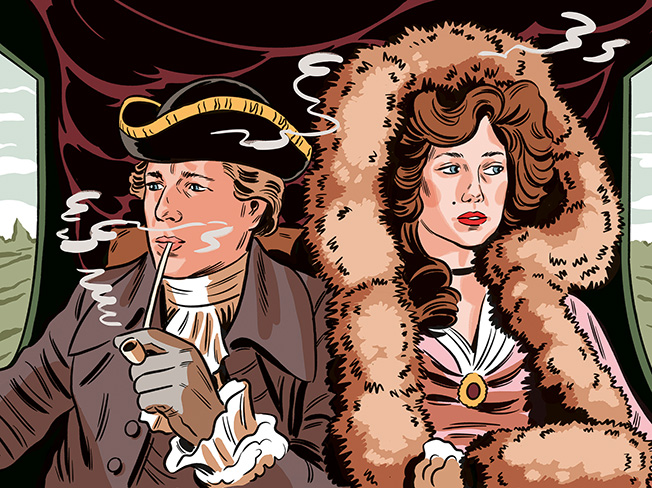
Barry Lyndon was not well reviewed when it was released in 1975, especially in the US. It was called a coffee-table movie, a jewelled corpse. Pauline Kael went to town on it in the New Yorker, saying it was one of the vainest movies ever made: “We might as well be at a three-hour slide show for art-history majors.” Mad magazine dubbed it “Borey Lyndon”.
Although it won Oscars for its score, costume design, art direction and cinematography, it was not the box office hit Stanley Kubrick and Warner Bros expected. On a production budget of $12m, it took just $20.2m worldwide, doing especially badly in America. In the year of Jaws, a long, slow period drama set in Europe in the 18th century did not appeal. Ryan O’Neal had been a big romantic draw since Love Story (1970), but this meant audiences did not enjoy seeing him as an empty vessel, ruined and maimed, either. All the anticipation created by Dr Strangelove (1964), 2001: A Space Odyssey (1968) and A Clockwork Orange (1971) was frustrated.
Time has reversed these judgements. While Kubrick’s futuristic visions appear increasingly dated, Barry Lyndon only looks better and better. It has been repeatedly rereleased into cinemas – including for its 50th anniversary this year, in a new 4K restoration scanned from the original 35mm camera negative and presented in the 1.66:1 aspect ratio that Kubrick specified – and its place in Kubrick’s work steadily re-evaluated. In polls, it is now rightly rated as one of his two or three best films, if not the best.
Kubrick came to Barry Lyndon on the rebound from his thwarted project about Napoleon. William Makepeace Thackeray’s The Luck of Barry Lyndon, about the ups and downs of an Irish chancer, published as a serial in 1844, was not an obvious choice for the director. The novel has never been much loved, due to the grinding irony of Barry Lyndon being revealed as an incessant liar and braggart, as he tells us his story in the first person. Kubrick, developing the script over three years, transformed all that, not only radically changing events – the opening and closing duels, for example, are his invention – but giving it a completely different perspective.
Instead of Barry Lyndon’s own narrative, there’s a superbly saturnine commentary (delivered by Michael Hordern), in which he tells us everything: not just what has happened and what is now happening, but also what is going to happen. The soundtrack is no less masterful, using wonderful pieces such as the Sarabande from Handel’s Keyboard Suite in D Minor and the second movement from Schubert’s Piano Trio No 2 to determine the tempo and feeling of scenes in an unforgettable way. Ryan O’Neal may have seemed an odd choice for the lead but the combination of his good looks and curious lack of purpose are perfect in context. Likewise, the fantastically beautiful but scarcely acting Marisa Berenson as Lady Lyndon was great casting.
Barry Lyndon is a film altogether about time, one of the good reasons for experiencing the full 185 minutes continuously, in a cinema. It’s much more rewarding to see on a big screen. Kubrick and his collaborators furnished every detail of the period setting with a perfectionism that has still never been rivalled, one of the reasons the trip the film takes us on into the past is just as strange and transfixing as any projection into the future. And Kubrick filmed it as no movie had ever been filmed before, using superfast Zeiss lenses developed for the moon landings to capture scenes using not just daylight but candlelight alone. Natural light is “the way we see things”, Kubrick said, simply. The film’s characteristic camera move is exquisite too: withdrawal, pulling back from a detail to reveal a whole landscape, the figures tiny in a panorama.
Barry Lyndon is an outright masterpiece, far surpassing this week’s new releases. One sign of its continued potency is David Szalay’s remarkable new novel, Flesh. Unnoticed by most reviewers and uncommented upon by Szalay himself, Flesh – which is about the picaresque career of its hero István, from Hungary to London, from poverty to riches and back to poverty again – is nothing less than a thorough revision and updating of Barry Lyndon (Kubrick’s movie, not Thackeray’s novel). Only one clever piece by Aled Maclean-Jones for the Republic of Letters seems to have spotted the eerie echoes.
That Szalay has so effectively reimagined the story of a man to whom things happen, who is at the mercy of events, subject to his body, is perhaps, in its own way, the finest tribute yet paid to this unmissable film.
“Barry Lyndon” is in cinemas from 18 July
[See also: Jurassic Park Rebirth is phoney and illogical]
Content from our partners




Related

This article appears in the 09 Jul 2025 issue of the New Statesman, The Harbinger
Join the debate
Subscribe here to comment