
Mark B Smith’s Exit Stalin tells the history of a Soviet society largely without protest, without violent repression, without dramatic events, and without sudden economic shifts. But it begins with all these things, in the town of Novocherkassk, south-western Russia, in June 1962. A wildcat strike against price rises for consumer staples escalated into street protests and the occupation of government buildings. The strikers and protesters carried old communist slogans, and expected that under “de-Stalinisation” they would not be harmed. They were wrong: on 2 June, government troops opened fire, killing more than 20 people. Nothing like this would happen again, until the Soviet Union’s collapse in 1989-91.
The massacre at Novocherkassk is placed at the start of Exit Stalin as a reminder that the Soviet Union, even at its most peaceful, kept extreme violence in reserve. But this is a book about what happens when a dictatorship liberalises itself without ceasing to be a dictatorship. It resides in the quiet space between two cataclysms, the famine, terror and war of the 1930s-40s, and the “shock therapy” of the 1990s-2000s. For Smith, a historian whose previous books investigated the Soviet housing programme and Russia-West relations and stereotypes, the use of the term “civilisation” is not a value judgement. Rather, it’s a description of a complete society, with its own distinct rules and values. It asks a timely question: what is life in a non-democratic modern society actually like? “Dictatorship” is not the same thing as “totalitarianism”: Smith describes a country that was certainly the former, but no longer the latter.
Smith builds up, through short sentences and character sketches, a picture of an entire culture, a way of life. It was one in which a continued Marxist-Leninist ideology was augmented with a technocratic discourse about a “scientific-technical revolution”, with a close link between the sciences and the arts. There was an official culture in which almost everyone participated and a dissident culture of an urban minority, but the cultural figures that most interest Smith occupied the space between these: the subtle novels of Yuri Trifonov, the feminist cinema of Dinara Asanova, the lowlife ballads of Vladimir Vysotsky, the anguished memorial sculpture of Ernst Neizvestny, the pessimistic science-fiction novels of Arkady and Boris Strugatsky.
Most of the character sketches are brief, but there are detailed studies of the three paramount leaders of the era – Khrushchev, Brezhnev, Gorbachev. The first of these fascinates Smith: a one-time ferocious Stalinist (telling a meeting in 1937, the year of the Great Terror, that “we must step over the corpses of the enemy for the good of the people”) who became a genuinely courageous reformer of the Stalinist system. Smith’s Khrushchev is a butcher with a heart, a man with “something of Ernest Bevin about him”. We find him giving his blessing to the publication of Solzhenitsyn’s One Day in the Life of Ivan Denisovich and denouncing Stalin’s crimes, first in 1956, “secretly”, and again, very publicly in 1961. We also find him homophobically bullying modern artists at the 1962 Manezh exhibition, and banning Boris Pasternak’s Doctor Zhivago – both decisions he would regret in his long retirement after his overthrow, itself a bloodless change of power that Khrushchev himself regarded as his greatest achievement.

The “thaw” that Khrushchev instigated had many ironies. The 1956 official commission set up to investigate Stalin’s terror was headed by Pyotr Pospelov, an author of the Short Course in the History of the Bolshevik Party, the great falsified historical text of the Stalin era. The thaw ended gradually, and only the suppression of the Prague Spring in August 1968 indicated its decisive finish. It “was a zone of slush, not a season of discrete stretches of ice and water”. Despite the clear message in 1968 that democratisation and the ending of censorship was off the agenda, by the 1970s a reasonably comfortable welfare state was constructed. There were paid holidays in pleasant seaside resorts, and no passport needed to travel to central and eastern Europe. Soviet professionals helped reconstruct the Third World after colonialism. But it remained extraordinarily difficult to visit western Europe or North America.
Accordingly, most dissidents – not Solzhenitsyn, but Andrei Sakharov, Roy Medvedev, or the tiny, brave group who protested in Red Square for “socialism with a human face” on the day the tanks rolled into Prague – were, for Smith, socialists who wanted to hold the Soviet system to its word. Smith does not explore the question, often obsessed over by Western socialists, of whether the late USSR was a class society, but he does note that for its rulers, “viewed from the capitalist West, the rewards were puny”. Reaching the top of the system meant a bigger flat, a nicer dacha, the ability to travel freely, and the ability to acquire Western consumer goods, mainly as “gifts”. There were other ways of acquiring wealth and prestige, though: organised crime filled in the gaps of the command economy, and took full advantage of the fact that very few people aside from the KGB had access to really accurate information.
Khrushchev spoke of creating a Soviet socialist “legality”, where citizens had rights and the secret services had to follow the rules. Nonetheless, for some, the full apparatus of repression still existed. For the irreconcilable working-class dissident Anatoly Marchenko, the “thaw”, and Brezhnev’s “developed socialism”, was Stalinism – a life of arbitrary arrest, labour camps, beatings, internal exile and eventually death in prison, though from a hunger strike rather than a bullet in the back of the head. Psychiatric hospitals were the preferred places of internment for dissident intellectuals, rather than the gulag, but prison camps still existed. Social liberalism advanced only slightly: Stalin’s ban on abortion was lifted, but his persecution of homosexuals was maintained. The Soviet Union was a patriarchal society, too, with very few women at the top; similarly, there was racism, enough in 1975, to cause public protests by Nigerian students in Lviv; and there was anti-Semitism, with informal quotas on Jews in universities. In these cases, the USSR was no worse than most Western societies – what made it different was the conflict with its own liberatory rhetoric.
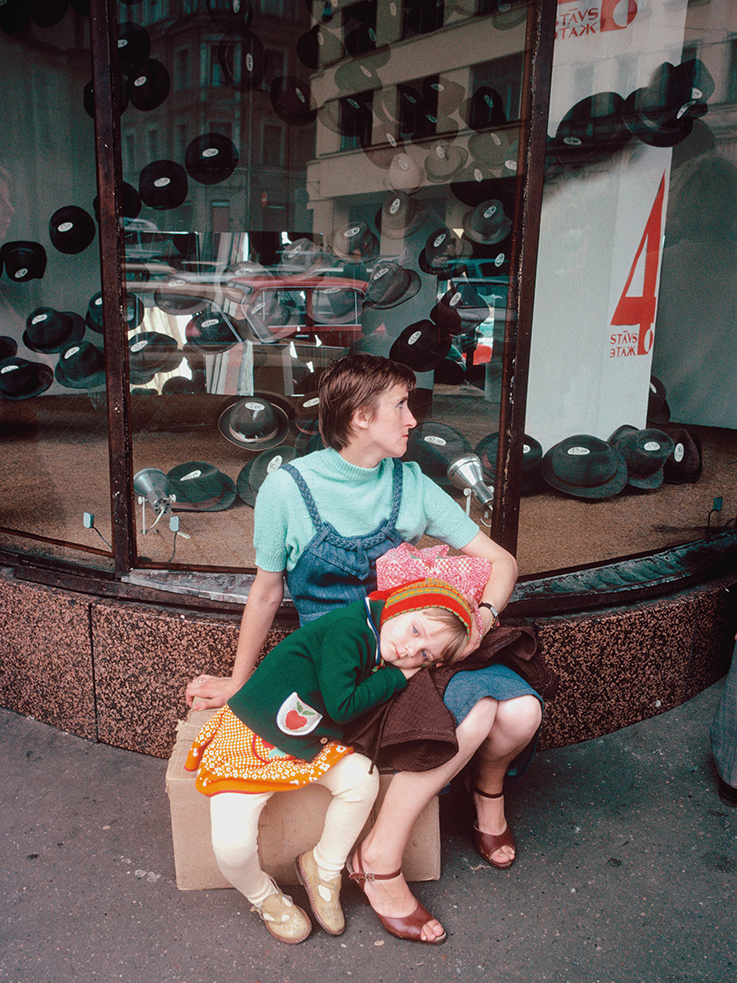
Ultimately for Smith, the late Soviet Union remained both a police state and a “revolutionary” state, right to the very end. But the police and the revolution were not noticed by all people at all times. What a Soviet city dweller did notice, Smith writes – in an exemplary sentence which gives a vivid sense of an entire disappeared world – were “the food shops that lacked sausages, the overcrowded bookstores, the thirsted-over jeans, the home-made skirts in bright colours, the Sony tape recorders and bootlegged records made out of X-ray plates, the women’s magazines with their shots of Eastern Bloc bikinis, the ever-higher apartment blocks with their still-cosier homes, the planned urban space with its concrete monoliths, red flags and open squares”.
The density of information in the book means speculation and theorisation are avoided. This causes occasional problems, particularly on Gorbachev, who suddenly morphs from sincere Leninist reformer to “social democrat” to neoliberal without any explanation. It does mean that the disasters, like Gorbachev’s economic programme, are explained empirically, rather than through abstraction. Smith lays the blame here on the early liberalisation of the financial sector: the banks that emerged in the late 1980s were immediately “the foci for get-rich-quick schemes and organised crime”, and more successful reformers, from China to Poland, were careful to keep finance under strict control. Smith also avoids grand claims on the “national question”. The Soviet Union was imperial – especially in the Baltic and Western Ukraine, annexed against the popular will, and in central Asia, where it inherited tsarist colonialism – but “the Soviet empire was run not by a phalanx of Russians in the interests of Russians, but by Russians plus a congeries of diasporas in the interests of the Soviet Union”. The largest “yes” votes, in Gorbachev’s March 1991 referendum on the maintenance of the USSR, were in central Asia: over 90 per cent. When Boris Yeltsin and the Ukrainian leader Leonid Kravchuk dissolved the Soviet Union at the end of that year, central Asians were not even consulted. In his discussion of the late Soviet cult of the “Great Patriotic War”, Smith distances the Soviet version from its recent use by Vladimir Putin’s government in manufacturing consent for the invasion of Ukraine: this narrative was a “later and murderous confection”, while the Soviet memory culture of the war had “many dead ends, thoughtful interludes and periods of indifference”.
Late Soviet life was made as predictable as possible, partly in reaction to Stalinism. During the latter, for example, the rocket designer and genius of the Soviet space programme, Sergei Korolev, spent the 1930s, 1940s and early 1950s in a state of constant uncertainty, imprisoned in the gulag and then yanked out of it: “The Stalinist system had given him privileges and then set about destroying him,” writes Smith. “It had pushed him naked into the wilderness and then retrieved him.” In that terrifying society, you could never be comfortable or secure. By comparison, a research scientist recalled of the 1970s that he “knew, for instance, that when I turned 40 I’d be given a table clock, at 50 a crystal vase, at 60 a 20-rouble raise, and that my pension would be 140 roubles”.
It is occasionally popular, in the present day, to compare the gerontocracies, the stagnant economies and the general hopelessness of the US or the UK in the 2020s to the Soviet 1980s. Judging from Exit Stalin, though, the problems of these societies are polar opposites. In the USSR, electronic gadgets and consumer goods existed, but were rare and expensive. Travel was a bureaucratic horror or a simple impossibility. Shortages of certain foodstuffs were endemic. Fashion was slow, and so were the queues. Food was extremely cheap. Utility bills were so low as to be merely nominal. Jobs were for life. Rented housing was cheap, secure and constantly being constructed, and social mobility was ubiquitous. Many people retired early to enjoy their comforts in tranquillity.
It is certainly not Smith’s intention, but one can imagine some, especially young, readers finding this all rather seductive, in much the same way as contemporary China, the USSR’s real heir, is appealing to so many Western Gen-Zs and millennials. But Exit Stalin also forces the question: would you accept the price? The intellectuals in the psychiatric hospitals? The killings on the border?
Exit Stalin: The Soviet Union as a Civilization, 1953-1991
Mark B Smith
Allen Lane, 576pp, £40,00
[Further reading: Fredric Jameson’s capitalist horror show]
Content from our partners


Related

This article appears in the 14 Jan 2026 issue of the New Statesman, Battle for power
Join the debate
Subscribe here to comment