
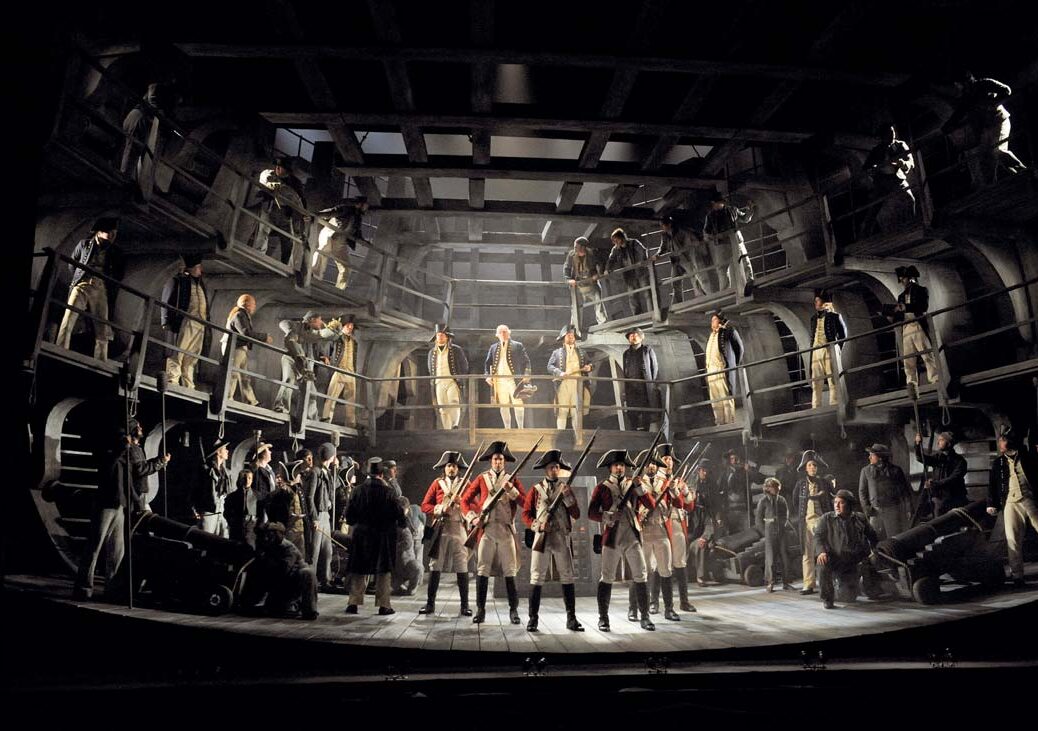
Billy Budd is that profound rarity: a work of art created by three geniuses. First performed 75 years ago at Covent Garden, the opera is based on a novella by Herman Melville, which EM Forster (libretto) and Benjamin Britten (score) transformed into a darkly mesmeric work. Melville, Forster and Britten – three men with overlapping but distinct sensibilities – brought their own touches to a classic tale of innocence destroyed by malevolence and a reflection on sexual and political repression.
It now returns to Glyndebourne in the form of a revival of Michael Grandage’s excellent 2010 production. Speaking via video call, the director tells me Billy Budd is Britten’s “greatest opera” – something he puts down to the libretto. “I have to say, Forster is what makes it a truly great opera because the poetry of the way he writes it is second to none.”
A year before the outbreak of the Second World War, Forster famously declared, in What I Believe, “If I had to choose between betraying my country and betraying my friend, I hope I should have the guts to betray my country.” Just as the friendship in his novel A Passage to India (1924) between the colonial schoolmaster, Cyril Fielding, and the Indian physician, Dr Aziz, could never be fulfilled under the shadow of imperialism, so in a world of militant nationalism individual connections could be crushed. Amid the gathering storm, Forster championed what he called “an aristocracy of the sensitive, the considerate and the plucky”.
You can see what attracted Forster to the 21-year-old English foretopman Billy Budd, a picture of goodness whom Melville describes as having a “smooth face all but feminine in purity of natural complexion”. The novella is set at sea in 1797, as monarchical Britain fights the revolutionary French state. After being captured from his merchant ship The Rights of Man and forced into naval service, Budd impresses his new crewmates on HMS Indomitable with his peacemaking skills and beautiful singing. All except the master-at-arms, Claggart, who for no obvious reason (suppressed attraction curdling into hate?) takes against Budd and, Iago-like, seeks to destroy him.

Britten and Forster met in the late 1930s through their mutual friend WH Auden, but it wasn’t until a decade later that they thought of collaborating. Britten must have suggested the topic; in a letter dated 11 November 1948, Forster confirms with excitement, “I have read Billy Budd.” Later, he writes, “I like the idea of a chorus, shanties etc,” but adds that he wants to make the opera as realistic as possible: “we keep human beings and the smell of tar”. Forster had never written a libretto and so when he visited, at the start of 1949, Britten’s seaside home in Aldeburgh, he teamed up with Eric Crozier, an experienced opera producer who modestly called himself a mere “technician”. There is a great photo of all three sitting in Crag House, Forster slumped in his desk-chair while Britten, wearing shorts, looks at the floor with Crozier ready to take notes.
Inevitably, there were clashes. When Forster heard Britten’s music for Claggart’s monologue confessing his hatred of Budd, he was dissatisfied: “I want passion – love constricted, perverted, poisoned, but nevertheless flowing down its agonising channel; a sexual discharge gone evil.” Britten also felt some friction. Writing to Crozier, he complained: “I’m having a bit of a worry with Morgan who can’t quite understand my method of work!” Nonetheless, all came right in the end, and the piece premiered on December 1, 1951, conducted by Britten himself with the set designed by the painter John Piper.
Reviews were mixed. The Wagner biographer, Ernest Newman, called it a “painful disappointment” and dismissively compared one scene to WS Gilbert and Arthur Sullivan’s farce HMS Pinafore. But when, a decade later, Britten upped the intensity by cutting the opera down from four acts to two, it soon established itself in the repertory.
While the novella focuses on the heroic Budd, the opera centres on the third figure in the story: Captain Vere. Forster and Britten chose to open the opera by having Vere look back at his decision to execute Budd after Claggart accuses him of stirring mutiny. Vere is a man of action but also a man of conscience; he reads Plutarch and immediately sees the goodness in his new recruit. But he believes he is compelled by law to order his death: “Struck dead by an angel of God!” he sings, “Yet the angel must hang!”
As Nicholas Carter, who will conduct the Glyndebourne revival, tells me, the opera could “almost be called The Tragedy of Vere.” He sees him as an anguished centrist, torn between his duty to his ship in a time of war and his fondness – even love – of Budd. Musically speaking, Vere’s prologue embodies in miniature the havering ambiguity of the whole work: “It could be part of a minor chord, we’re not quite sure, because it’s only two notes, and then in a different key… you see Vere’s moral dizziness in that moment.”
In quite a different mode is the crew’s stirring chorus song, “O heave! O heave away, heave!”, which they sing while scrubbing the deck. Carter compares it with the Chorus of the Hebrew Slaves singing for freedom in Verdi’s Nabucco. “It’s the third cousin of ‘Va, pensiero’.” But this aspiration for freedom is “just completely slapped down by the authority of the B flats and the trumpets.” Like Claggart’s feelings for Budd, the crew’s longing for liberty is brutally repressed.
One of Forster’s worries was the all-male cast – uncommon in an art form that prizes sopranos. Later critics, especially those interested in the latent gay theme, have taken this up as a point of pride. (Not without precedent: Melville said the ships he served on were “wooden-walled Gomorrahs of the deep”.) In fact, the viewer quickly forgets the single-sex cast since all the emotional types are present, from the dreamy romantic Billy to the campily villainous Claggart and the tragically noble Vere, plus that gorgeous chorus.
In Alan Hollinghurst’s novel The Swimming-Pool Library (another all-male cast), the narrator William Beckwith watches Billy Budd at Covent Garden. For Hollinghurst, the opera is the mid-point of the shadow world of male love in 20th-century Britain: “The opera that was, but wasn’t, gay.” Forster, who felt he could not publish his love story Maurice in his lifetime, and Britten, who hid in plain sight his relationship with the singer Peter Pears (who played the original Vere), apparently did not discuss sexuality when writing the opera. Yet the theme is what gives the piece its emotional power. Even Hollinghurst’s cocksure narrator weeps when Billy sings, “Farewell, O Rights of Man, farewell.”
Grandage sees a more contemporary political resonance. Oil tankers in the Strait of Hormuz have been stuck for weeks waiting for the US war in Iran to end. “I was reading about it yesterday and I thought, my God, they are literally stuck on a vessel exactly like these guys were.” As the food runs out, discipline may break down: we may even see mutiny.
But you won’t be seeing Glyndebourne’s chorus in modern sailor jumpsuits. Grandage’s production is firmly set in 1797 with keen attention to accuracy of costume and set design: HMS Indomitable even fans out to include the wooden auditorium, catching the audience in the claustrophobia of life at sea. He tells me it’s more powerful when viewers make connections themselves. “At its heart,” Grandage says, Billy Budd “is about repressed emotion and the truth of love.” Which is why its many creators and interpreters over the years have found it such a resonant, universal fable.
Billy Budd will be at Glyndebourne 28 June – 30 July
Content from our partners



Related


Join the debate
Subscribe here to comment