Victory in Venezuela?

Controversial Venezuelan president Hugo Chávez secures the right to run again after winning a refere

A decade into the rule of Hugo Chávez, it seems a majority of Venezuelan voters still have an appetite for the Bolivarian revolution.

At least, they are very willing to let Chávez present his case for a third term when the South American nation goes to the polls once more in 2012.

On Sunday night the Venezuelan electoral council announced that a constitutional referendum removing term limits for the president, governors, mayors and legislators had passed by about 54.6 per cent to 45.4 per cent, with a sizable 70 per cent turnout.

Outside of the Miraflores presidential palace, the scene was much different to that in December 2007.

Then, his supporters waited hours to celebrate with him, only to find out later that voters had narrowly defeated a comprehensive and radical package of constitutional reforms which also included the provision allowing for unlimited consecutive re-election. Chávez never appeared that night, but rather gave a sober and humble speech to his supporters saying that the revolution had been held back, although temporarily.

But this Sunday night Chávez and his supporters made no attempt to contain their overflowing euphoria as he appeared in the balcony singing together with the crowd, reading a congratulatory note from Fidel Castro, quoting writers from Bertolt Brecht to Jorge Luis Borges, and declaring his project for a socialist Venezuela re-invigorated.

“God grants victory to perseverance,” he said.

It was a significant blow for the opposition, which had been resurgent since 2007, first with the defeat of the last attempted constitutional reform, and when it made small but significant gains on the ruling United Socialist Party in regional elections in November 2008.

These gains were often seen as being grounded in effective criticisms of nagging problems such as very high levels of crime, inflation, and widespread corruption perceived in many of the people surrounding Chávez.

But Chávez himself remains a powerful and popular figure in Venezuelan politics. Analysts say part of the reason this referendum was so important for the opposition is the worry that they won’t be able to produce someone to compete with him in 2012.

While most supporters and Chávez himself do not deny the country’s problems, his popularity ratings fluctuate around 60 per cent, as they have for a while.

Loyal Chavistas, when given the chance, will provide a long list of reasons for their support, including a successful commitment to poverty reduction and widespread public health and educational missions.

According to the UN’s Economic Council for Latin America and the Caribbean, poverty in Venezuela since 2003 has dropped from 51 per cent to 25 per cent, and extreme poverty has dropped from 25 per cent to 7 per cent.

Supporters of Chávez also cite the appeal of a progressive or revolutionary ideology, the opposition to the hegemony of the US and other rich countries, as well as the personal appeal of the man himself.

Opinions differ on the import of a political movement built around a powerful figure.

George Ciccariello-Maher, a UC Berkeley doctoral candidate who is writing a book on Chávez, said: "We are always inclined to see Latin Americans as incapable of rational thought, voting blindly for charismatic populists, but we ought to remember that citizens of the US just voted for vague promises of 'hope' and 'change' wrapped in inspiring rhetoric."

During the 2007 referendum campaign the focus tended to be on the provision for Chávez’s continued re-election, while some journalists tried to point to scores of other very significant constitutional reforms in the package. But the hasty organisation of a February 2009 referendum on the one issue of re-election seemed an admission that keeping Chávez in power is the most important item on his movement’s agenda.

“A solid revolution shouldn’t depend exclusively on its leader, in this case, Chávez," said Carlos Santaniello, a 25-year old call-centre worker in Caracas who has been active in left-wing youth organisations.

“But right now,” he said “we don’t have necessary level of organisation, so, it’s necessary to keep holding confidence in Chávez and his government.”

The opposition seemed exhausted after an election as recent as November and complained they couldn’t compete with the massive resources of the government, who, they claimed, bent rules by using massive amounts of public funds on the campaign. It is very likely they did.

But as for the election itself, the leaders insisted on the transparency and the solidity of the Venezuelan electoral system, though this did not stop the rank-and-file opposition from expressing their cynicism or disappointment.

“Why does my one-year old nephew have to have the same government for 21 years?” asked Marialba Castillo de Leon, 20, who has lived half her life under Chávez and works for an importer in the private sector. “We’re just like Cuba now,” said Castillo de Leon, who claims the government exchange controls make it difficult for her employer to import goods at official exchange rates.

The opposition, though numerically smaller, is just as committed and vocal as the supporters of Chávez, if not more so. They are more likely to come from wealthier neighborhoods, but this is far from universal.

They tend to decry Chávez’s problems with crime and the economy as well as his personal style and claim they are discriminated against politically when seeking government jobs.

The best evidence indicates this is probably true in many cases, though not ubiquitous. However, the political divisions are so deep there that it may be just as hard for an open government supporter to get a high-paying job in the private sector.

Chávez’s constant electioneering probably takes resources away from problems of day-to-day governance, as well as forcing a deferral of decisions responding to the lower price of oil.

Oil, of course has funded most of his social projects.

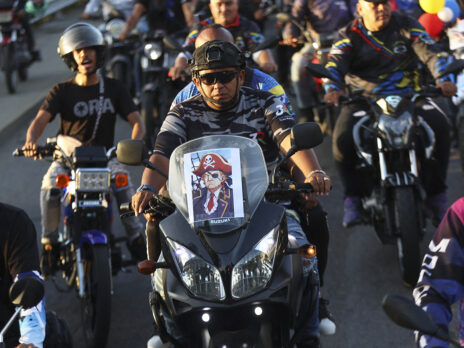
Then there is the failure to deal with a committed left militarism which, in the run-up to the election, disrupted conservative opposition meetings, in some cases with motorcycles and tear gas.

In another case, the newly-elected right wing mayor of Caracas has had his office occupied by former employees of the city’s social missions, in protest of his decision to fire hundreds of them.

Hugo Chávez’s ten years in power in Latin America have been accompanied by a significant switch leftwards in the politics of the region.

Only Colombia and Peru have stayed to the right of centre. Almost all of the countries in the new broad left coalition are good friends and staunch defenders of Hugo Chávez.

Even Brazil’s Luiz Inacio Lula da Silva, one of the region’s most moderate and diplomatic leaders, is full of praise for Chávez, especially in comparison to Venezuela’s often disappointing history of leadership.

“Chávez is without a doubt Venezuela’s best president in the last 100 years,” he told Germany’s Der Spiegel last year.

One journalist in Venezuela who has made no bones about his criticism of Chávez, admitted privately he didn’t trust the old elites to take over again, and that he wanted Sunday’s referendum to pass. “I don’t mind another six years of Chávez. The opposition just doesn’t deserve it yet, or at all,” he said.

At a riotous celebration party on the streets of Caracas on Sunday night, one woman, clad in red and full of emotion, was much less measured. “They’re not coming back,” she said, referring to the country’s former rulers. “This is another victory for the revolution.”

17 comments

Vivat's picture

Carl-

It's important to note Venezuelan elections are some of the most carefully scrutinized in the Western Hemisphere, all electronic votes produce a paper print-out that can be viewed by the voter before it is put in a box to also be tallied, that the elections count on the participation of numerous international observers, and that even the Venezuelan opposition has given up on the strategy of questioning election results.

They reason, correctly, that doing so weakens Venezuelan democracy.

harry4's picture

"Analysts say part of the reason this referendum was so important for the opposition is the worry that they won’t be able to produce someone to compete with him in 2012."
Indeed. Partly because he arrests most of them.
"However, the political divisions are so deep there that it may be just as hard for an open government supporter to get a high-paying job in the private sector."
Of course! The private sector has been shrinking since he got into power! There are no available jobs in it anymore!

BillyHewitt's picture

Hurray for Chavez our hero. It is time for America to
follow Chavez and nationalize the banks and jail the
corrupt bankers that have pushed us into a global
depression.

VC's picture

Its a amazing what can be achieved with Deibold voting machines...the same machines which gave Bush his second term.

CharlieX's picture

I think to condemn this in Venezuela is hypocritical as we have the same system in the UK.

The leader should go, when the majority of the people say so. The last few months of the Bush period in office were a farce as everyone knew he had to go.

VC's picture

Vivat, if you say so. I have nothing at face value against Chaves and like much of what he`s done. But I do believe he is an Amerikan (NWO) puppet and the rhetoric between Caracas and Washington is for public consumption...brianwashing.

ChloeGChand's picture

Superb, this should now give Chaves more time to completely eardicate all US interference in the country.

Richard Irons's picture

International Observers Ratify Transparency of Referendum Results
The results of the referendum held yesterday in Venezuela are totally transparent and trustable, said on Monday an international observer and vice-president of the National Assembly of Ecuador, César Rodríguez.
“This electoral process enhances the Venezuelan society with absolute clarity and legitimacy so its democracy deepens and progress,” he said in the special TV program Vota 2009, broadcasted by state-run TV station Venezolana de Televisión (VTV).

Likewise, Rodríguez stated that in spite of some little logistics mistakes which are usual in such a great event in Venezuela, the country can boast about one the most advanced electoral systems in Latin America and the world.

“Venezuela experienced an electoral process that ennobles the homeland and may transform it into the next world power. This makes clear that democracy in Latin America is living a very important moment,” he added.

On his part, international observer and depute from Ecuador, Eduardo Zambrano, highlighted that it was a totally transparent process and it’s a flippancy to say it was “full of vices” as daily El Nacional reviewed this Monday.

Mr. Zambrano explained that according to his experience as observer in the electoral process, he was able to observe a transparent process. Even though there were some slight mistakes, they did not affect the results.

“It was a global victory of the Yes option and a democratic party that Venezuela experienced. Everything was guaranteed by the automated electoral system that goes at the technology vanguard of the peoples of our America,” he explained.

VC's picture

Richard Irons

Never trust a system/machine that can be hacked...if Washington wants Chaves to remain in power, no OFFICIAL is going to question the process.

W Toomey's picture

The use of the expression 'rule' when referring to what is usually termed leadership in a president is weighted and unfair. After all Chavez has a mandate; the people don't HAVE to vote for him, but they have CHOSEN to do so. And when the elections come up again in 2012 they can make a fresh decision if the CIA haven't assassinated Chavez at that point. He is an elected president not a dictator, and he has taken great care to devolve power so that the population can have a proper say in their futures. The People have seen what has changed in their favour and have made a decision about their lives. They are not stupid. They live in a democracy far truer than the systems in the UK and US and the people of Venezuela will fight to keep it that way. I wonder whether the Venezuelans would quietly allow bankers to be paid out billions in order to 'retain their expertise'

EL PUEBLO UNIDO JAMAS SERA VENCIDO

Latest tweets