
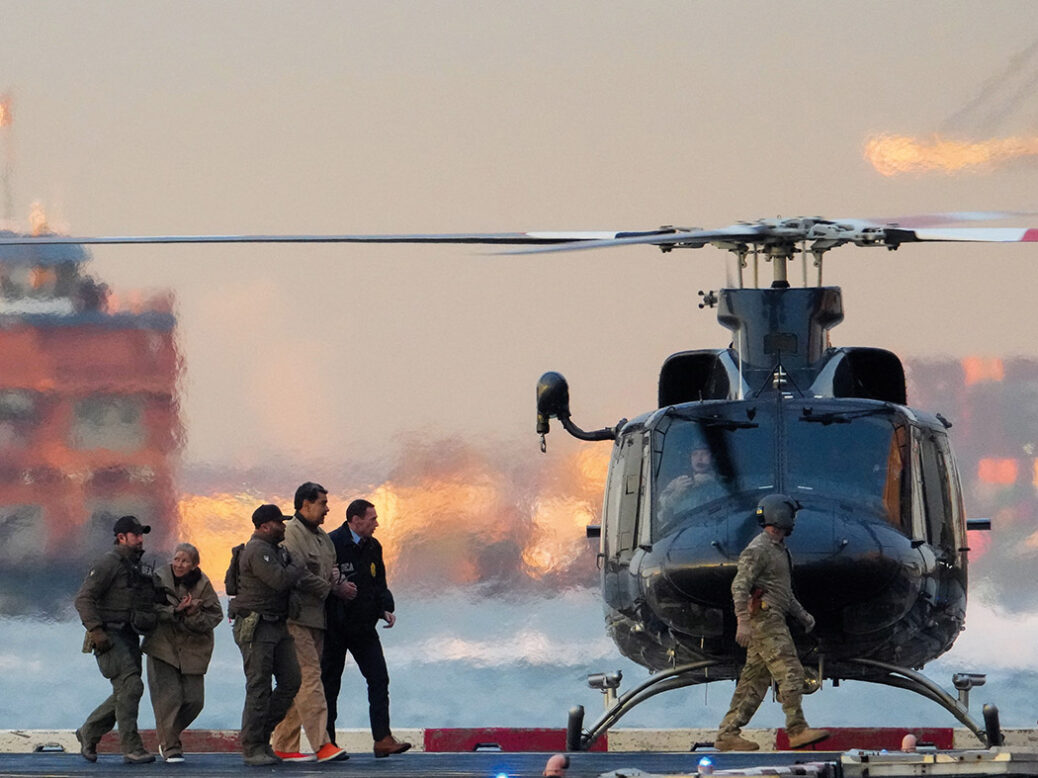
At the extraordinary press conference at Mar-a-Lago celebrating the capture of Nicolás Maduro, Donald Trump’s subordinates spoke of how this operation showed that when the president said something he should be taken seriously. The Venezuelan leader had failed to respond with sufficient vigour to America’s offer of negotiations. Others tempted to defy Trump should take notice. “If I lived in Havana, and I was in the government, I’d be concerned – at least a little bit,” said Secretary of State Marco Rubio, who has long sought regime change in Cuba. If drug cartels are really the issue, then Mexico and Colombia should be nervous. Then there is Iran, where Trump has threatened to retaliate if the beleaguered regime fires on protesters. And lest we forget strikes were recently authorised against the Islamic State in Nigeria even though it is unclear if anything of significance was hit.
Trump’s fiercest critics draw the same conclusion though with a different political slant. Trump unleashed, they say, ignoring all laws and conventions, is just as bad as was warned. He is unabashed in his imperialism – especially when oil assets might be available. From this perspective, when Trump says that he wants to take Greenland or turn Canada into the 51st state, accept that he means what he says and plan accordingly.
He is of course not the first American president to go after Latin American leaders deemed hostile to the United States, nor is he the first leader of a great power to ignore the supposed restraints of international law, although most make more of an effort to deny that they do. He enjoys addressing other governments like a mafia boss. He does not even resort to euphemisms, so he was quite happy to describe the extraction of Maduro as a “kidnapping”.
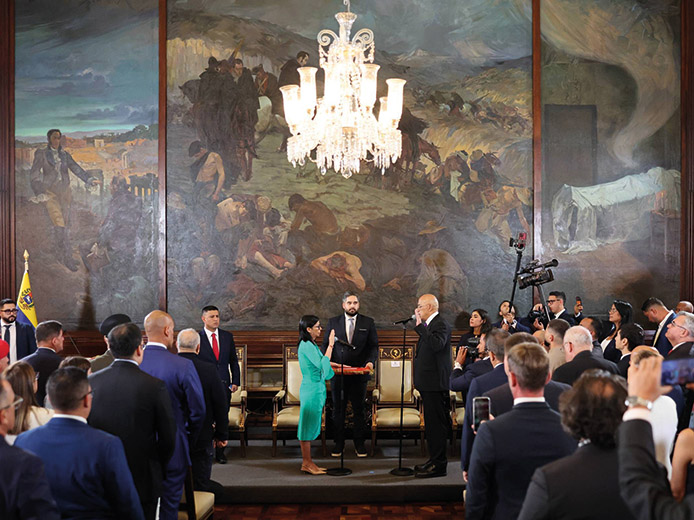
Venezuela will be used as a precedent by others to justify similarly aggressive acts, but for those that want them there is no shortage of past cases. The importance of precedents, however, lies not just in the initial act and the promises of what is to come, but also by what happens next. Putin’s invasion of Ukraine, which began with a failed attempt to take out President Zelensky, could also be considered a precedent, but few would look at what has happened since and say that this was a model to follow. That may well be the case with Venezuela.

We have only had the first step in a process that will take months and even years to unfold. The next steps are uncertain. It may all lead to far less than Trump claims.
It is one thing to capture a foreign leader who is accused of crimes that affect the United States – for which he will be tried in the US – which is how 3 January began. It is quite another to claim to have taken over the running of the country, which is what Trump did at his press conference a few hours later.
His fantastical boasts were taken literally, as he is, after all, the president of one of the world’s most powerful countries. It suited both his supporters and critics to take at face value his assessment that the US had taken over Venezuela when it clearly had not.
Trump habitually describes situations in ways that satisfy him, whether or not they correspond with reality. What he says is laced with doses of make-believe and wishful thinking. This happens so often that everything he says should be treated with scepticism at the least, and where appropriate with incredulity.
This goes beyond his customary hyperbole, in which every military operation is the most accomplished since the Second World War and his peacemaking efforts are unparalleled in the history of civilisation. He regularly misrepresents the problems he is trying to solve and the effectiveness of his chosen solutions. He insists, for example, that his tariffs will have no adverse economic effects, and sending in the National Guard has drastically reduced crime in American cities, that the war in Ukraine is somehow Biden’s fault and Putin is a man of peace who cares about the Ukrainian people. This tendency has become a political liability. Claims the economic situation is rosier than experienced by most ordinary Americans are one reason why Trump’s poll numbers have been dropping. His efforts to bring an end to the Russo-Ukraine war have been hampered by his misreading of Putin and his readiness to make concessions.
With Venezuela, Trump’s exaggerations will cause him serious problems. He has already triggered intense international reactions objecting to a strategy that is not actually being followed while obscuring the one that is.
Much ink has already been spilled on the implications of the US taking over Venezuela for international order, as if this was now an established factor. His supporters talk about a new age of American power, while his detractors warn of the consequences of his brazen illegality, emboldening predators everywhere or even encouraging an international division into spheres of influence, as the United States concentrates on its own Western Hemisphere and leaves Europe to Russia and the Indo-Pacific to China.
Yet it is already apparent that the US administration has few ideas on next steps or even what this is all about. It is clearly not about a democratic transition. The poor leaders of Venezuela’s opposition have been sidelined, with Trump brutally deriding its leader, María Corina Machado, who had the temerity to accept the Nobel Peace Prize that Trump believed was rightfully his. The administration has decided to work with the rest of Maduro’s government, and has tried to sweet-talk his deputy and now acting president, Delcy Rodríguez, into serving as its agent in Caracas.
And for that reason this is hardly regime change. Unless one believes that Maduro’s crimes were his alone and the rest of his government was completely in the dark about the corruption and cartels, or that his warm relations with Cuba, Iran, Russia and China was purely personal, then the rest of his administration shares the guilt.
The reason why there is no regime change is because Trump does not really want to put “boots on the ground” and occupy the country. He likes military operations that are carefully planned to achieve a specific task – the assassination of a terrorist leader, knocking out an Iranian nuclear facility, capturing a president – but he is wary of open-ended commitments. He spent much of his first term trying to get out of Afghanistan. He must also be aware that there is a substantial section of his base that voted for him because he would not get into more so-called forever wars, and who are already disgruntled by how much time he is spending on foreign affairs. He now insists that the US is not at war with Venezuela.
If the US’s complex military operation mounted to extricate Mr and Mrs Maduro from their redoubt had been combined with a landing of sufficient troops to take Caracas, then the rest of the Venezuelan government might have either fled or been captured. If that were to have happened the US would then have been stuck trying to govern without a functioning administration, as well as with the responsibility for enforcing law and order in a country close to chaos. And with each passing day it becomes much harder to send in ground forces, as Venezuelan troops prepare for a proper invasion.
Trump is threatening more strikes against Venezuela if Rodríguez does not bend to his will. “If she doesn’t do what’s right, she is going to pay a very big price, probably bigger than Maduro,” he recently told the Atlantic. The idea is to coerce the Venezuelan government to do the right thing, which means that until it does, economic sanctions will be maintained and it will not be able to sell its oil. So long as this state of affairs continues, life in Venezuela will get harder and the transition to something better will be delayed. It would be nice to imagine the US administration negotiating with itself the conditions that will allow these sanctions to be lifted. After all, it is now supposedly running the country
In practice the negotiations will be with Rodríguez and she will have every incentive to be emollient and conciliatory. But what will she be asked to agree to? As set out by Rubio, the demands are that the oil industry must be run for the benefit of the Venezuelan people, a halt to drug trafficking and gang problems, removal of the Colombian groups Farc and the ELN, and no more cosying up to “Hezbollah and Iran in our own hemisphere.” There is plenty of scope here for solemn undertakings and promises of best efforts. But how long will the Americans wait before they concede that the economic pressure must be eased? Then what happens when little changes in practice?
Rodríguez has a tricky job managing the distinctive interests inside the Venezuelan government, including tense civil-military relations, at a time when key figures will be calculating what is best for them. There are going to be arguments inside the government and the country at large about how to deal with the Americans, and Washington will have to decide whether non-compliance represents deliberate obstruction or incompetence and confusion. What happens if frustrated oppositionists decide to make a move? Will they now be allowed to speak out against corruption and repression, or will Trump approve a crackdown? Will a substantial American mission be inserted into the Venezuelan government, attempting to guide a system they barely understand? And who will be responsible for the safety of this mission?
What will be the role of the 20,000-plus Cubans believed to be in the country, who play a key role reinforcing the military, but who presumably the US wants to see expelled? What happens if the country has been so destabilised by these events that there is an outbreak of lawlessness with which security forces struggle or think is now Washington’s problem? If things go badly and the country becomes unstable, how will American oil companies be persuaded to take on Venezuela’s oil fields, and who will provide the funds for the massive investments required?
Perhaps the US administration has thought about all of this, but I doubt it. Unless the White House executes a viable plan quickly, the Venezuelan precedent could turn out to be another awkward one, reinforcing the lessons from Iraq and Afghanistan – namely that it is really hard to run another country. And in those cases the US and its allies had the advantage of a substantial presence inside the country. An attempt to run an unstable nation by indirect means backed by coercive threats sounds even less promising. And if this is the case, then we will have a reminder that even if they are left alone in their respective spheres of influences, as Russia has discovered, great powers often struggle to bully and cajole others to bending to their will.
[Further reading: Trump’s Venezuela intervention is a gift to China and Russia]
Content from our partners

Related
This article appears in the 07 Jan 2026 issue of the New Statesman, What Trump wants
Join the debate
Subscribe here to commentGreat article, making very clearly the key point about this Potemkin ‘take-over’. Trump will have some limited influence perhaps, but Venezualans will presumably know perfectly well he’s not going to put in a substantial military force. The removal of Maduro is perhaps more seen as a piece of dramatic theatre – very well executed – but a long way from Mr Trump’s absurd boasts that the U.S. is now ‘running the country’.
There is a minor typo by the way – ‘Noble’ needs to be changed to ‘Nobel’, around the middle of the article.
Thanks for flagging the typo, we’ve amended!
Most commentators are of the same opinion that Trump is all talk and no trousers. However, what is happening in Venezuela s important to what we call the West. Blair and Clinton thought they could use their power to force change, and the results in former Yugoslavia proved that intervention in some cases was successful. Iraq and Afghanistan proved that it did not work in Islamic states. America has a responsibility to follow through, not with boots on the ground, but investment to restore the oil industry and establish an administration that reflects the recent presidential election. They are rich enough to do this service and enable the eight million forced to emigrate to return. No one thinks it will be easy but the right people in charge of the army, the return of the Cuban militia to Cuba, would be a start.