
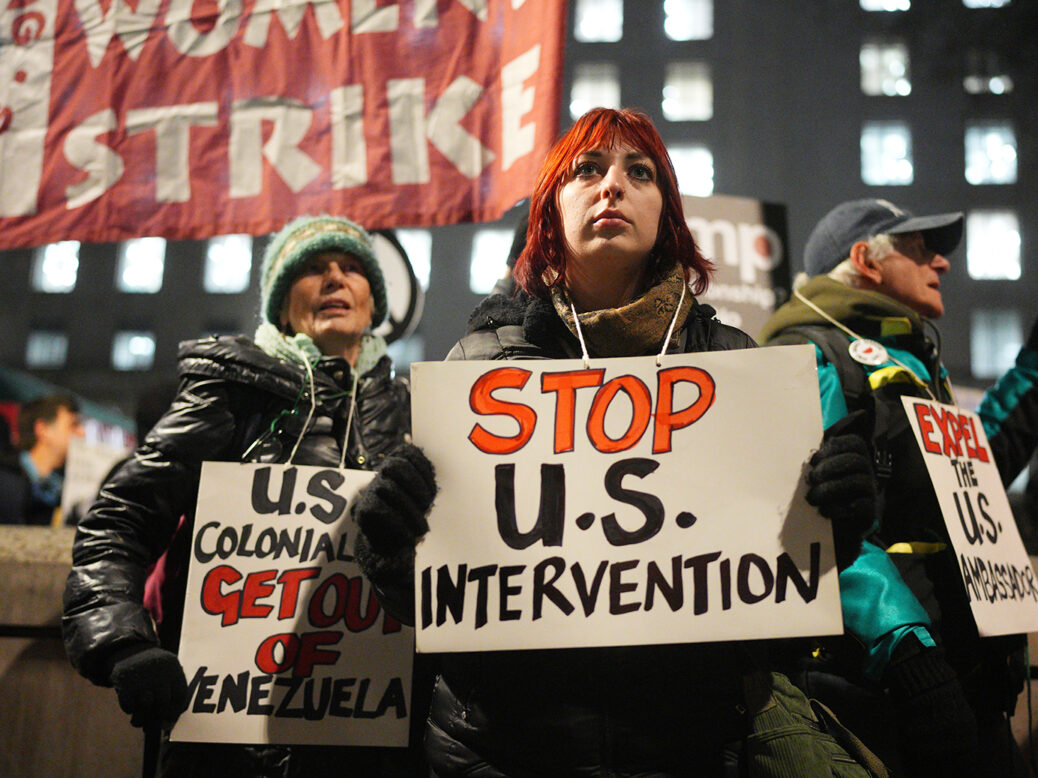
The Venezuelan man dressed in a Diesel tracksuit eyed me warily when I told him I was a journalist. “No quiero hablar del gobierno, es peligroso,” he said – “I don’t want to talk about the government, it’s dangerous”. Even though he has lived in London for 12 years, he has family in Venezuela and feared any repercussions they might face if he voiced his opinions. “Your name appears in a newspaper speaking out against Maduro and the next week you disappear,” he added, shrugging his shoulders. He didn’t give me his name, but we spoke for half an hour about Venezuela as people transferred money to various Latin American countries below us, and the overground trains rumbled overhead in the Latin quarter of Elephant and Castle. Even though more than 4,500 miles separate him from Venezuela, he still feels like he isn’t out of the government’s reach.
He felt conflicted about the US’s attack on Venezuela. “Trump did what we couldn’t do. He got rid of Maduro,” he said. He believed that Maduro lost the 2024 election and unlawfully clung onto power. “The Venezuelans can’t fight back. We only have our hands and words; the government have guns,” he continued. “So for getting rid of Maduro, we can only be grateful [to Trump]”. It was likely, he said, that Trump attacked Venezuela for its oil, “but there are many countries taking our oil for free: Russia, China. At least he did something for us.”
Did he think things will get better with Trump’s involvement? “No,” he answered curtly, folding his arms across his chest. Yet he didn’t anticipate a full-scale war between the two countries. “The Venezuelans are peaceful people, pacifists,” he emphasised multiple times. Instead of war, he hoped that the removal of Maduro would give the country a chance to improve, especially for the working class – la gente humilde, he called them: the humble people.
Tucked away in an alley behind a glass high-rise in the Borough of Southwark is a small Venezuelan restaurant. Leaving the snow settling outside and entering the warm, densely packed restaurant feels like stepping into a different country; Joropo music plays softly in the background with its lively blends of Indigenous, African and Spanish influences. Stepping into a side room, I was warmly greeted in Spanish by the owner, in a flour-dusted apron, kneading cornbread for arepas behind the counter. Her smile faded when I told her I am a journalist.

There was a long and uncomfortable pause after I asked whether I could speak to anyone about the situation in Venezuela. The owner continued her work in silence, shaking her head from time to time. Right as I set my mind to leave, she said to me, “I don’t know anyone who would want to speak about this.” She carried on: “I am not a Chavist, but I can’t agree with what happened. I have a business; I don’t want to talk about politics publicly.”
The owner turned towards the diners. “Does anyone want to speak to her?” she called out. Two men looked up, one in his mid-thirties wearing a grey bomber jacket and jeans, the other a pensioner. The younger man said he would not speak to me and returned to finishing his arepa. But the older man came over to where I stood by the counter with the owner. “We should normalise talking to the press,” the pensioner said to no one in particular. Yet he still wasn’t willing to answer my questions.
“The people are scared,” he said plainly, “we are here but most of us have families in Venezuela. [Delcy] Rodríguez is in power, but this is still Maduro’s government,” he concluded. Though the owner disagreed with Trump’s arrest of Maduro, she agreed with the older man in the hopes that this is a start of a positive change to the country. The man in Elephant and Castle’s Latin quarter had called Maduro “the cancer.” Even Venezuelan expats living in the UK since before Maduro was in power remain scared that his reach could contaminate the lives they created for themselves here.
Human rights organisations have reported that the Venezuelan government enforces disappearances of its journalists and citizens as part of its policy of repression. The Venezuelan constitution prohibits enforced disappearance, even in states of emergency, but groups like Amnesty International document the ongoing crimes against humanity committed by Venezuelan authorities. During the pandemic many journalists disappeared after documenting correct death figures as the government continued to promote falsified information. “People die from curable diseases. They only have access to electricity for three hours a day,” the man in the Latin quarter told me. Half of the country’s hospitals are reportedly running on generators, many of which are not fully functional or only power emergency wards. “The government invests its money into businesses and capitalism, but leaves nothing for infrastructure,” he said.
No one I spoke to was willing to be identified, most said they felt a mixture of fear and hope. They could not tell me how events in their home country would unfold. Either way, no one thought things could get any worse.
[Further reading: The world after Trump’s Venezuela gambit]
Content from our partners

Related
Join the debate
Subscribe here to comment