

The May 2026 local elections look set to be historic for – potentially – unprecedented insurgencies on both left and right, nationalist victories in Scotland and Wales, and perhaps even the fall of Keir Starmer. But they might also be the last elections before 16-year-olds are given the vote. Britain’s youths are emerging as a distinct and desperate element in British politics: only 36 per cent expect to be better off than their parents. In a bid to make sense of their melancholy, and understand how their vote might change national politics, I have spent the last month meeting youth representatives of Britain’s political parties.
Labour
As Labour’s membership numbers fall nationally, there has been a particular drop in youth memberships. Ellie Sandover, A Labour Youth Officer in Croydon, wishes she had a canon event that made her join Labour. “I wish there was this one light bulb sort of thing. It was probably a collection of things but with my upbringing, always Labour.”
After we spoke, further details of that upbringing emerged when it was reported by Inside Croydon that Sandover is, in fact, Keir Starmer’s niece. The paper also reported that local members were disappointed by her selection, and that two of Bensham Manor’s sitting councillors, Eunice O’Dame and Enid Mollyneux, were blocked by Labour from standing as candidates in 2026. When approached for comment about Sandover’s selection, a Labour Party spokesperson said: “Labour is proud to have a strong set of local candidates standing for election in Croydon and right across London. Only Labour is on your side – vote Labour on Thursday 7 May.”

Aside from her family, other aspects of Sandover’s biography point towards a career in Labour politics. “I was raised in a very working class household, I went into private foster care very young,” she said. Her mother, Katy Swabey, works as a nurse in a care home. Sandover later attended the prestigious Brit School for performing arts in Croydon, read law at university, and wrote a dissertation analysing the relationship between breakfast provision, social deprivation, and knife crime prevention in the UK. She considers the introduction of universal, free breakfast clubs in all primary schools in England to be one of Labour’s biggest achievements.
The young people she meets “care about the pride in where they live, where they come from. Walking outside of their house and feeling proud and not feeling worried about going home.” Of the young people involved in national parties I spoke to for this piece, Sandover was the first to stress local politics ahead of national issues. In many ways this is admirable, most of the means by which the government can improve the lives of individual young people lie with local, not national, government.
For Sandover, votes at 16 are a good idea despite growing concern that this will simply hand votes to the Greens. “there’s elements of what the Green Party represents that are very credible. It’s a party that I respect and I think a lot of the young people are attracted to it because they’re really clear. I guess a lot of young people think there’s a space on the left for that.”
Just don’t call her a radical. “Radical, progressive, the first thing that I thought was I’ve never referred to someone or a party as that.” And maybe that’s where Labour is now, invested in an image of sensibility. Sandover said: “The best thing about a Labour Government is having a Labour government in power and not in opposition and able to actually do things.”
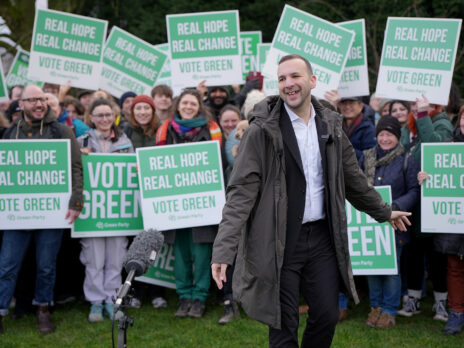
The Greens
The Green Party is set to be one of the main beneficiaries of Labour’s record unpopularity. A quarter of 18-24 year-olds intended to vote for the party when Zack Polanski became its leader. Now, more than half of them are expected to do so. One fifth of the party’s expanding membership is aged under 30.
Lilac Carr, an undergraduate at Soas, is the secretary of London Young Greens and a council candidate at the upcoming local elections. She is a pre-surge pro-Polanski Green. “I joined at a time (early 2024) where I felt I couldn’t vote for anyone else, even if perhaps it was not considered realistic that the party would be a real contender.”
Camden is the exact kind of council where Polanski has made the Greens real contenders: urban, young, vastly unequal. Here, Polanski’s urgent, moralistic rhetoric is lavishly praised. This had led to label him a populist. I asked Carr about this criticism.
“Populist? That would really depend on who you ask in the Greens. I think most Young Greens would probably want to align with that…. The Greens offer a far more unifying message of populism. We’ve all seen how the world has gotten worse and we’re all experiencing that together. And when you come together and recognise that actually the problem is billionaires, it’s not migrants, then that can be a real unifying message that I think appeals to a lot of people.”
This has led many to question quite how green the new Green Party is. Earlier this year, polling showed more Green voters support drilling in the North Sea than oppose it. But Carr objects to the idea that the Greens have ditched their environmentalism to attract a broader base. “I think there’s been a perception historically in the Greens of us being a purely environmentalist, middle class party that is less concerned with people’s everyday experiences, and that’s not true. The party has consistently cared about issues of economic justice, but I don’t think they’ve necessarily communicated that as well as they have now under Polanski.”
The young Greens, Carr argues, are “a far broader group” than simply the “tofu-eating wokerati”, who make up “a beloved but only partial representative of what the Young Greens are”.
Carr believes the youth swing towards the Greens represents that cohorts different attitudes. “I don’t think I would outright say like we’re better in any way. I think in many respects, we have become more progressive, and that’s a wonderful thing.”
The Conservatives
Today’s young Conservatives joined their party, which does appear to have a bright future during their political lifetimes, for diverse and sometimes eccentric reasons. Jay Chan, a chronically online young Tory and pintfluencer, joined because of his Hongkonger upbringing. He was a card-carrying member within a year of moving to Britain. He went on to work for Marco Longhi MP, who lost his seat in 2024 and has since defected to Reform. Chan, meanwhile, is still a Tory member and on a mission to down a pint in all 650 parliamentary constituencies to highlight the plight of Britain’s pubs. At the time of writing, he’s ticked off 153.
“When I joined I did not have a Thatcherite view of the economy or something like that,” Chan told me. “That’s way too complicated for me. I was 16.” He spent a bit of time being a libertarian, then he was a Christian nationalist. “I used to retweet Charlie Kirk for some reason – that was a bit silly and cringe.” But he is now a Tory wet, one-nation and paternalistic. And so, he believes, are most young Conservatives.
Chan is not dismayed at the prospect of the local elections. “Yeah. We’re still here.” When Chan joined the party, he found that the young members were “people who really want a career in politics. Some of them really hate fun.” Now, by contrast, freed up by the irresponsibility of opposition, it seems the Young Conservatives are a more light-minded bunch. “It’s not like a football club. I doubt half of us even know how to play football. But now it starts to have a sense of community. More moderate, more community spirited, more fun.” But CCHQ may be less sanguine about the possibility of the Conservative Party being reduced to a right-wing drinking club.
The Lib Dems
Constrained by electoral geography, older progressive voters often hold their nose and vote Liberal Democrat to avoid a right-wing alternative. The Lib Dems are the party of compromise, and tactical voting is how they win. Why would the innocent and idealistic opt for compromise at young ages and join the Lib Dems? For Rebecca Jones, Secretary of Liberal Democrat Women, who joined in 2019, the reason was Brexit. “Being too young to vote in the 2016 referendum. It felt like this decision was made by other people, and it’s us who have to suffer those consequences.”
For the young people joining the Liberal Democrats now, it tends to be housing. And according to Jones, young Liberal Democrats also debate women’s rights, racial equality, LGBTQ+ rights and drug reform. Jones thinks this is a product of Gen-Z being, with regard to social issues, “much more overwhelmingly progressive than a lot of generations are. Generally speaking, we’re more radical.”
A difficulty is that one of these key issues mobilising young people in Britain today is plan 2 student loans, which the coalition government introduced in 2012, alongside the tripling of tuition fees, despite famously pledging to scrap them.
Jones considers this legacy “kind of annoying, but I don’t really hold it against the Lib Dems. It was something that was spearheaded by the Conservatives. I think we should have held our ground on a lot more issues, but I think the party learned a lot from that.”
Reform
What do The New International Version Bible, Dale Carnegie’s How to Win Friends and Influence People and Happy Sexy Millionaire by the Diary of a CEO Podcast Host Stephen Bartlett have in common? These are the books that make up the Reform UK influencer Jayden Palmer’s heavily curated TikTok backdrop.
An eighteen-year-old student reading Media and Communications at Exeter, he has amassed more than 20 million social media views in his quest to become Reform’s most visible youngster. And he wants to be prime minister one day.
“I joined Reform slightly before the last election (Richard Tice was still leader at this point), simply because I felt very disenfranchised with all the other parties. I’m very right-wing: low taxes, control on immigration, fiscally conservative. But I looked at the Conservative Party and couldn’t ignore the past 14 years of what they did. I didn’t feel like I could trust them, and I don’t know why anyone should trust them after how shockingly bad they did.”
Born in 2008, Palmer was still in nappies when Cameron came to power. Having only known Britain in relative decline, it was only in 2024, when Palmer was 16, that GDP per capita rose beyond that of the year preceding his birth.
Reform ranks fourth amongst 18-24 year olds. So what attracts a middle-class, affluent teenager with a clear talent for online communications? Economic policy. Palmer made no reference to a Judeo-Christian moral code, and considers Restore Britain extremists. “They’re talking about deporting legal immigrants, and I think that’s a very dangerous territory to get into.”
If being popular amongst his peers was Palmer’s aim, he is in the wrong game. “Lowering the minimum wage, I actually believe helps young people. You choose a young person because you can pay them less at the end of the day.”
Palmer considers that on the whole, British 18-25 year-olds are conservative. But according to YouGov, 93 per cent of them are still set to vote elsewhere.
We will see what the future holds for all these political parties and these young people. Results day looms large, just as it did a few years ago when they sat their A-levels. Strikingly, the political youths are all optimistic about the future and believe that, on the whole, the majority of their peers agree with them. The pessimism which currently defines Gen-Z is nowhere to be found. Perhaps joining a political party will become advice for tortured teens.
Or perhaps not. Despite, or maybe because of, their pessimism, less than a quarter of 18-24 year-olds are expected to vote at these general elections. A parliamentary report last year found that only half are registered to vote. I leave the process stuck in the rut of pessimism. All of them just seemed like younger incarnations of their respective parties’ status quo, modelling themselves on their favourite member of their party’s hierarchy. The kids are alright, but not a lot more.
[Further reading: Stevenage Woman keeps thinking about Nigel Farage]
Content from our partners



Related


Join the debate
Subscribe here to comment