
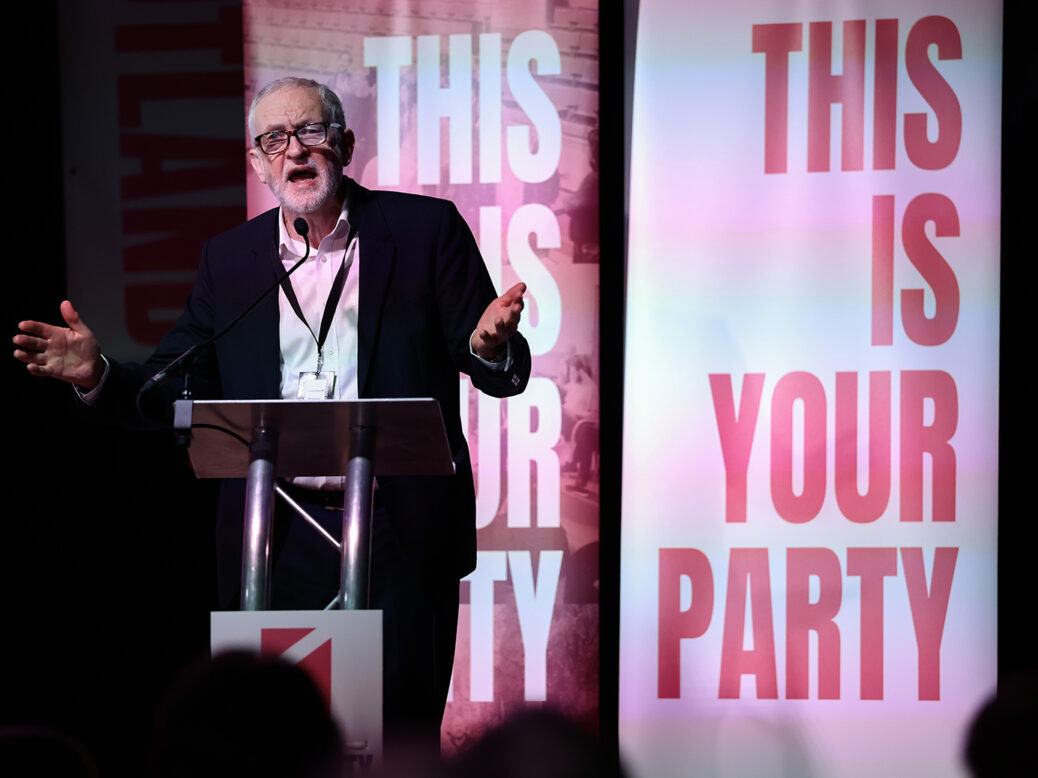
The revolution was born on a Zoom call. On 3 July 2025, more than 20 assorted faces of the British left assembled online. Among them were intensely well known public figures, and others who have spent decades working behind the scenes of political life. It was the eve of the first anniversary of Keir Starmer’s loveless landslide; but the meeting was not to discuss the Labour Party.
The group had gathered informally to discuss the creation of a long-prophesied and brand new left-wing party. Jeremy Corbyn was on the call. Many of those who joined, like the independent MP for Islington North, had been victims of Starmer’s purge of the Labour left. Jamie Driscoll, a former Labour mayor who was banned from standing for re-selection was there. So too was Beth Winter, an ex-Corbynite Labour MP. Salma Yaqoob – the former leader of Respect who unsuccessfully stood in 2021 to be the Labour candidate for mayor of the West Midlands turned independent – chaired the call.
Other faces logged on: Andrew Feinstein, the South African independent who had eaten into Starmer’s previously unassailable majority in his Holborn and St Pancras constituency in 2024, appeared. All four of Corbyn’s colleagues in the Independent Alliance of MPs – Adnan Hussain, Iqbal Mohamed, Ayoub Khan and Shockat Adam – joined too. So did Khan’s parliamentary assistant, James Giles. Pamela Fitzpatrick, a director of Corbyn’s Peace and Justice Project – who stood unsuccessfully as an independent candidate in Harrow at the 2024 general election – was there as a proxy for Karie Murphy, Corbyn’s Stakhanovite former chief of staff during his days as leader of the opposition. James Schneider, another former Loto apparatchik and Momentum veteran who was involved in early discussions, was – like Murphy – unable to attend. His book Our Bloc, published in 2022, laid some of the theoretical groundwork for a putative left-wing party. Frustration with Starmer and Morgan McSweeney, the wider Labour Party and the terrible toll of Israel’s war in Gaza had hardened on the left into real conviction. New political horizons were opening. Zarah Sultana, the MP for Coventry South who had the Labour whip suspended, logged on to the call.
What happened next would define the future of the British left. The events which took place in the first ten minutes, let alone the first ten months after that Zoom call, would shape Corbyn and Sultana’s political careers for the foreseeable future. They would open the door for Zack Polanski’s eco-populist Green Party to become the logical home for disaffected Labour voters as long as Starmer remained in power. And for a brief moment, they would spark the political hopes of 800,000 people. This story is complicated, and at times morbidly funny. But, above all, this story remains disputed by all the characters within it.

The Sultana Post
The fracture came at 8.11pm, shortly after the call had concluded. Some of those present were already at the pub; James Schneider was live on LBC. In a surprise post to her X account, Sultana announced that she had quit the Labour Party. Instead, she told her 400,000 followers, she would be co-leading the founding of a new party alongside Corbyn. “Join us,” she said, “the time is now.”
Corbyn was unaware of Sultana’s intended announcement. On the Zoom call earlier that evening, an informal motion – tabled by Feinstein – which proposed that a new left-wing party should be co-led by the 76-year-old-former Labour leader and his 31-year-old colleague had been debated and voted on by a majority of those on the call (including all four of the Independent Alliance MPs). But Corbyn had abstained. “I don’t think this is a good idea,” he wrote in the chat, “can we delay?”. In the end, Sultana forced his hand. Your Party was born. Its parents were already at odds with each other.
The foundations of Your Party were laid in months preceding Corbyn’s expulsion from the Labour Party. Corbyn was the last person to accept it was coming. Those around him and in his grouping on the disaffected former Labour left had eventually come to terms with their exclusion. There was a new electoral opportunity ready to be grasped. Around 300,000 people had left the Labour Party; the policies put forward by Corbyn in 2017 and 2019 remained popular with what Schneider termed “downwardly mobile graduates”; and a new constituency of voters, furious with Starmer’s timid and in their view deeply immoral approach to the conflict in Gaza (particularly his comments on LBC in 2023) had now sprung up in Britain’s cities and other areas with large Muslim populations. There were several different views on the form the party should take. But all agreed: it must involve Corbyn.
The idea of forming a new left-wing party was brewing even before the 2024 general election was called. In February that year, Murphy and Fitzpatrick launched Collective – a new group which met regularly and described itself as “the engine that will drive the formation of a new, mass-membership political party of the left in the UK”. Collective favoured a more formal, cohesive unitary model, mirroring a traditional political party (like the Labour Party, for example), with Corbyn at the helm.
In 2025, another circle emerged: the MOU group, named after a Memorandum of Understanding written by Driscoll earlier that year. In their view, a new left-wing party should take a more federated approach, crowding in support from existing local independent groups across the country such as Majority, the Newcastle based left-wing pressure group founded by Driscoll in 2024. Though Sultana ended up becoming more closely allied with the MOU group, in early discussions she favoured the unitary party model. “Ironically, that view is what united Karie and Zarah,” a Your Party source later explained.
Driscoll, alongside Winter and Feinstein, established a company, MOU Operations Ltd, in April 2025 with the express goal of helping to found the new party. But the group itself was initially wider than the three politicians: Yaqoob, Schneider and even Corbyn attended some of its early meetings. Once the establishment of a new party was announced by Sultana, MOU Ltd took on responsibility for collating party donations, setting up a bank account in order to do so. The Peace and Justice Project, meanwhile, had control of the party’s data.
In the end, members of the MOU Group and Collective came together to form the “organising committee” – an informal group whose discussions were mainly conducted over Zoom meetings and on WhatsApp chat bearing the same name. There was some animosity from those in the MOU Group towards Murphy owing to her history as Corbyn’s chief of staff. More than one of Corbyn’s allies warned him not to bring her on board, worrying that her perceived impulsiveness and ability to rub people up the wrong way could cause problems for the nascent party. Perhaps owing to residual guilt over the way she was sacked from Loto in 2019, or his deeply felt loyalty to Murphy, Corbyn ignored them. Murphy has remained a key figure in Your Party’s creation and continued operation.
It was shortly before the 3 July call that Sultana came on board. Aware that she was unlikely to get the Labour whip back after she was suspended for voting against Starmer’s first King’s Speech, Sultana had, according to sources familiar with the matter, been exploring the option of joining the Greens. Once she had been brought into the fold the idea of the pair co-leading a new party on the left began to be floated. Sultana – a young renegade MP with the biggest TikTok following in Westminster and ability to capture a new, younger base – could compliment Corbyn’s experience, name recognition and convening powers on the left.
Sultana was always fervently pro co-leadership. Her critics frame this as her wanting to piggyback off Corbyn’s success. But there is a world in which – had the pair got on – their partnership could have made a lot of electoral sense. Sultana, at 31 years old when she announced Your Party, could have been the heir to the 76-year-old Corbyn. This was the logic of many of those who initially supported co-leadership. But no one could have foreseen how relations between the pair would break-down – nor the role which Sultana’s husband, Craig Lloyd, or Corbyn’s wife, Laura Alvarez, had in increasing tensions.
When we spoke again for this piece, an ally of Corbyn told me, “If I had known the way they would behave, I would have tried to alert Jeremy to this a long time ago and say, don’t do it.”
Socialist or social conservative?
After Sultana’s messy surprise for her co-founder, attempts were made to reconcile the two and begin the process of launching the party in earnest. Corbyn wound up the organising committee in the days following Sultana’s post – a decision seen as a mistake by some involved in the party’s early stages. It would never meet again after that unfortunate call on 3 July. Instead, a new structure was put in place to oversee its establishment. The Independent Alliance of MPs – as the parliamentary element of this new haphazard alliance – would steward the process. One member – Adnan Hussain, the independent MP for Blackburn – was even offered deputy leadership of the party as a sweetener. A source close to one IA MP suggested that in retrospect, they now think independents were being used to shore up the new party’s legitimacy with Muslim voters, pushed away from Labour by its stance on Gaza. Hussain, Mohamed, Adam and Khan had taken seats from Labour incumbents by appealing to disaffected Muslims in Birmingham, Blackburn and Leicester at the last general election.
Sultana, having resigned her Labour membership, joined them, bringing the burgeoning group’s number in parliament to six. Soon a proper founding process was worked out, a website set up and a holding name – Your Party – decided upon. More than 800,000 people signed up, ahead of a founding conference that would take place that autumn in Liverpool. Sources tell me Sultana ostensibly agreed to the founding process and to the role of the IA. But, to their surprise, she soon dived headlong into some of the more sensitive issues swirling around the nascent party.
In early September, Sultana claimed in a post on X that social conservatism had no place in the new movement, to the surprise of the IA and allies of Corbyn. Her comments were predominantly aimed at Hussain, who had posted on X: “women’s rights and safe spaces should not be encroached upon” but rather “safe third spaces should be an alternative option”. Sultana hit back: “There is no room for socially conservative views in a left-wing socialist party. Period,” she posted. One party insider told me Sultana’s comments “took a hammer” to the fragile electoral coalition Your Party was aiming to represent: downwardly mobile, progressive graduates as well as more socially conservative Muslim voters in seats such as that represented by Hussain. Another source, who despite being sympathetic to Sultana’s criticisms, said that it was too early on in the founding process to have such debates.
But a deep fracture between Sultana and Corbyn had already formed earlier when, in an interview with the New Left Review on 17 August, Sultana said that Corbynism “capitulated to the IHRA [International Holocaust Remembrance Alliance] definition of anti-Semitism”.
Sultana’s comments frustrated Corbyn. At Your Party events and rallies towards the end of 2025, Corbyn would be frequently and aggressively heckled for refusing to call himself an “anti-Zionist”. Already sensitive after years of battling accusations and counter-accusations over anti-Semitism as Labour leader, one source close to Corbyn said, “to hear someone that he thought was on his side say his leadership had capitulated on anti-Semitism was very upsetting.” Corbyn’s allies believe it was these comments that later led to an uptick in harassment against him. “She knew what she was doing,” one source close to Corbyn claimed. It was at this point, too, that Alvarez, furious with her husband’s treatment to date, became even more hostile towards Sultana. Fiercely loyal to her husband, Alvarez would later put up major resistance to Corbyn appearing on panels alongside Sultana (one observer described Corbyn’s wife as the “Yoko Ono” of Your Party).
Even so, though Corbyn remained deeply upset by Sultana’s comments, relations between the two were still workable at the end of August. All six of the then members of the Independent Alliance of MPs agreed a founding process for the party; the march towards a new force on the left could formally begin.
The bombshell tweet
It all came to a head on 18 September: “terrible Thursday”. At 11.09 am, an email went out to the 800,000 sign ups urging them to buy a Your Party membership for £5 a month, or £55 a year. Sultana immediately posted the portal to her X account and kept posting as the number of members ticked up, reaching 20,000 within a few hours.
Except, there was a problem. Corbyn – once again – was unaware of her plans. A statement quickly went out from the Independent Alliance of MPs (excluding Sultana) urging people not to sign up. The portal was a fake. The privacy policy – seen by the New Statesman – used an email address which mimicked that which had been used in the official post a few weeks earlier, which had garnered 800,000 signups. The Peace and Justice Project – which had control of the membership data – referred itself to the ICO.
Sultana later threatened legal action, claiming she had been cut out of the process by the IA MPs and was therefore a victim of a “sexist boys club”, a claim which allies of Corbyn refute to this day citing the fact that Sultana agreed to join the alliance in the full knowledge that it would be made up of five male MPs, with her the only woman. Schneider quit the project that day. Two of the IA MPs – Hussain and Iqbal Mohamed – left in the months afterwards. Others remained but looked on in horror at the mess that now surrounded them. On 24 September, another – official – membership portal was launched. Relations between Corbyn and Sultana were at hit rock bottom. Trust lay in tatters. The Green Party, under the leadership of Zack Polanski, who had been elected on 1 September, was growing fast, gaining members quicker than ever before in its history. Could the Your Party come back from this?
A struggle to the death
Against all the odds, Your Party struggled on to the long-promised conference in November 2025. By that point all three of the leading figures in the MOU Group – Feinstein, Driscoll and Winter – had gone their separate ways, leaving Sultana as the sole director of the company they had set up to help found the new party. It was also during this period that she became closer to fringe groups within the party. One such group was the Democratic Socialists for Your Party, which included the former Momentum activist, Max Shanly, who had long been calling for a “party republic” (a party run completely by members, with no “monarchical” single leadership structure).
Over a frenetic weekend, delegates gathered in Liverpool’s drafty ACC. After the chaos of the membership portal launch, the new party’s factionalism had intensified. Corbyn and Sultana were barely speaking. Mistakes were made early on by those in charge of running the conference: many of them allies of Corbyn, under the leadership of Murphy. The banning of members of the Socialist Workers Party from attending on the eve of conference is widely viewed as one such blunder (despite rumoured threats that they were planning to storm the stage).
A rumour quickly spread that Corbyn and his wife, Laura Alvarez, had been confronted about the barring of SWP members from the conference by Lewis Neilson – the SWP general secretary – on the train to Liverpool (this was flatly denied by Your Party sources). A rally held by Sultana later that evening in which she decried the ban as a “witch hunt” galvanised her supporters. Meanwhile, at a rival event across the city, Len McCluskey, the former Unite the Union boss, read the entirety of Dylan Thomas’s “Do Not Go Gentle Into That Good Night” to a sanguine Corbyn.
Sultana’s boycott of the first day of the conference was the culmination of all these tensions. Surrounded by her supporters, including her husband, Sultana announced that she would not dignify the inaugural conference (for the party of which she was a co-founder) with her presence. Delegates left the weekend having technically founded a new left-wing party but no clearer as to which faction had won out.
Allies of Sultana were claiming victory, having secured collective leadership for the party. Instead of co-leadership, which for a long-time was Sultana’s greatest dream, Your Party would be led by a committee of lay members – the Central Executive Committee. Her boycott of the first day of proceedings, and magisterial return on the second, had received almost all of the weekend’s press coverage.
Those around Corbyn were licking their wounds. The conference, as many of them now concede, was a difficult moment in which mistakes had been made, such as the expulsion of the SWP on the eve of conference. Instead, they looked towards the Central Executive Committee elections, hoping that this would give them one final chance to wrestle back control from Sultana and her allies. The slate set up by Corbyn and his allies was named “The Many”, riffing off the refrain from “The Masque of Anarchy” by Percy Shelly, the rousing poem he recited to an ecstatic Glastonbury crowd at the height of his popularity as Labour leader in 2017. Briefings began to surface that if Sultana’s slate -– Grassroots Left – won, then the party would be doomed to irrelevance. “We were locked in for a struggle to the death for the party,” one source told me, “if we lost, we were all out, and it didn’t have any potential.”
Trauma Zone
Where is Your Party now? The Central Executive Committee elections in February, in which Corbyn’s faction won a majority, are widely viewed as having ended the internal psychodrama. The party has a leadership structure behind it. And Sultana’s allies have been kept well clear of the machinery of power. For some involved in early discussions around Your Party, and who were privy to its torturous first six months, even reflecting on what happened a year ago still proves difficult. One source told me they remain “traumatised” by what happened.
Both Corbyn and Sultana are now registered as Your Party MPs on parliament’s systems. Sultana went first; Corbyn arguably dragged his feet. According to sources familiar with the matter, he changed his alliance from independent MP to Your Party MP after the speaker’s office got in touch. As the “Parliamentary Leader of Your Party” it made no sense for him to remain unaffiliated. Shockat Adam and Ayoub Khan – the two Independent Alliance MPs who have remained in the party – are still listed as independent MPs. Sultana is keeping a low profile. As she is not a member of the officers’ group on Your Party’s Central Executive Committee, Sultana has little power over the direction of the party. The past year thrust her into the spotlight and not in a good way. Rumours have swirled that she will leave Your Party in the coming months either to join Zack Polanski’s Greens or to sit once again as an independent MP (rumours denied by her team). She is still the sole director of MOU Operations Ltd.
There is still some hope. The party is founding its own local branches to organise around 58,000 members, a far cry from the 800,000 who signed up all those months ago. (One source involved in early discussions mused that at least 100,000 of them must have joined Polanski’s Greens). In June, the first three were established in South Scotland, the Isle of Wight and Ceredigion Penfro in Wales. After polling at 0 per cent around the local elections – in which the party won no councillors – support for Your Party has now ticked up to 1 per cent. Those who remain are laying low – watching and waiting for the reputational damage to slowly ebb away.
And what of Corbyn? At the age of 77, he is once again the leader of a political party – a role he has long resisted. There is a world in which the long-serving (and long-suffering) MP for Islington North never needed to do any of this. He has always been at his most comfortable when being a principled, hardworking, backbench MP. Instead, he is now tied to an organisation that I would argue – having followed the rise and fall of Your Party keenly for the past 12 months – he may never have wanted to be a part of in the first place.
This is the crux of Your Party’s failure. The one thing agreed on by all of those who have drifted in and out of involvement with this project over the past 12 months is that it needed Corbyn’s involvement. But his responses to Sultana’s attempts to bounce him into founding a new left-wing force only served to reinforce his resistance. The two people the party’s existence depended upon were an overly impulsive, radical politician on the cusp of her career and a veteran MP coming to the end of his, who is notoriously bad at making decisions: an impossible combination of impetus and hesitancy. With such a precarious foundation, perhaps there was nothing to be done: Your Party was always doomed to fail.
[Further reading: How the Greens will take on Andy Burnham]
Content from our partners

Related
Join the debate
Subscribe here to comment