
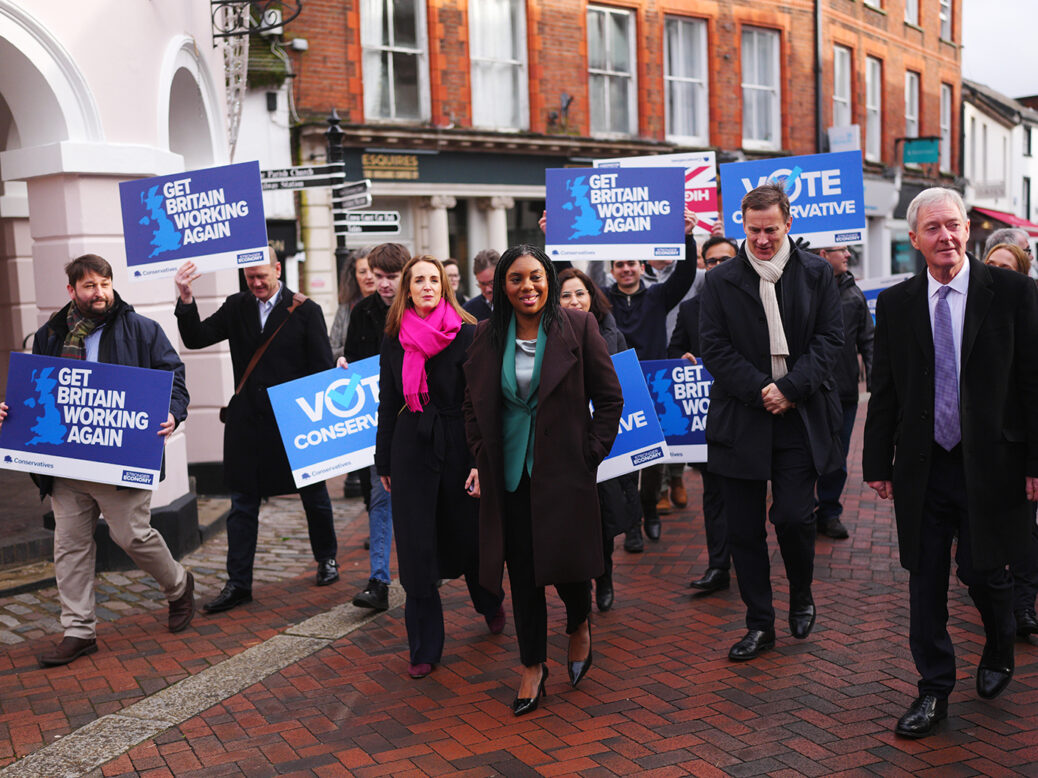
The Conservative Party got 2 per cent of the vote in the Makerfield by-election on Thursday. The result was a dramatic fall from its – admittedly poor – share of 11 per cent in the 2024 general election. As Reform UK looks to become the main party of the right, is there any hope left for the Tories?
The answer might lie in Harlow. In last month’s local elections, Reform nearly had a clean sweep in Essex. Nigel Farage’s party won 53 seats in the county and gained control of Essex County Council, ending 25 years of Conservative rule. But in Harlow, a town in the west of Essex, the Tories won all 11 seats up for election – a sign, Kemi Badenoch claimed, that the party is “coming back”. (This was perhaps an overstatement amid a national loss of 563 councillors.) I wanted to know how the town bucked the trend. So I hopped on the train to work out what it is that makes Harlow different from the rest of the county.
The road from the station to the town centre is peppered with England flags hanging limp on lampposts. When they went up in summer 2024, Dan Swords, the Tory leader of the council, said removing the flags was not a “real issue” the council would prioritise. Not everyone is so relaxed: in a Waterstones I meet a woman giving out posters of her play, a queer retelling of A Midsummer Night’s Dream. She says that some of her friends have climbed lampposts to rip the flags down. Yet the flags are very much still up. If Harlow is a town of two halves, it seems the nationalists are winning.
In 2016, Harlow voted 68 per cent to leave the EU. But residents and shopkeepers I meet have little love for Reform. I’m told of how when Nigel Farage paid a visit to Harlow a few weeks ago, he was heckled. When I ask one shopkeeper about Reform UK, he replies: “I don’t know much about politics, but isn’t that the one that’s kind of racist?” While Reform did come second in every seat, it was on average around 40 per cent behind than the Conservatives.

Harlow won £23.6million of investment from the Towns Fund, the regeneration programme that underpinned both the Conservative’s Levelling Up ambitions and now Labour’s Pride in Place. With this money, the council has planned to regenerate most of the town centre, rebuild the bus station and create an Arts and Cultural Quarter. The fund’s effects are far-reaching and inescapable. The centre of Harlow is a building site. Thick plumes of dust hang low in the air, there are constant whirrs of drilling and hordes of builders at work. Residents can see their town improving in real time. The areas that are boarded up have emblazoned on the walls: “WE’RE NOT JUST PROMISING TO REBUILD THE TOWN CENTRE, WE’RE DELIVERING IT”.
The entire middle of the main square has been dug up. In a café on the square, the owner explains how his family has owned it since 1958, and how they’ve watched as Harlow has fallen by the wayside. He is excited for the project to be completed. He has faith in the council, and tells me how Dan Swords, an occasional customer, is hugely popular and influential.
When I speak to Dan Swords over a video call, he tells me that nationally the “fundamental issue for a long time has been people failing to make things happen”, and the “political class is failing to address” issues. This town that has been slowly sliding into decline finally has a saviour.
Swords argues that the fracturing of the two-party system has correlated with a decrease in tribalism. He tells me of lifelong Labour voters on the doorstep who voted Conservative to keep the regeneration project going. On campaign leaflets the Conservatives had written “put national politics aside”. Swords assures me this was not a dig at Badenoch’s leadership, but instead was to focus voters’ minds on local issues. (Perhaps this was also an attempt to get Reform-curious voters to stop thinking about immigration.) With only a third of seats up for election this cycle, the Conservatives were the only party that could realistically form a majority. Swords therefore used the promise of a strong council and the guarantee of the continuation of the regeneration project.
Both Labour and Reform had also pledged to continue the project, and had pointed to the work of the neutral council officers in helping the process. Yet ultimately, the regeneration project is seen as the magnum opus of Swords. In an interview after the count, Harlow Labour Leader, James Griggs, described the election result as “the Dan effect” and that he had “basically made [the election] a referendum on himself”. When I ask Swords if the regeneration project is a Conservative one, Swords says it isn’t “inherently political”. However, he mentions his commercial approach and commitment to freezing council tax as key Conservative tenets to his leadership.
Many local councils are driving similar projects of regeneration. Schemes like the Towns Fund provide resources for this, but even without direct investment from the fund, visible changes to the local area are key for voters who feel that nothing ever changes. Swords describes a “wave of optimism” in Harlow. When town centres change for the better, populist storytelling of broken Britain feels less plausible. “People are so fed up of politicians failing,” Swords says. So does this resurgence of the country’s most successful party suggest competence can help the Tories defeat Reform nationally?
Probably not. Harlow was a highly successful local operation, backed up by ambitious municipal action; it cannot be taken advantage of by the national Conservative Party. Perhaps, like as the Lib Dems did after 2015, the post-2024 Tories can find new success through specific area-focused projects. Swords says he “hopes a new era of Conservative councils would do similar things” to his work in Harlow. The Tories are a local party now.
[Further reading: Makerfield is Labour’s last lifeline]
Content from our partners

Related
Join the debate
Subscribe here to comment