
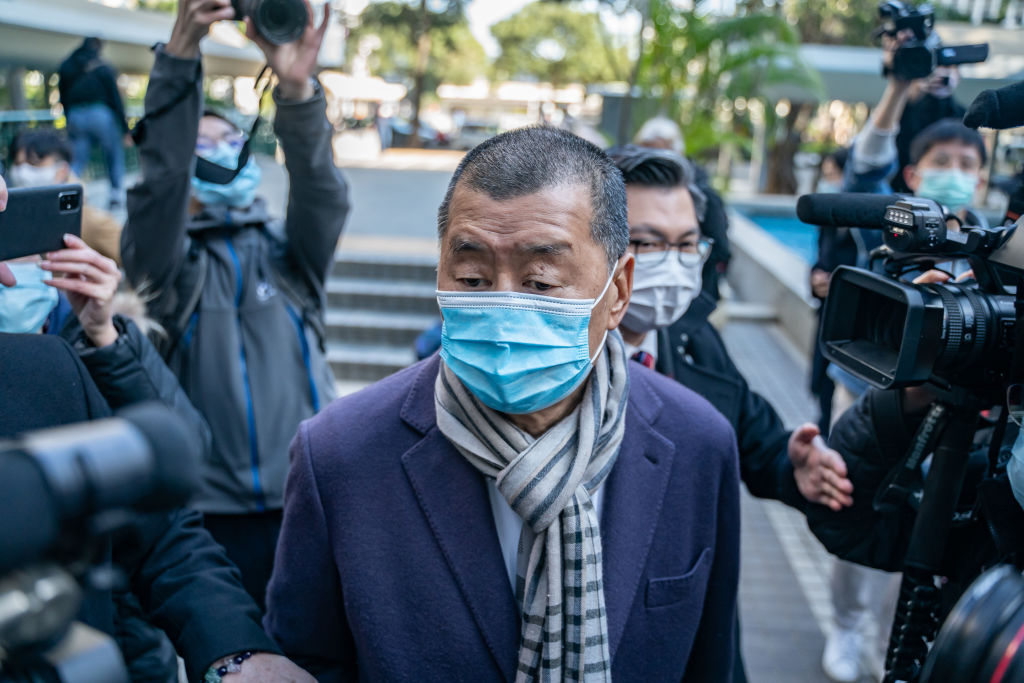
If Beijing had abided by the terms of its treaty with the UK over the handover of Hong Kong, Jimmy Lai would be a free man. When the territory was transferred to China in 1997, Hong Kong was meant to be guaranteed a “high degree of autonomy” until 2047, with existing rights and freedoms, including freedom of speech and freedom of the press, protected for the next half century. Instead, those freedoms have been crushed. On 9 February, Hong Kong’s most famous media tycoon, who is 78 and a British citizen, was sentenced to 20 years in prison, which his family has said amounts to an effective death sentence.
His daughter, Claire Lai, described the sentence as “heartbreakingly cruel,” warning that if it was carried out, her father would “die a martyr behind bars.”
Jimmy Lai was convicted in December of conspiring to collude with foreign forces and conspiracy to publish seditious material at his former newspaper, Apple Daily, which was forced to close in 2021. Six former Apple Daily staff members and two activists were convicted alongside him and sentenced to serve between six and 10 years in prison. The charges derived from Lai’s pro-democracy activism and meetings with US lawmakers after mass street protests in 2019, which the government-approved judges at his trial, held without a jury, claimed had been intended to “seek the downfall” of the Chinese Communist Party (CCP). Lai was presented in court as the “mastermind” of the conspiracy and thus deserving of the “heavier sentence.” Lin Jian, a spokesperson for China’s foreign ministry, went further after the sentencing, accusing Lai of having been the “principle mastermind and perpetrator” behind the protests, even though in real life they were leaderless.
In truth, there was no prospect that Lai would be acquitted. National security trials in Hong Kong, which are held under an expansive national security law passed in Beijing in 2020, have a nearly 100 percent conviction rate. Whatever the wording of the charges against him, Lai should be seen as a political prisoner who is being punished alongside hundreds of other Hong Kongers, including the young student activist Joshua Wong, for daring to stand up for the territory’s freedoms and demand the rights they were promised during the handover from British rule.

A self-made billionaire, who fled to Hong Kong from China as a stowaway on a fishing boat in 1961, Lai could easily have left the territory for a comfortable life in political exile in the UK. Instead, he chose to remain, writing from prison that he must “uphold the dignity of Hong Kong people, as one of the leaders for the fight for freedom.”
Lai could be a brash character and he was a complicated figure for some – particularly among the younger generation – in Hong Kong’s pro-democracy movement. In the run-up to the 2020 US presidential election, he praised Donald Trump, later explaining that he was concerned Joe Biden would abandon Trump’s “tough China policies” if he was elected instead. But his sentencing will be viewed as an unequivocal tragedy for Hong Kong’s once-vibrant, even raucous media environment. Where Hong Kong ranked 18th out of 180 countries and territories in the world for press freedom in 2002, it is now ranked 140th and likely to fall further. “Today, the curtain falls on press freedom in Hong Kong,” said Thibaut Bruttin, director general of Reporters Without Borders in a statement on 9 February. “This court decision underscores the complete collapse of press freedom in Hong Kong and the authorities’ profound contempt for independent journalism.”
The timing of Lai’s sentencing will also be viewed as a further humiliation for British prime minister Keir Starmer, and a symbol of the increasingly asymmetric relationship between the UK and China. Less than two weeks ago, Starmer travelled to Beijing where he was said to have raised Lai’s case directly with Xi Jinping, apparently to no avail. It was not the only diplomatic slight. Whereas Xi treated Trump to a private tour of the Forbidden City during his visit in 2017, and accompanied French president Emmanuel Macron on a sightseeing trip to Chengdu in 2025, he did not extend the same courtesy to the British prime minster. Instead, Starmer was left to look around the Forbidden City with a tour guide, where he was filmed wandering around amongst the crowds.
Afterwards, the prime minister posted a slickly produced video showcasing his travels in China on social media –inexplicably including slow-motion footage of the People’s Liberation Army – where he said he had been “flying the flag” for British exports. It is a shame he could not have done the same for British values.
The foreign secretary, Yvette Cooper, has since promised the UK will “rapidly engage further” on Lai’s case, pressing for his release on humanitarian grounds. The 78-year-old suffers from a heart condition, as well as diabetes, and has lost a significant amount of weight in the more than five years he has been detained, most of which has been spent in solitary confinement. US officials have also vowed to push for Lai to be freed, and it is possible that Trump, who has previously said he is “100 percent” certain he will “get him out,” will lobby Xi to release Lai during his planned visit to Beijing in April.
Perhaps counterintuitively, Lai’s conviction and sentencing offers at least the faint possibility that he could eventually be released on medical grounds if Xi was minded to do so. In the Chinese system, it is highly unlikely that a defendant would be released before the criminal justice system was seen to take its course. But Beijing has previously rejected all external criticism of Lai’s imprisonment as an attempt to “interfere in China’s internal affairs,” and at a time when both the US and the UK seem to be seeking to improve relations, Xi may well calculate that neither country is likely to put up a real fight over the fate of Lai. The real question is likely to be whether Xi views Lai as more of a threat as a martyr imprisoned in Hong Kong, where he is likely to die behind bars unless he is given a reprieve, or as a free man overseas.
Lai’s family is clear that he is not giving up hope. In court, after he listened to the judge hand down his 20-year sentence, the 78-year-old smiled and waved at his wife in the public gallery, and made a heart symbol with his hands towards his supporters. “Although his health is failing him, his spirit and his faith is still strong,” his son, Sebastian Lai, said in a television interview afterwards. “He’s still holding on.”
[Further reading: Britain’s road forward runs through China]
Content from our partners



Related
Join the debate
Subscribe here to comment