
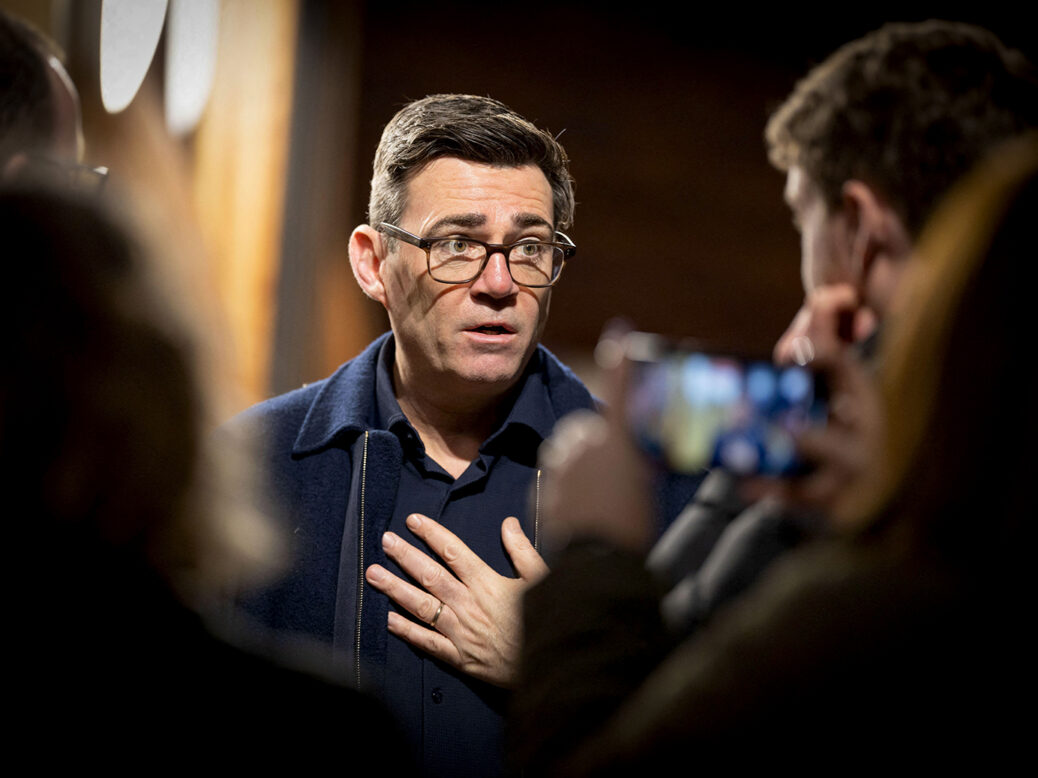
Andy Burnham could be blocked from standing as an MP due to gender balance considerations, the New Statesman has learned.
It is unlikely that a male candidate would be put forward for shortlist in any forthcoming by-election, an NEC source told this magazine. “Gender balance in our party is much more important than boosting the ego of any single politician,” they said.
It comes after a weekend of yet more speculation about Burnham’s intentions, with front page stories in the Sunday Times and the Mail On Sunday claiming that he had found a seat to run in. But could this spell a final end to the Greater Manchester mayor’s parliamentary ambitions? Party officials could decide to select only female candidates in forthcoming by-elections because of the current gender imbalance of the Parliamentary Labour Party.
This would be a political decision by the selection panel and would differ from All Women Shortlists prescribed by the party’s rulebook, which are only used for selections of general election candidates but not in by-elections. A second NEC source said that any selection panel would consider whether to choose a female-only shortlist. They cited the example of the 2018 Lewisham East by-election, in which the National Executive Committee (NEC) chose a shortlist of only Bame women to reflect the diversity of the seat.

Labour introduced all women shortlists to British politics under Tony Blair, but in recent years they fell into abeyance as the party gained more female MPs. In the 2024 general election, Labour didn’t use any all women shortlists because by the end of the last parliament, the Parliamentary Labour Party was majority women. Since the landslide result at the general election, that has changed. The PLP is now 54 per cent male to 46 per cent female. If a female MP stands down, creating a vacancy, it would be almost inconceivable for the party not to select a female candidate to replace them, an NEC source claimed.
But even in the event of a male MP stepping down, a shortlist of women might be considered in order to help rectify the PLP’s gender imbalance. If only female candidates were chosen for a shortlist in an upcoming by-election despite Burnham announcing his intention to stand, it would raise questions about whether this was being done for principled reasons or because of fears about his ambitions. It is the latest development in the will-he-won’t-he story of Burnham’s ambitions to govern Britain.
The five steps
The process for Labour candidate selections is relatively arcane. In the event of a by-election, the shortlisting process is contracted to a panel of the party’s NEC. The panel is made up of five members: three officers of the NEC, a representative from the regional board and a representative from the Constituency Labour Party (usually the secretary).
The panel drafts a longlist, interviews them, and then makes a shortlist. The shortlist is then submitted to the local CLP which votes for its preferred candidate. As a sitting metro mayor, Burnham would have to clear five hurdles to become a Labour MP through a by-election.
First, under the Labour Party rulebook, he would have to secure a waiver from the NEC to give up his mayoralty and run for parliament. In the party rulebook it is there in black and white: “Directly elected mayors and police and crime commissioners must seek the express permission of the NEC/SEC/WEC (as applicable) before seeking nomination as Labour candidates for the Westminster Parliament. The NEC/SEC/WEC’s decision shall be final.” (Chapter Five, Clause Four, Subsection Two.) The person responsible for signing that waiver would most likely be the chair of the NEC’s organisational subcommittee.
Second, if Burnham obtained that waiver he would have to make it on to the longlist for the seat. This would be relatively easy given his name recognition.
Third, he would have to pass the interview stage with the NEC panel and make it on to their short list. At this point things start to get less plausible. In the interview, the panel usually asks the prospective candidate the sort of questions they would be bombarded with by the media on day one of a campaign. In Burnham’s case they would focus on his motives for running and his reported designs on the premiership. One NEC source said that allowing Burnham through after such a grilling would show “a collapse of political will”. The panel would also focus on other qualifications. The three main criteria for getting on to a shortlist are how local and suitable the candidate is, and their level of name recognition. Another NEC source said any by-election shortlist at the current moment would need to comprise only local candidates. If Burnham were to stand outside his heartland in greater metropolitan area of the North West – Merseyside, Greater Manchester and the bit in between – then he might be stopped for not being local enough. Of course any attempts to block Burnham would probably start a storm of controversy within the Labour Party. It is not clear whether the Prime Minister currently has the political strength to weather such a storm.
Step four for Burnham, after making it on to a shortlist, would be getting selected by CLP members. It is hard to imagine a scenario in which Burnham, one of the most popular Labour politicians in the country, does not win a ballot of Labour members at a selection meeting.
Then finally, Step five. He would have to win the by-election as a Labour candidate – not an easy feat while his party is languishing at 18 per cent in opinion polls.
[Further reading: Does Andy Burnham have a route back?]
Content from our partners


Related
Join the debate
Subscribe here to comment