
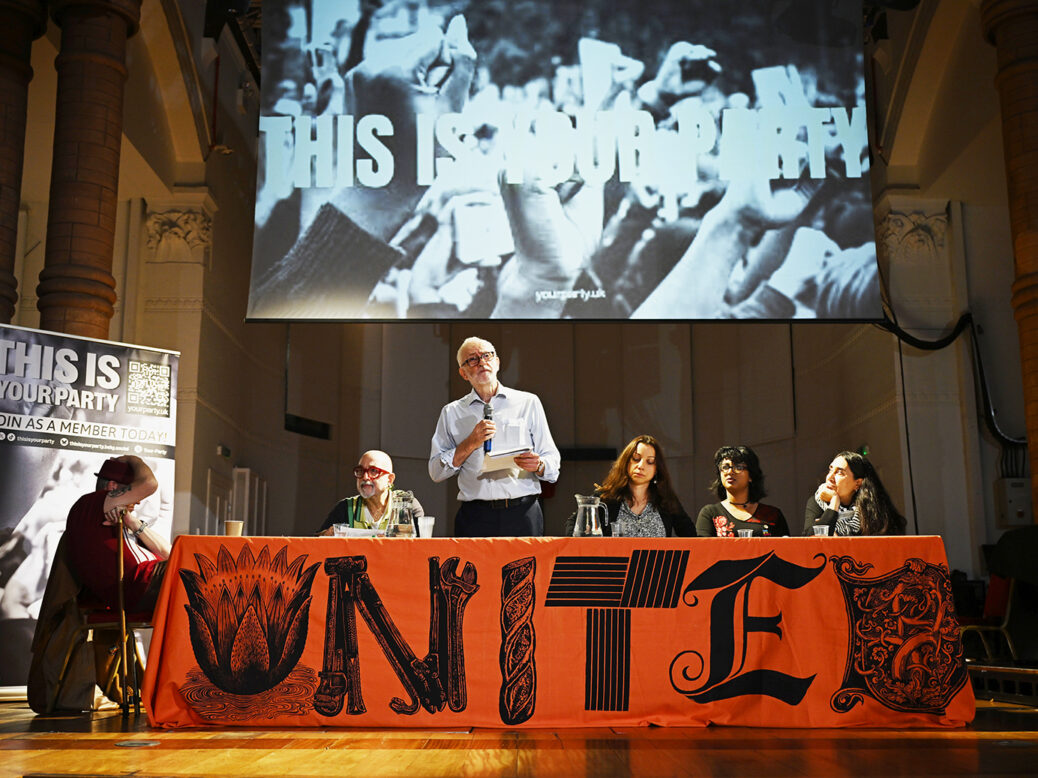
The mayhem at the top of Your Party has delighted those who are desperate for it to fail. While 50,000 people have so far registered as members – more than any British party to the left of Labour in living memory – the gap between that figure and the colossal 750,000 who initially signed up shows the effect of the ceaseless infighting, with another series of body blows in the past week. First, Jeremy Corbyn and the other Independent Alliance MPs accused Zarah Sultana of withholding funds that were needed for the inaugural party conference, claiming that she had only transferred a meagre portion of the donor money she controls. Then, as hostile press briefings escalated, one of those independents, Adnan Hussain, resigned from the project, lamenting that it was no longer a “broad church” thanks to the attacks by Sultana and her supporters against those who do not follow progressive orthodoxy on certain culture-war issues. Now, with increasing numbers of would-be Your Party members decamping to the Greens, the party’s prospects – once bright, polling level with Labour over the summer – have darkened. How did we get here? What are the structural causes of this crack-up?
The details of the conflict are mostly a matter of public record. In the wake of the 2024 election, two distinct teams began to discuss the prospect of a new mass political organisation of the left. One was called Collective and had been set up by former Corbyn officials, including his former chief of staff Karie Murphy; the other became known as the Memorandum of Understanding (MoU) group, after a document drafted by the former North of Tyne mayor Jamie Driscoll. Corbyn was closer to the former and Sultana to the latter. When, at Corbyn’s behest, they eventually came together in a single organising committee, representatives of the MoU group proposed that Sultana co-lead the party’s founding process with Corbyn – whereas many of Corbyn’s allies insisted only he had the authority to lead, at least for an interim period.
After a majority of the committee voted for co-leadership, Sultana made a unilateral announcement to that effect, which Corbyn refused to endorse, viewing the vote as illegitimate. Since then, relations between the figureheads have failed to recover, as they have wrangled over who should be in charge of the upcoming conference, both of them keenly aware this would determine whether there would be an all-members vote on co-leadership (favouring Sultana), or whether the party would have to elect a single leader (favouring Corbyn). Corbyn wanted to empower the Independent Alliance of MPs, assisted by advisers like Murphy, while Sultana called for a new body drawn from the party’s base. With Corbyn’s team in the ascendant, Sultana tried to regain leverage by launching her own membership platform, linked to the MoU group, in September – a move she said was essential to ensure grassroots participation in the party, but which Camp Corbyn saw as an attempted coup.
The deeper explanation for this sorry episode is more elusive than it might seem. The fault lines are not political, in the sense that Corbyn and Sultana have the same aspirations for Your Party’s programme: public ownership, state investment, decarbonisation and internationalism. There is no clear procedural disagreement, since both have more or less signed up to the official blueprint for the party’s founding process: a series of regional assemblies leading up to a one-member-one-vote conference. Nor is this a personal power struggle in the typical sense, with two oversized egos vying for control. Corbyn and Sultana are clearly more committed to the cause than to their own advancement.

The fundamental problem is rather one of competing claims to legitimacy: an inability to decide who has a mandate to represent “the left”, which stems from the peculiarities of its formation in this country. The ideology of Labourism – which holds that the Labour Party is the only route to any progressive change – has long kept British socialists shackled to a party that, for most of its history, and especially since its Blairite takeover, has worked tirelessly against their aims. The result has been to deprive them of an independent identity or institution, which has made it almost impossible to coordinate across their various forces – activist collectives, single-issue campaigns, trade unions – or to cultivate universally recognised leaders. While Corbyn’s Labour briefly transcended these divisions, bringing the left together under the authority of a single figure, it later foundered over Brexit and capsized completely in 2019, initiating a bleak period in which socialists mostly retreated into local organising and bickered over whether to stay in the party or leave it.
Five years later, that debate finally appeared to have been settled. The mobilisations against the assault on Gaza saw the left return to the political mainstream – not as a loyal opposition within Labour, but an insurgent force outside it. This revolt, powerful enough to elect five independent MPs to parliament on pro-Palestine platforms, looked like the basis for a historic rupture, in which the left would no longer strive for concessions within a hostile organisation but finally cast out on its own. Corbyn, previously reluctant to throw his weight behind such a project, began to heed the overwhelming pressure from its supporters. And yet, as soon as practical discussions got underway, the barriers became clear – for the left’s apparent unity, forged by the Palestine movement, was brittle.
That movement combined Muslim groups, Trotskyist outfits, community associations and direct-action networks in an amalgam that was better suited to flooding the streets of Whitehall than to forming a new electoral institution. Yet the problem was not necessarily that these actors were too ideologically divergent. There are clear differences between Sultana and her independent colleagues on issues like trans rights, but most national political parties have similar rifts, and there is no reason in principle why Your Party could not have been open enough to accommodate them. The recent eruption of such controversies is itself the result of a more fundamental misalignment over who, in this fragmented landscape, had the authority to make binding decisions.
Because the post-Corbynite left was still an amorphous entity that had failed to create any solid structures for practising mass politics, it had no way to resolve this uncertainty. It initially manifested in a seemingly insoluble disagreement between the Collective and the MoU group about what form the new electoral vehicle should take: a unitary party, as Murphy and her allies wanted; or a looser coalition favoured by Driscoll et al. Then, when Sultana joined the negotiations in spring 2025, the axis of opposition shifted. With the issue of conference on the table, two rival conceptions of left legitimacy – with different implications for who was even fit to found let alone lead Your Party – began to emerge.
For Corbyn’s allies, his Labour Party is the only contemporary reference point for a viable left politics in Britain, having won 13 million votes for a radical programme which expanded the country’s horizon of possibility. Murphy and the other staffers who steered that project can thus make a strong claim that they should play a role in shaping its inheritor (especially if the ultimate defeat of Corbynism was a result of Brexit splitting its voter base, not of any major strategic errors on their part). This position is bolstered by their alliance with the independent MPs, who, though their backgrounds are not in the socialist movement, are nonetheless emblems of the Palestine upsurge – without which there would be no Your Party. The fact that they inflicted a stunning defeat on the Labour machine by turning out thousands of voters means that their control over the conference has a clear democratic foundation. These are leaders who have already proved their ability to reach people who were neglected by the two-party system and who may well have otherwise stayed home on election day: precisely the kind of experience that Your Party needs to harness and extend.
Supporters of Sultana, however, dismiss the idea of a party founded by Corbyn staffers and MPs as “Labour 2.0”, asserting that the defeat of 2019 calls for tough, self-critical reflection on their record – not just the contingencies of Brexit, but what she claims were deeper patterns of mismanagement. To avoid the mistakes of the past, Sultana argues, it is necessary to open up the proto-party to other parts of the left, particularly activists and social movements. On this basis she has styled herself as a defender of the grassroots against the bureaucrats. Her proximity to politicians like Driscoll and Andrew Feinstein, both of whom emphasise community organising as the force for rebuilding Britain’s progressive bloc, is a reflection of this tendency. She objects to the elevation of the independent MPs on the grounds that a resolute commitment to the left – and a determination to revivify it after years in the wilderness – is more important than any ephemeral election victory.
So while Corbyn and the independent MPs have staked their claim on inspiring many who were, or still are, outside the left, Sultana has mostly played to its base. The online row over gender politics between Sultana and the independent MP Iqbal Mohamed should be read as a reflection of this dynamic. It is not simply another debate over “women’s spaces”, which could in theory be settled by adopting a sufficiently principled yet pluralist policy at conference. It is a clash over who has the right to represent Your Party: the Independent Alliance as the proxy for the protest vote of 2024, powered in large part by Muslim communities who do not always identify with the left; or Sultana as the tribune of an uncompromising socialism.
The hope was that co-leadership would allow Your Party to display both these strengths: looking outward to the country at large while also activating its core cadre. But, again, because socialists in Britain do not have many robust political institutions, nor even a coherent political culture, they have struggled properly to balance these two priorities – and a polarisation has instead asserted itself. This structural issue has, in turn, been exacerbated by dubious decisions on the part of both factions. Team Corbyn is scarred by the memory of letting people into the inner circle in 2015-19 only for them to sabotage the project. They have therefore treated Sultana with suspicion and hostility. Team Sultana has been so confident in its claim to legitimacy, and so outraged by its perceived exclusion, that it has made unilateral decisions – the co-leadership announcement, the membership system – which have further inflamed tensions.
Contrary to the narratives circulating among many Your Party supporters, it is not necessarily that either side is more “democratic” than the other. It is that they have irreconcilable visions of what democracy means in this sui generis context: appealing to the masses or the movement, empowering those who have made historic electoral breakthroughs or those who have proved their mettle outside the parliamentary sphere. For Your Party to become a meaningful force, it must combine these sensibilities. Many of us hope that it will. But with a potential leadership election between Corbyn and Sultana looming, the present mood is far from one of reconciliation.
[Further reading: Your Party is fumbling a historic opportunity]
Content from our partners



Related
Join the debate
Subscribe here to comment