
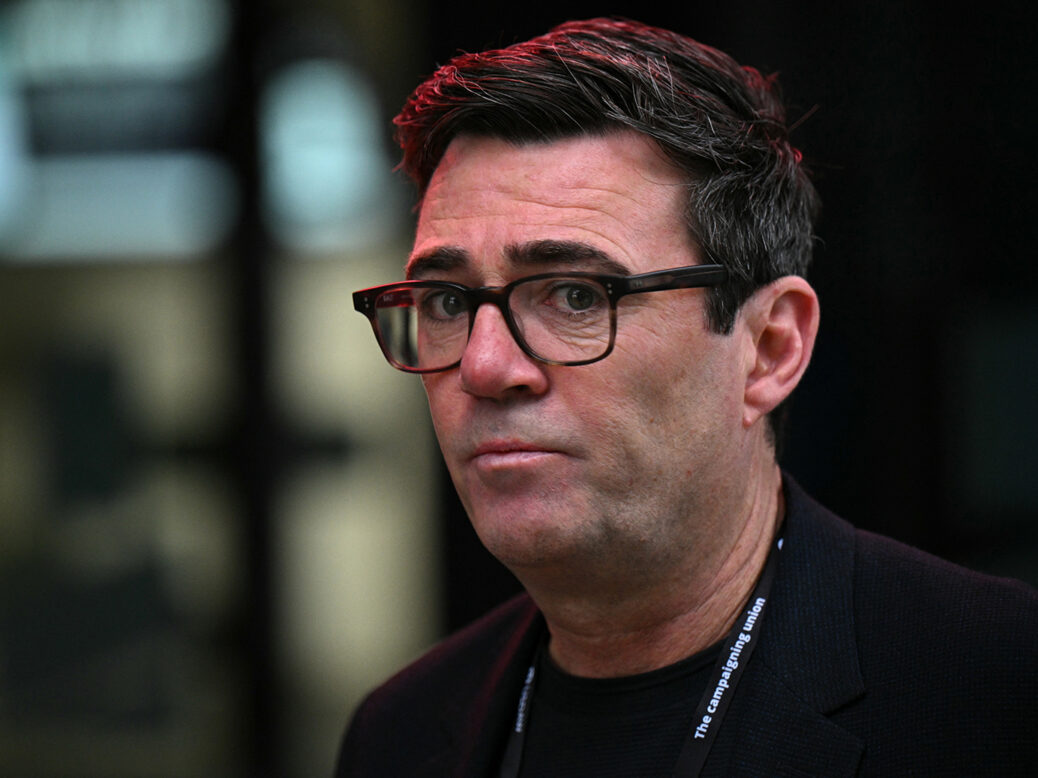
Last June, when Andy Burnham effectively launched his third leadership campaign at Compass’ conference, a supportive MP concluded to me: “They are not going to let him come back into parliament”. It was a blunt, unsentimental judgement that aged well.
On Saturday there was hope among Burnham’s allies that the political momentum behind his bid to stand for selection in Gorton and Denton could prove unstoppable. At the Fabian Society conference at London’s Guildhall, the annual gathering of the party’s oldest socialist society, a succession of senior figures – Lucy Powell, Ed Miliband, Sadiq Khan – declared that Burnham’s candidacy should be approved. Angela Rayner, Unison general secretary Andrea Egan and a smattering of backbenchers did the same.
But it was LBJ’s maxim – that the first rule of politics is knowing how to count – that ultimately held. For all of the support assembled for Burnham, only one of the above, Powell, held power where it mattered: among Labour’s NEC officers’ group. And so it was that Burnham’s bid was rejected by a landslide margin of eight votes to one, a mark of the control that Keir Starmer and Morgan McSweeney retain over the party machinery (with a trusted ally, Hollie Ridley, as general secretary). “We had all assumed that Andy had a secret cunning plan, but he didn’t have one,” reflects a left-wing Labour MP. Over the months that I have reported on this saga, Starmer’s allies never once wavered in their insistence that the mayor’s return would be blocked: because of his unashamed ambition to displace the sitting leader and because of the £500,000 cost for Labour of a Greater Manchester by-election.

The party’s soft left wanted Starmer to use this moment to reorient his premiership, embracing Burnham as a “star player” in an act of belated pluralism. But instead the Prime Minister finds himself on the opposite side to some of his oldest allies in Labour politics: Miliband, who as leader helped him win selection in Holborn and St Pancras back in 2014, and Khan, who he has known for over 30 years as a fellow human rights lawyer.
While Starmer has thwarted a potential Burnham challenge, he will bear the blame should Labour be defeated in the Gorton and Denton by-election (expected next month). Victory for Reform or the Greens – the latter described by a senior Labour source as an “existential risk” – would take the fraught debate over Starmer’s leadership to new heights. As ever in politics, the question is this: who benefits? Burnham’s exile in his Manchester kingdom means that the most popular Labour politician – a Survation poll found that he would defeat Starmer by 58 per cent to 32 per cent – will not appear on any leadership ballot in the near future.
Rival contenders such as Wes Streeting and Shabana Mahmood both benefit from the mayor’s absence and were able to demonstrate their independence from Starmer. When I interviewed Streeting at the Fabian conference he pointedly condemned the briefings against Burnham as “disgraceful”, a reminder to members that he had endured the same treatment, and again warned that Labour must be more than Britain’s “maintenance department”. Mahmood, meanwhile, yesterday praised the mayor as an “exceptional politician”, going far beyond the No 10 line, and as NEC chair abstained from voting in line with convention.
An insurgent soft left, meanwhile, still lacks an agreed candidate as doubts persist over whether Angela Rayner, the name most often floated, truly wants the prize. For Starmer, finally, the imperative is to prove that his victory over Burnham need not be a Pyrrhic one.
This piece first appeared in the Morning Call newsletter; receive it every morning by subscribing on Substack here
[Further reading: If not Burnham, who could defeat Starmer?]
Content from our partners


Related

Join the debate
Subscribe here to comment