
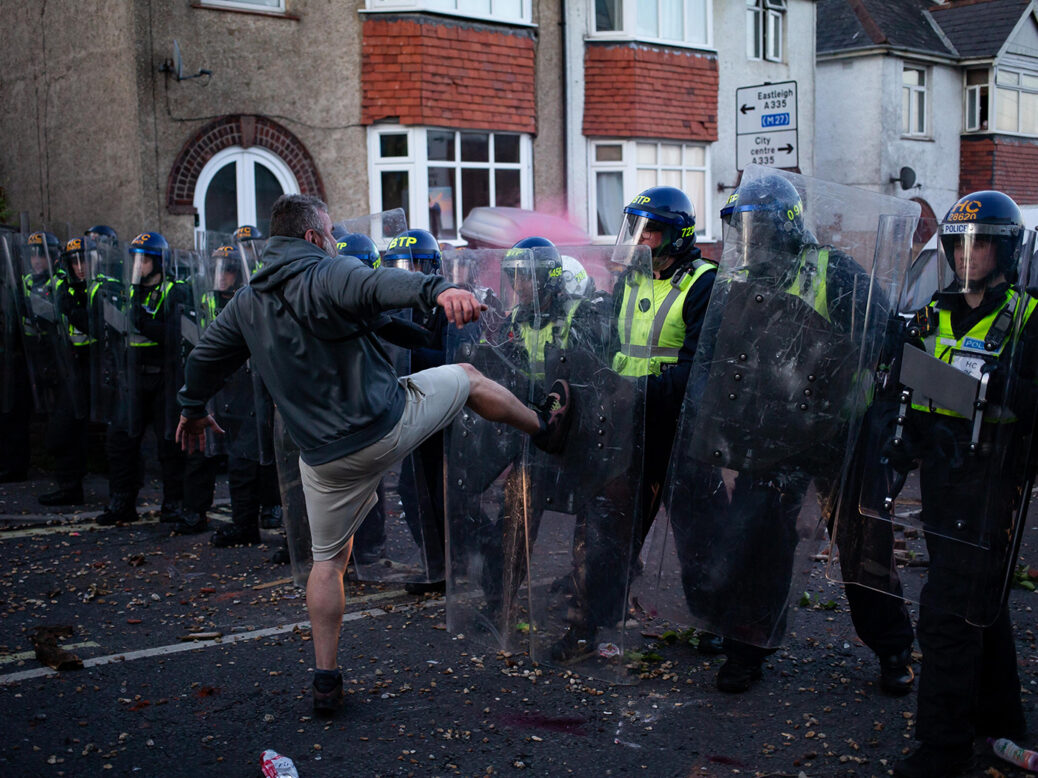
As I write, the UK has just experienced its third night of racist rioting in a month. What even recently would have been shocking now seems routine. After the horrific murders in Southport in July 2024, there followed a wave of pogromist reaction across parts of England and Northern Ireland. That week featured some of the worst acts of racist violence seen on British soil, events which reached their apogee when hundreds of rioters in Rotherham attempted to set fire to a hotel housing asylum seekers. A year later, in the summer of 2025, an orchestrated campaign saw thousands of flags attached to lampposts, spreading from Essex and the outer suburbs of London to the north-east and beyond, coinciding with yet more protests outside migrant hotels.
Britain, we heard from every quarter that summer, was a “tinderbox” which, in the words of Telegraph, “would need just the tiniest spark to go up in flames”. Leading the charge in this was David Betz, professor of war in the modern world at King’s College London, whose dark premonitions of urban decay became a regular feature in the right-wing press. Britain’s cities, Betz and his ilk warned, were crime-infested hellscapes pockmarked with ethnic no-go zones, from which civil war will soon erupt.
Such a vision will be familiar to anyone who has spent time on social media. Your daily scroll is now likely to be filled with decontextualised videos of fights, riots, violent crime and intercommunal strife – some real, much AI-generated – sitting next to nudge-nudge-wink-wink images of the multi-ethnic “Yookay”. Many of us would once have dismissed this kind of content as the fevered products of a few racist cranks – led, of course, by the crank-in-chief: the world’s richest man and the oligarchic owner of one of its primary modes of communication – and, in doing so, been backed up by the fact that Britain beyond the phone screen looks little like the one within. The sad reality, however, is that for millions of people today what happens online is as real, perhaps more so, than anything that happens in the world outside. The real world, for many, is mediated so densely by social media that it is increasingly difficult to disentangle the two. In this mediated world, a spiral of radicalisation, facilitated by algorithms designed to push extremist eyeballs-at-all-cost content in the name of engagement, can easily draw people to the furthest fringes.
There are more complex reasons than online radicalisation that mean we cannot simply dismiss the violence as just another outburst of a hardened racist few. Not least because to do so would seem to leave us destined to regular summer bouts of pogromist violence. We also cannot discount the powerful local forces in Northern Ireland that have caused the current disturbances. As Luqman Saeed wrote in a powerful account of the riots for the LRB, “In a society where sectarian identities still determine political affiliations, immigrants and ethnic minorities have become the new other.”

Beyond the Irish statelet, the reality is that for much of the country immigration has come to stand as a synecdoche for the broader failures of the British state. Stagnant wages, flatlining productivity, rising rents and energy bills, decaying high streets filled with vape shops and cash-in-hand barbers, potholed roads, the now-ubiquitous fly tipping: all these and more are symbols of the country’s deep dysfunction. If the government cannot get a handle on a few thousand people crossing the Channel in inflatable boats every year, many are now saying, what chance does it have of sorting any of this mess out? It’s likely that this, rather than some sudden mass outbreak of social sadism or racism, lies behind the YouGov polling last year that found nearly 60 per cent of people favoured a military solution to the small boats issue.
Of course, the blame for this situation must go, to a large degree, to parts of the media and to mainstream politics and politicians. It is they who have consistently and repeatedly, over many years, drawn a direct line between economic and political dysfunction and race, producing what I have characterised elsewhere as a structure of feeling dominated by a form of racialised declinism – in which the decline of the country at large is fused onto questions of immigration and demographic change. Such has been the effectiveness of this coordinated effort by parts of the political and media establishment that discussion of the “remigration” of foreign nationals, even threats to deport British citizens, have become commonplace.
Now, setting the pace on the right is Rupert Lowe. The leader of the far right Restore Britain, a strange patrician figure as much redolent of parts of the old Tory right as of the very online new right, has in recent months opened a dangerous front on Reform’s right wing, openly appealing to ethnonationalists with his slogan that “millions must go”. As Daniel Trilling recently said, this has put Nigel Farage in a bind: “on the one hand [Farage] needs to moderate his party’s image in order to broaden its electoral coalition – but on the other hand, faced with this pressure … [he] has to signal to his base that he is the bearer of their radical right-wing nationalist hopes.” This, Trilling says, is a signal of Farage’s weakness, not his strength: losing parts of his base to those to the right of him, he risks alienating large chunks of the wider population by chasing after them.
Perhaps. It is certainly true that in recent weeks Farage has appeared uncharacteristically flustered, complaining of Restore’s backer Elon Musk who, he said, “has decided he will try to split the right of British politics as best he can”. He has also struck a far more inflammatory line in response to the riots than he would once have done; only a few years ago Farage was claiming that mass deportations were “politically impossible”. Now he’s staging mock deportation flights to announce his deportation bill and using the phrases like “White Lives Matter”. But, with so many now pushing harder and faster to the right, it could less a sign of weakness than a symptom of the ground already gained by the project of political and social reaction.
The period from the start of the 19th century until the late 1970s and early 1980s, following Raymond Williams, can be seen as the “long revolution”, in which following the advent of industrial capitalism, the widening of political democracy and the development of various forms of mass communications and culture, once-entrenched forms of inequality were challenged, if never quite overthrown. Now, we are at the start of what could be a long counter-revolution. Equality has gone too far; now, we hear, is the time for reaction. It is the emboldening of this agenda, as much as electoral calculation, that lies behind the shouts of “two-tier policing” and remigration.
The right will react to the riots in its now-standard way. Rupert Lowe and his gang of broccoli-haired reactionaries and ethnonationalists will no doubt double down on the dehumanising rhetoric and their talk of “third-world savages”. The Tories and Reform will no doubt tail them, although perhaps with the occasional caveat that it’s not quite all black and brown people they take issue with thrown in.
How the left reacts is far more uncertain. Of course, it all depends what happens in Makerfield next week. Keir Starmer, it should be clear, has neither the vision nor the ability to make any kind of galvanising appeal to the nation at large. Nor does he seem to grasp the severity of the issues affecting the country. Whether Andy Burnham can is another matter.
Responding at all will require a root and branch reform of the dominant political and economic system: nationalising failing utilities; largescale state investment in housing, key services and industry; an end to the regime of outsourcing and privatisation that has done so much to hollow out state capacity. Its watchwords should be “taking back control”: offering to voters a vision of a renewed and democratic economy that can reverse the decades of damaging neoliberalism; not just tinkering around the edges with policies of tax and spend.
It’ll also require severing the associations between immigration and decline, dysfunction and loss of control. The small boats crisis is such a charged and emotive force now that any vision that fails to confront it is doomed to fail. We have a responsibility to offer safe and legal routes for those seeking asylum, but the sight of unvetted young men landing on the beaches of Kent and Sussex is such a glaring signal of state failure that something must be done to stop it and to stop those who profit from it. This must be done humanely, and must be allied to a humanist politics of what Paul Gilroy has called “conviviality” – the recognition that Britain as it actually exists, as a multi-ethnic and post-imperial polity, is for the most part a well-functioning and integrated society. Non-white Brits are our family, neighbours, friends, carers. Maintaining that requires an honest conversation about immigration in Britain, one that can counter the absurdity of the false narratives of white replacement.
In this, the stakes are high. If we cannot get this right, the ever-hardening right will capitalise. That should scare us all.
[Further reading: The Belfast riots: new targets, old hatred]
Content from our partners

Related

Join the debate
Subscribe here to commentPart of the problem is that it isn’t clear that contemporary Britain really is a “well-functioning and integrated society”. Sure it “functions”, but it increasingly looks like the kind of plural society British imperialism established across the world. Communities come together in the market place but have less and less in common elsewhere. A new sense of society needs to be built.
If Britain has to acknowledge itself as a multi-ethnic and post-imperial country, then the British Left also needs a model for the kind of multi-ethnic and post-imperial country it wants to be. The Right is fairly united on this, they look to Singapore: a market-friendly authoritarian state with state-led social integration. What does the British Left look to? What vision for a new society is being put forward?
Being able to identify some kind of national common ground seems important to this process. But it isn’t clear that much of the Left has any vision for this.
For the left to be honest about immigration would be to understand with a degree of empathy, the concern of many at the changing nature of their neighbourhoods as a cultural matter. However an equal and opposite honesty should be demanded of the right especially the far right, namely to stop the pretence that we can do without immigration. Somewhere between those two “honesties” perhaps lies a modus vivendi we can take forward – but I’m not suggesting it would be easy – nor have I any easy answers myself.
Yes I wish the left could be honest but I highly suspect they will follow the same playback whomever is in charge. It is one thing to condemn racist riots and reactions to events but you also need an actual response that isn’t just condemnation and then the ritual chant of the same kumbaya politics. A typical response from someone on the right is to highlight where the individual critic lives (white majority suburb). Anoosh’s recent piece really confirmed this denialism. It would be interesting to see how the middle classes responded if all of the HMOs suddenly got moved to their neighbourhood. Reckoning with this fact is what the left needs to be honest about. My fear is that they genuinely have no solutions that would still align with their values.
Thanks, I agree wholeheartedly. I’ve become sadly accustomed to creeping normalisation of extremist views and behaviours becoming part of the fabric of discourse and politics.
We need our political leaders to stand up and be brave. There is no context that can be applied to what has been happening on the streets of the UK this last week.
As the son of Irish immigrants to the UK I have always had a semi-detached view of England but when I worked in the USA in the 1990s I became extremely homesick. What I missed was that very specific English bolshie attitude that I remembered from my working class roots. I suppose it goes all the way back to what patrician politicians called the ‘mob’. For me it was that careless, let’s have a laugh approach which did not necessarily include working very hard. That’s why we have so many great comedians. I think it also sums up why English natives are having such a hard time. Immigrants work harder and now that good jobs are getting scarce it leads to a nasty state of affairs. Of course we can hope the English middle class can save the day but they too have a diluted form of this bolshie atittude. I like England very much but you need so much money to have a decent life now something is going to have to give.
“The real world, for many, is mediated so densely by social media that it is increasingly difficult to disentangle the two. In this mediated world, a spiral of radicalisation, facilitated by algorithms designed to push extremist eyeballs-at-all-cost content in the name of engagement, can easily draw people to the furthest fringes.”
The truest thing in the article. I think it was Barack Obama who first successfully recognised and harnessed the power of the internet and social media to boost his campaign. It seems to come back to bite everyone who harnesses the runaway dragon.