
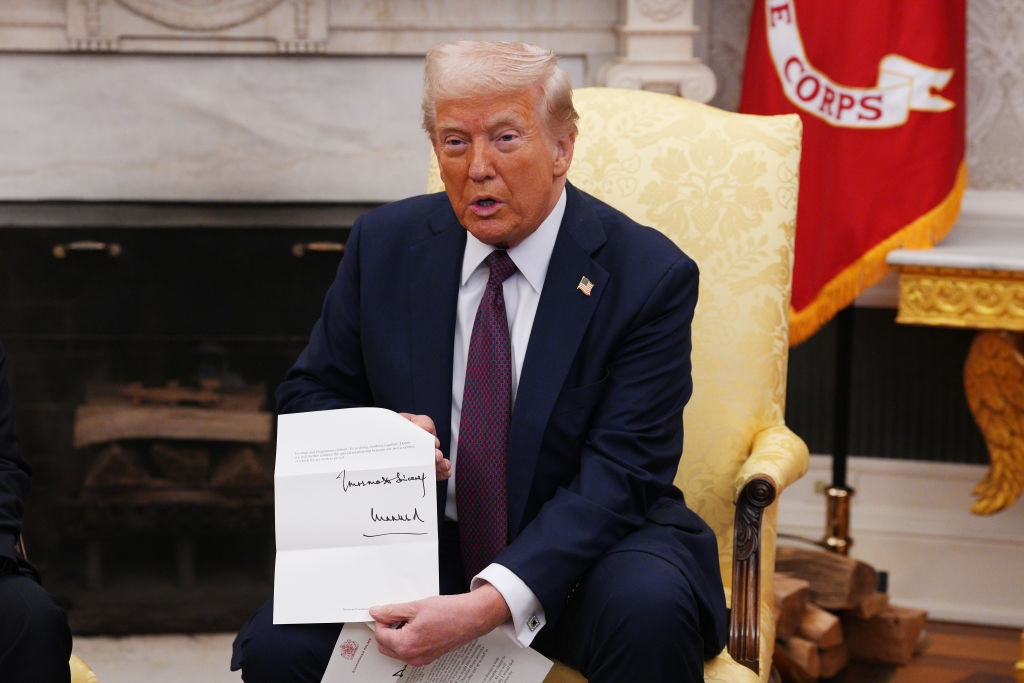
When Keir Starmer handed Donald Trump a letter from King Charles III in the Oval Office on February 27, it looked like a diplomatic coup – a theatrical moment of smooth statesmanship.
“Am I supposed to read it right now?” a genuinely surprised Trump asked the Prime Minister. Starmer replied: “Yes, please do!” The President studied the letter – supposedly an invitation for a second state visit to Britain from the King to Trump. “This is really special. This has never happened before, this is unprecedented,” Starmer said.
But this week’s unprecedented second state visit by the former and now returning President was not the result of masterful planning. It was the product of a trio of blunders.
Blunder One: the botched hand-off

The letter from King Charles III, delivered via Starmer, was never meant for public eyes, a senior diplomatic source told me. It was intended to be passed discreetly in a side room, away from the cameras. But a logistical mishap in the Prime Minister’s travelling party meant the letter wasn’t at hand when it needed to be. By the time it reached Starmer he was already in the Oval Office, in front of the world’s media. The handover, instead of being a private gesture, turned into a televised spectacle.
Blunder Two: misreading the royal fine print
Contrary to popular assumption, the King’s letter was not an invitation to a state visit. As I reported in The Times on June 24, it was a proposal to discuss one. The letter was deliberately vague – a kind of diplomatic “voucher” with strings attached: it left the door open for a second state visit, but without committing to a date. Think when you bump into someone in the supermarket and you say “we must do lunch”… you are not actually committing to lunch.
The real aim of the letter was to gently defer – suggesting Trump “drop in” at Balmoral the next time he was in Scotland, where plans could be “discussed”. I spoke to one of the officials who drafted the letter. They believed they’d achieved something quite clever. And perhaps they had – if the recipient were Macron, or Trudeau, or anyone else fluent in the veiled, Downton-esque dialect of Whitehall Civil Service English (which, incidentally, I am). But nuance is not Trump’s native tongue.
Unsurprisingly, Trump skipped the subtext. He saw the words “state visit” and “this year” and ran with them. “I was just notified by letter from King Charles,” he told reporters, “that he’s extended, through the Prime Minister, a historic second state visit to the United Kingdom.” And just like that, the spin became reality.
Blunder Three: conditions, quietly dropped
Behind closed doors, No 10 and Buckingham Palace had agreed on two quiet conditions for making any visit official.
First: Trump had to tone down the rhetoric about Canada being the “51st state” – remarks seen by the Palace as undermining King Charles’s sovereignty in his role as Canadian Head of State.
Second: the UK had to secure a more favourable trade arrangement with the US. That, at least, has partly materialised. Tariffs on some UK goods were recently reduced from 27.5 per cent to 10 per cent – enough, apparently, for officials to declare the conditions met.
But were these really the right benchmarks? A state visit – with all the ceremony, symbolism and soft power it entails – is Britain’s diplomatic ace. Is this when we want to play it?
What’s left to offer?
Trump’s second term is still young. And that’s assuming he doesn’t return for a third term. He has not – despite his campaign promises – ended the war in Ukraine within “24 hours” of taking office. He has not recommitted the US to Nato in any meaningful way. And while the recent tariff reductions are a start, they hardly constitute a sweeping trade breakthrough.
Put bluntly, what have we gained?
This episode raises a more uncomfortable question: can traditional diplomatic tools work on a president who doesn’t play by traditional rules?
Trump is a transactional operator. Sure, he likes the Royals. But he’s a businessman. Hosting him at Windsor might have looked like clever positioning but in practice it gave away a major concession for little in return. And crucially, it leaves us with even fewer levers of influence for the next three years.
So while Trump’s motorcade winds its way through Windsor’s closed streets and the bunting goes up, we should ask ourselves: did we invite a partner – or just fold early?
Emily Channon is a writer and producer, who previously spent eight years working in the Civil Service.
Content from our partners
Related
Join the debate
Subscribe here to comment