
My admission in last week’s issue that I had dipped my toe into the brooding world of Wagnerian opera provoked messages of mirth from colleagues, friends and readers. And so, this week, Andrew Marr offers a teasing warning that I should beware the old man’s charms: warning heeded! A friend from outside the New Statesman, however, proffers the opposite advice: ignore the naysayers, throw yourself in at the deep end. “There’s no point in fucking about with pop Italian operas: go straight to the real thing.” Oof, fighting talk.
Reader David Perry, from Cambridge, writes in with a different take. Developing a taste for Wagner can feel as though it must come with public displays of repentance: “My name is David Perry, and I’m a Wagner fan…” he imagines himself declaring, Alcoholics Anonymous-style, before admitting his frightful peccadillo. Yet he cannot help but fall for the sheer power of the music. It is so all-consuming and self-assured, in fact, that it can almost feel “totalitarian”, David writes, somewhat ominously.
Still, as David asks, “Is there such a thing as self-doubting or sceptical music?” The subtlety of the question gnawed away at me this week. Is there such a thing as good art that is unsure of itself, uncertain what emotion it is trying to elicit or what message it is trying to send? Or is that simply bad art, whether it is music, theatre or writing: art that fails to understand its central purpose and so obfuscates, unsure what it has to say or why? And what about politics? Must all political messages be delivered without self-doubt or scepticism if they are to land with the public?
I’m not sure I know the answers. Perhaps, ironically, I’m simply too self-doubting and sceptical. I thought of Yeats’s line about the best lacking all conviction, while “the worst are full of passionate intensity”. But isn’t this just a cop-out for us sceptics? I suspect that is what Keir Starmer is feeling as he watches Andy Burnham move closer to power, declaring his message with an insurgent’s confidence. If that is the conclusion Starmer has reached, though, he needs to think more deeply about why his government failed.

Over dinner with a leading Labour figure this week, our conversation quickly moved on to this philosophical terrain. Starmer’s problem as prime minister, this figure argued, was not simply presentational – that he couldn’t play the music with sufficient conviction, even if the substance was all there. No, the problem with Starmer was that he combined far too much certainty about himself with too little certainty about the purpose of his government.
Starmer, they observed, struggled to open up even with those closest to him in politics. But by not showing any vulnerability, he struggled to forge real bonds of loyalty with his team. At the same time, he was never able to convincingly explain to his cabinet what they were supposed to be loyal to – if not to him, whom they could never get to know. Without either personal or ideological loyalty, the government became small and fractious, and the result is what we see before us.
This twin challenge of government now falls to Burnham, who must be confident enough with those around him to show the openness required to build trust, while being certain enough in front of the public to convince them he knows what he wants and where he is going.
It is not an easy challenge. He must know his own mind and build a team that shares his vision for the country and is prepared to make sacrifices in pursuit of it. His choice of chancellor is the most crucial he will make. Whoever takes the job must deliver Burnham’s vision, not their own. We have had too much disharmony without purpose.
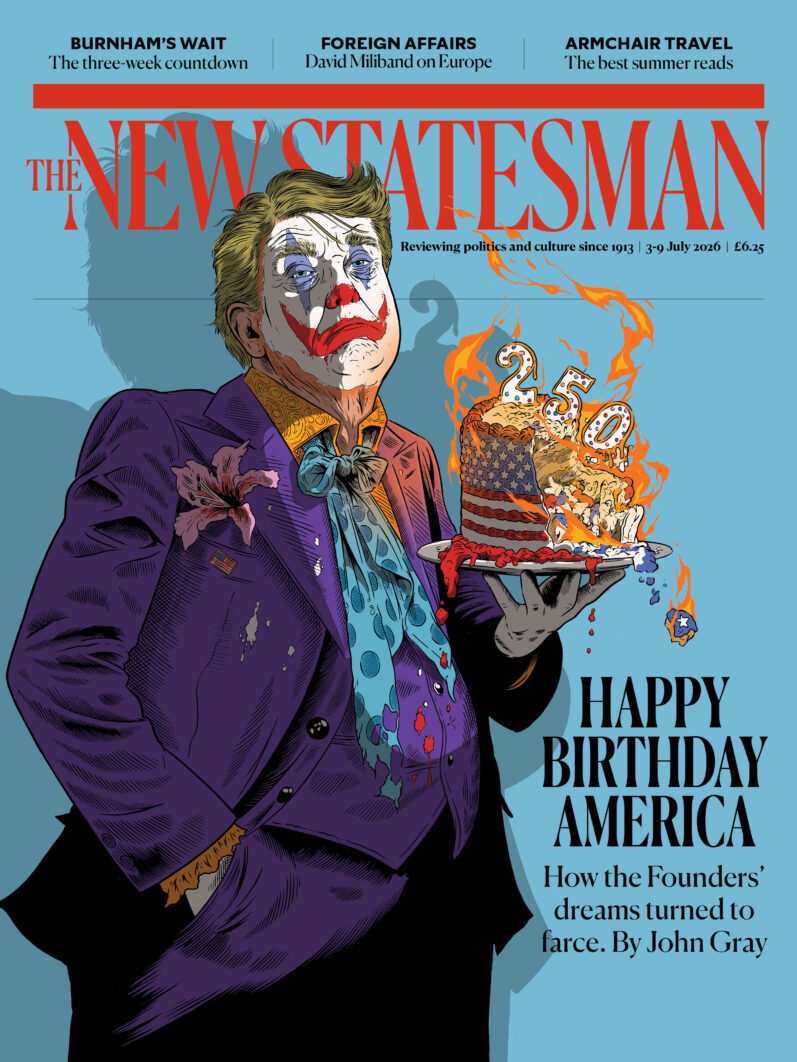
With such thoughts in mind, it is hard to avoid similarly sombre reflections about the fate of the US on the 250th anniversary of independence. As John Gray writes in his cover story this week, the Founding Fathers understood the importance of sacrifice and vision, even as their minds were filled with classical premonitions of decay and tyranny. Abraham Lincoln would bind his “team of rivals” behind a cause, as would those who followed. Today, though, what do we have? “A nihilistic trickster [who] is dissolving the country’s origin myth,” as John writes. Without myth, without belief, the country has turned to delirium. Sometimes it feels as though the same is true of Britain. Perhaps that is the real reason I got lost in Wagner’s own mythology: pure escapism.
[Further reading: Andy Burnham’s crucial three weeks]
Content from our partners



Related
This article appears in the 01 Jul 2026 issue of the New Statesman, Happy Birthday America
Join the debate
Subscribe here to commentIt’s time to change our framing. Look hard at the No10 North proposal. To make that work requires a front rank minister who can turn themes into missions which motivate and focus cross-department. This needs both high intellectual skills an high political skills, but that minister holds the success or failure of the Burnham project. He may not thank me for it, but Ed Miliband should be not chancellor but Prime Minister’s Secretary of State, based in Manchester and charged with defining and making progress against the three targets.