
The languid contemplation of the miseries of others is, as Christopher Hitchens once said, one of the few areas of transcendence remaining to us. He was speaking in a long tradition of selfishness which lends itself easily to bleak and self-satisfied aperçu (“It is not enough to succeed. Others must fail,” was Gore Vidal’s crack). But I like to think even these sneering egomaniacs had their limits. The faint cheer in the school lunch hall when some poor soul drops his tray is one thing. But there are pits of anguish and misfortune that aren’t very funny, and simply make you rather sad.
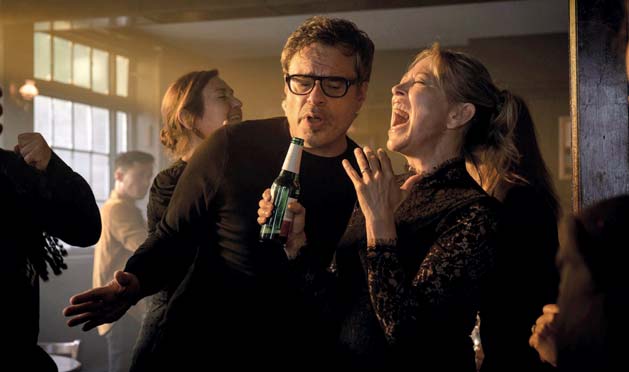
Such disordered and disconcerted thoughts were my main response to Disney’s Alice and Steve, a strange new TV series which calls itself a comedy, and which plays a very unpleasant family breakdown for laughs. It’s a far cry from the director Tom Kingsley’s previous shows for Channel 4 and the BBC (Stath Lets Flats, Ghosts).
From the title, it sounds like a chummy, jaunty romcom. But the product is something darker and weirder, as if some radical auteur adapted Romeo and Juliet by cutting the star-crossed early acts and moving straight to the final scene. Alice and Steve (Nicola Walker and Jemaine Clement) are two old friends who used to date in their early twenties and are now tipping 50. They’re the kind of Gen X oldsters who take pride in the fact that they met at the Haçienda, who still take coke on nights out and who have the sort of breezy metropolitan jobs that only characters in Richard Curtis movies have (she’s some sort of product designer; he’s a hairstylist). And it’s on one such chaotic night out, prompted by the funeral of their friend Mike, that Steve sleeps on her sofa, and then winds up sleeping with Alice’s 26-year-old daughter Izzy (Yali Topol Margalith).
There are contextual reasons for this – Izzy’s just broken up with a boyfriend – but the one-off quickly becomes semi-serious when they find a shared affection for spaghetti vongole and when Izzy stuns Steve by knowing the melodies of the old music he likes (specifically Willie Nelson’s “Blue Skies”). But whatever the personal dynamics at play here, the basic problem henceforth as a TV show is it can’t decide if this is hilarious or heartbreaking or just very odd. When Alice finally answers Steve’s calls and says, “You are a piggy-eyed, big-nosed, ugly fucking paedo loser, and I hope you fall out of your fucking window and get pierced in the heart by your railing, and that no one comes to your funeral,” it’s hard to know exactly when to laugh.

The happy couple quickly explain their relationship status to Alice, who, after a predictable and understandable rage, organises a dinner party, ostensibly in the spirit of rapprochement, but really for the purpose of sabotage. Alice invites several of Izzy’s friends, and also her grandmother, and the ordeal teeters between farce and tragedy. The grandmother is played as a lusty old fool, who comes on to Steve as well for some reason, suggesting he could “do all three generations”. And then Alice tries to draw out some generational discrepancies, bringing up Steve’s admiration for the films of Woody Allen, something that Izzy’s friends seem to genuinely find weirder than their friend’s new boyfriend. Steve wins them back around with some of his celebrity hairstyling stories, and then things turn very nasty, with the guests storming out one after the other. “I want to put her tiny hand in the disposal unit,” Alice says, about her daughter, that is, to a deserted living room.
None of this tonal chaos is helped by the discrepancies in performance. Nicola Walker is a very fine actor, and has got very good at put-upon professional middle-aged women, basically the same role she had in The Split. Jemaine Clement, however, will unfortunately forever be that guy from Flight of the Conchords, and his character never seems to register the scale of the emotional breach, confining himself to lines like: “Turns out I’m a complete fucking arsehole.”
You’re never quite sure how to watch it: as a suburban satire, or something heavier – an interrogation of our time of age-gap scepticism? And on the whole, I’d suggest you don’t.
[Further reading: OnlyFans, a Great British export]
Content from our partners



Related


Join the debate
Subscribe here to comment