
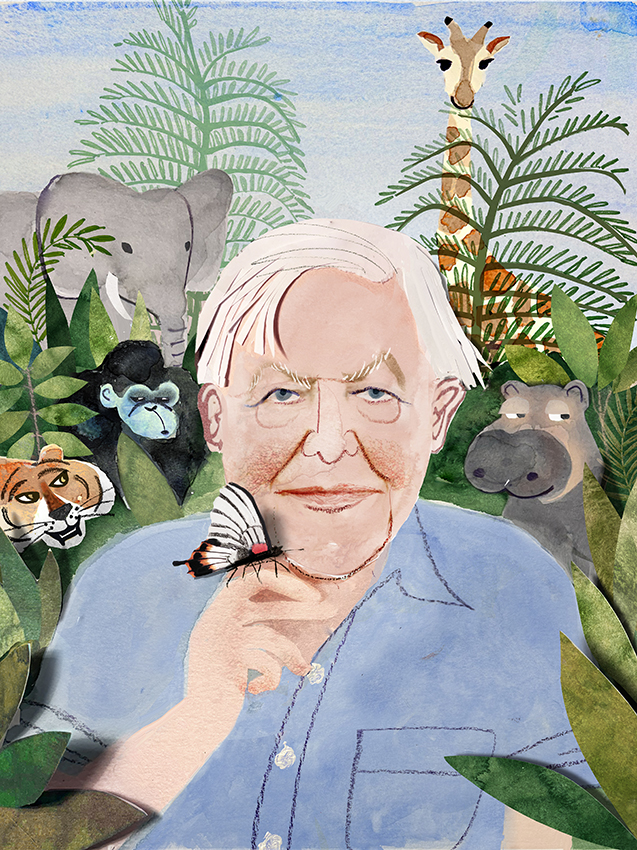
One of the more unexpected headlines to appear in the British press declared that “David Attenborough fought to put transgender people on TV”. The article, from 2018, told the story of the 1973 BBC series called Open Door, which, in a bold departure from tradition, allowed marginalised groups to speak directly to audiences with minimal editorial interference. An early episode featured members of the Transex Liberation Group, who described what it was like living in a world that saw them as a “problem” to be solved. In another episode, a group of black teachers offered audiences a glimpse into the racism that was in London schools.
In television, countless individuals are involved in turning any idea into a programme. But it was David Attenborough, in his role as the BBC’s then director of programmes, who had given Open Door the managerial thumbs-up. His aim, he said at the time, was to bring to the BBC “voices, attitudes and opinions that… have been unheard or seriously neglected”.
Open Door was one of the last in an extraordinarily rich set of pioneering programmes that Attenborough helped bring to the screen in the 1960s and early 1970s. In those days, instead of fronting natural history series, he was a broadcasting impresario.
Attenborough’s breakthrough came when he was appointed controller of BBC Two in 1965. The new channel had launched the previous year, but with too few programmes ready for transmission its first controller, Michael Peacock, had struggled to provide the cornucopia of star-studded fare that the BBC’s advanced publicity had promised. A hastily arranged reshuffle had left Attenborough in the hot seat. And there couldn’t have been a better time to take over. One quick glance at the ratings and the press cuttings told him “there was nowhere for it to go but up”.

His colleague Huw Wheldon thought him perfect for the role. “He was a bit of a polymath. He’d read science at Cambridge, he was very keen on music, the arts were his game.” Attenborough joined the BBC in 1952. His first job had been as an assistant in the factual broadcasting team, then known as the Talks Department. In the 1950s that meant working on almost any kind of programme: short stories, quizzes, studio discussions, party political broadcasts, science. Attenborough even directed a ballet about a fishmonger. In this period Attenborough also experienced his first stint as a presenter, notably on the animal programme Zoo Quest, which ran from 1954.
It was, he remembers, “an intoxicating time”, the moment he developed what he called a “religious fervour” in his devotion to the BBC and what it stood for. Commercial television had arrived in the UK in 1955, but inside the BBC, Wheldon explained, “our competition was undoubtedly with each other”.
The coming decade proved to be a buoyant, optimistic time in British broadcasting. By the time Attenborough took over BBC Two, the corporation’s income from the licence fee was rising quickly. The opening of Television Centre in 1960 provided British programme-makers with the largest and most advanced facility of its kind in the world. Bill Cotton, another of Attenborough’s contemporaries, described the effect as almost alchemical: “You just walked that little bit taller.”
As controller, Attenborough felt not just that he had a “blank sheet”, but also that he was free to indulge his own wide-ranging tastes. “We would take programmes from every category one could think of, and find new approaches and neglected subjects,” he explained. “One measure of our success… would be the width of the spectrum that our programmes covered.” Joanna Spicer, an influential figure at TV Centre, said that Attenborough simply “created BBC Two in his own image”. Archaeology appeared in the form of Chronicle, which took a distinctly global and contemporary approach to the subject. Life in the Animal World was launched, and featured the zoologist Desmond Morris reporting on nature and conservation, while a sister programme, Horizon, covered science more broadly. On the drama front, there were adaptations of classics by George Eliot, Henry James, Sartre, Tolstoy, Dostoevsky. And classical music was given prominence through a stream of live concerts, including an electrifying 1965 broadcast of an 83-year-old Igor Stravinsky conducting The Firebird at London’s Royal Festival Hall.
There were some guiding principles. Since BBC One was the corporation’s main weapon in competing with ITV, BBC Two was relieved of the need to chase big audiences for each and every programme. The channel’s viewership might have been fewer, but it would actively seek out its offerings. It was a “second-fiddle” status that liberated Attenborough: “I would say a million eyes on BBC Two is worth four million on ITV, on BBC One.” As far as he was concerned, new ideas could be tried out every week without undermining the ratings war. His only condition was that there should be nothing in the schedule that was “mindless”.
The biggest idea of all was colour. The challenge of switching from black and white to colour had, Peacock claimed, “become a process wrapped up in mystery”. But Attenborough chaired the working group that set out to find the necessary technological fixes. It was soon clear that his own channel, which used the more sophisticated 625-line system rather than the older 405-line one, would take the lead. “Suddenly,” Peacock recalled, “BBC Two assumed an importance of its own by virtue of the fact that if you wanted to do programmes in colour you did them for BBC Two and so David had a reinvigorated sense of purpose… and he got more and more support from all the departmental people.”
The first regular colour broadcasts were of the 1967 Wimbledon Championships. Later, there would be snooker in the form of Pot Black. But there was one showstopper that transformed public and critical responses to the new technology: the epic 13-part 1969 series Civilisation: A Personal View, which was presented by Kenneth Clark.
Attenborough originally conceived of Civilisation as the television equivalent of the “part-works” he’d grown up with: specialist magazines that came out periodically, ready to be bound up, once complete, into something accessible but also authoritative. “It was that concept of a weekly instalment that was going to build up into something that was behind Civilisation.” Colour though, was also a vital component from the start, a means of creating something truly “high fidelity”. “I thought a nice way to show this would be to find the loveliest things created by civilisation in the past 2,000 years, and put them on the screen… it created a format of serious television which was to last another 15 years, at least… that was a BBC Two invention that came from necessity, where the necessity was… to think of a way of exploiting colour.”
The series was unashamedly patrician in its approach. It opened with Clark in Paris, glancing admiringly at Notre-Dame. “What is civilisation?”, he asked. “I can’t define it in abstract terms yet. But I think I can recognise it when I see it. And I’m looking at it now.” Over the following weeks, there was to be no Africa or Asia or Islam, nor any women centre stage. Clark’s theme was civilisation as “we”, the West, knew it, and how it needed to be defended from the forces of barbarism.
Critics and viewers loved Civilisation. Nevertheless, inside the BBC, there were some rumblings of discontent. Aubrey Singer, the energetic and ambitious head of the arts, science and features department, told Attenborough that it was “an absolute scandal” a series with this title had nothing to say about science. “This miffed me,” Singer confessed. “I thought that a civilisation wasn’t, to put it bluntly, to do with aesthetics.” He demanded a new project, a “magnum opus”. And as a presenter, another polymath: Jacob Bronowski. Attenborough was enthusiastic. He thought Bronowski “had a feeling for language, for narrative”.
So, it was Attenborough who cooked-up a cunning plan to get the scientist on board: he invited Bronowski to a private screening of Civilisation at the BBC. When the credits rolled at the end of the first episode and the lights went up, he asked Bronowski what he’d thought of it all. Bronowski’s reply was direct. “Where,” he asked, “was the science?” Bronowski duly signed up.
Just over three years later, and after a vast amount of gallivanting around the world, The Ascent of Man was broadcast. It was another, hugely ambitious series that established the 13-part “magnum opus” as a distinctive BBC brand, and would lead, in turn, to Attenborough’s own Life on Earth.
Singer had been hugely impressed by Attenborough’s support throughout. He was, Singer decided, a great deal tougher than he looked. “Under that boyish exterior there was a mind of steel that calculates all the time.” It was a toughness that was recognised at the very top of the BBC, too. By the time The Ascent of Man was in production, Attenborough had been promoted to the post of director of programmes, covering the whole of BBC Television. He was in fact being groomed as a future director general.
Yet senior management was never an easy fit. Attenborough liked being at the cutting edge of programme-making. Better still, he liked being in the jungle or on the savannah. Being on the corporation’s board of management was, he said, like having to spend one day a week “sitting and doing nothing”. So after serving a respectable amount of time, he took the decision to step down and return to presenting.
One era was ending. Another, the era of the David Attenborough blockbuster wildlife documentary, was about to begin.
David Hendy’s books include “The BBC: A People’s History” (Profile)
[Further reading: How not to read JG Ballard]
Content from our partners


Related

Join the debate
Subscribe here to comment