
Kazuo Ishiguro has always spoken about his work with remarkable honesty. Although A Pale View of Hills, his first novel – published in 1982 when he was 27 – won him the Winifred Holtby Memorial Prize and was widely translated, he was candid about its faults, saying he “didn’t have quite the technical sophistication to pull it off”.
The book is narrated by Etsuko, a Japanese woman living alone in England after the death of her second husband, an Englishman. Keiko, her daughter from her first marriage in postwar Nagasaki, never adapted to England and has died by suicide. Her daughter from her second marriage, Niki, visits Etsuko and prompts her to reminisce about her life in Japan. What she mainly remembers, apart from being pregnant and married to a distant salaryman, is her odd friendship with Sachiko, a rackety, unreliable woman. Sachiko was constantly scheming to escape to the US with her supposed American boyfriend while behaving with stunning cruelty and indifference to her unhappy little daughter, Mariko, even drowning her kittens.
Only at the very end of the book is it shockingly clarified that this little girl must represent her own daughter, Keiko, who never liked her “new father” or wanted to leave Japan. Etsuko has been telling this story about Sachiko and Mariko, whether or not they actually existed, as a way of deflecting her own guilt. A Pale View of Hills is a primitive prototype of Ishiguro’s unreliable-narrator novels, in which characters are unable to face up to the whole course of their lives being mistaken. After developing the form further in his second novel, An Artist of the Floating World (1986), he perfected it in his next one, The Remains of the Day (1989). As he was completing this third book, a Tom Waits song (“Ruby’s Arms”) led Ishiguro to realise it would be more affecting if the armour of Stevens the butler finally cracked, allowing “a vast and tragic yearning to be glimpsed underneath”, he revealed in his Nobel lecture.
“I’ve written the same book three times,” he subsequently told the Paris Review. “I just somehow got away with it.” As for A Pale View of Hills, he admits the reveal is not well anticipated in the rest of the book. The Nagasaki-set scenes “don’t have the texture of memory, and for that reason the end doesn’t quite come off”. Nonetheless, here is a faithful rendition of the novel, produced in Japan, scripted and directed by Kei Ishikawa for his fourth feature.

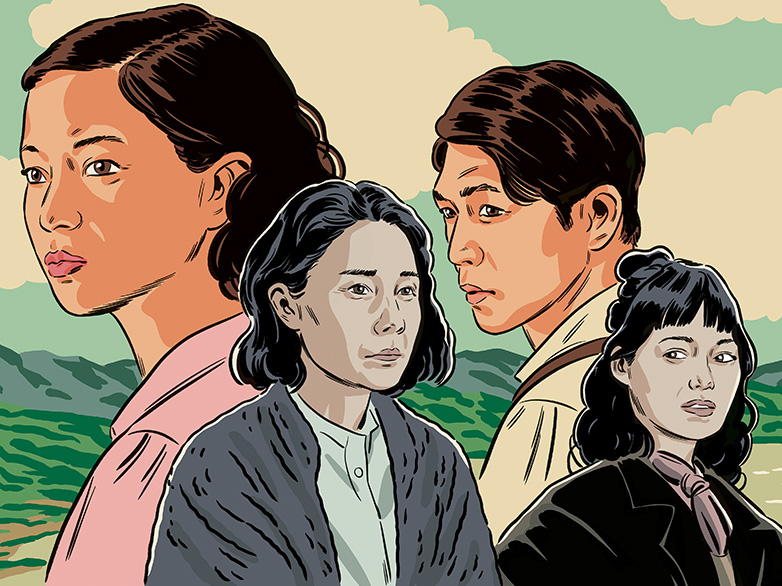
Very little has been altered. Having the older Etsuko (Yoh Yoshida) being prompted to speak of her past, rather than just narrate, foregrounds the role of her daughter Niki (Camilla Aiko), an aspiring journalist who tapes her mother and rootles around the memorabilia in her house to tell her story. Niki has previously written about the Greenham Common women, linking to an elevated emphasis on the lingering consequences of the bombing of Nagasaki.
This English part of the movie, filmed in deliberately drab colour, is stilted and brittle. Far more vivid are the scenes in 1952 Nagasaki, presented in picture-postcard brightness. As the timid younger Etsuko, Suzu Hirose (star of Our Little Sister) is very engaging. Fumi Nikaidô (Shōgun) is strikingly mercurial as Sachiko, and Mio Suzuki marvelously sullen as Mariko. Ishikawa has a much surer touch with this setting, too. Indeed, a subplot about Etsuko’s unrepentantly old-school father-in-law (Tomokazu Miura) coming to stay is better realised than the main story, even if it still feels more made for TV than Ozu.
However, just as in the novel, the livelier drama in the past works against the eventual disclosure that it may be fabricated, which, unlike in the novel, is painfully clunky. “I knew right from the start, you see – I knew that if we came here, Keiko wouldn’t be happy. I made the decision all the same,” Etsuko confesses at last. Niki comforts her: “I don’t think I’ll ever understand but I do know one thing – it’s not your fault that Keiko died.” Just to make sure we get the point, we then get a montage of key scenes from 1952 replayed, with Etsuko taking the place of Sachiko with the little girl.
“When an adaptation of a well-known book doesn’t work, 95 per cent of the time it’s because the filmmakers have been too reverential.” Kazuo Ishiguro himself said that, and he always talks sense.
“A Pale View of Hills” is in cinemas on 13 March
[Further reading: Louis Theroux stares down the manosphere]
Content from our partners



Related
This article appears in the 11 Mar 2026 issue of the New Statesman, The Great British Crisis
Join the debate
Subscribe here to comment