
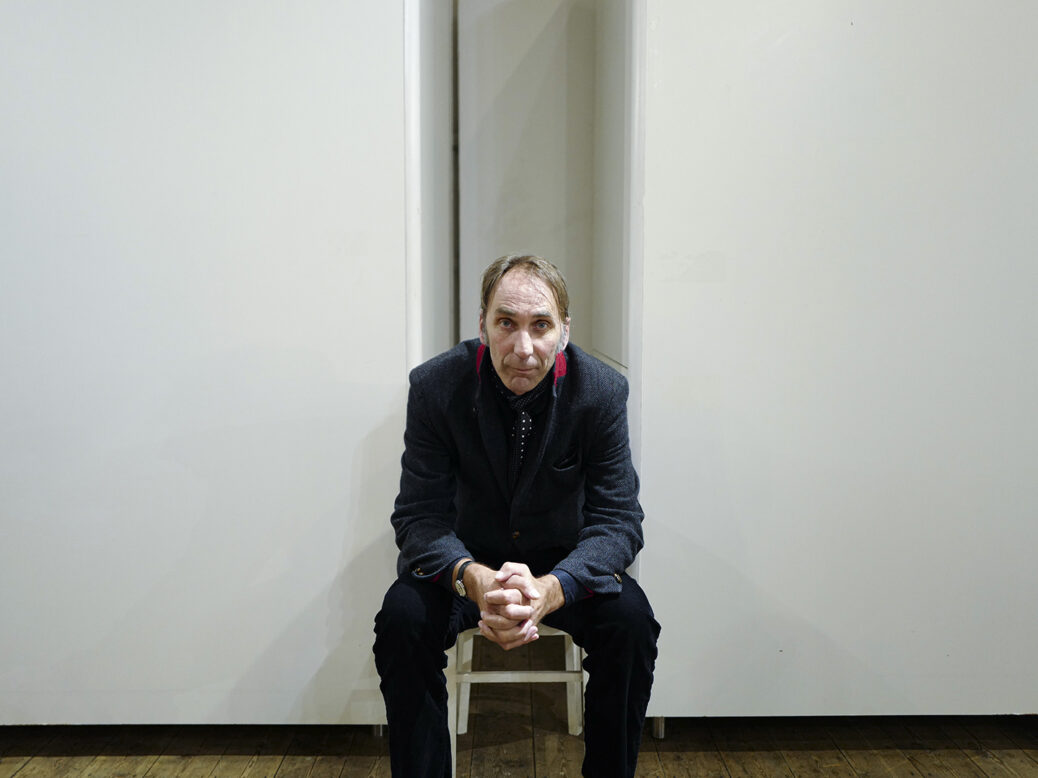
In the first short story in Will Self’s first book, The Quantity Theory of Insanity, published in 1991, the narrator’s mother dies from a cancer that “tore through her body”. Cancer is now tearing through Self’s body. He has secondary myelofibrosis, a blood cancer. His new book, called The Quantity Theory of Morality, is a “sequel” to his first, and watches a fictional Will Self die of blood cancer, aged 64. The author is now halfway through that year of his life.
“I thought I was gonna cark it,” he says. “The chances aren’t great on these stem cell transplants.” Self’s south London road includes a stretch of broad-windowed, park-facing houses with blue plaques for past cultural grandees; Self lives in one of the darker Edwardian terraces that come after the park runs out. There is a walking stick by the door and a huge Bible staged on a table. Self invites me to start recording, then stations a recorder of his own next to his armchair. We sit an unnatural distance apart, with him at the window, to lower the risk of infection. He sits side-on to me, having folded his lanky, paunched body into the seat. It was once Self’s practice to walk “obsessively” and “psychogeographically” around London, but he had to stop walking more than a year ago. The heels of his feet, once such fine instruments, are visible between the soft ankle cuffs of his trousers and the soft hoods of his slippers as dumb purple blocks.
His stem-cell transplant was a “hard graft” of another person’s immune system, and it triggered graft-versus-host disease. “You have to cover your body with steroid cream three times a day to fight this attack, and the steroid cream burns every time. And the GvHD is like a hive, an itch all over your body, that has been going on for years. I’ve had that for years, OK? You want to know why I’m irritable? I’ve had literally a vermiculating hive under my skin for seven years. No repose at all. I ended up wearing dresses in the year before the transplant. I took so many antihistamines I had no nerves left in my feet. That’s why I can’t walk. I don’t fucking complain about it.”
His chances of surviving for two more years are four out of five and these odds are swiftly followed by a challenge: “Do you want to pick up a gun – I’ve got one upstairs with one shell in five chambers – and hold it to your head and pull the trigger?” Self challenges you: he raises his voice, points, stares, laughs enormously, swears furiously. At one point he says: “You’re shifting about! You need the loo! Go to the loo – it’s right there under the stairs. Off you go, you need to pee! Silly boy!” It is only once I am out of the room, I hear on my recorder afterwards, that Self cracks open the Coke can he had not paused to open, at that point, for an hour and 53 minutes.

Once upon a time, of course, this exhibition was the toast of British culture. In the Noughties, Self was an omnipresence on Radio 4 and on shows like Question Time (14 appearances) and Have I Got News for You (nine appearances). He seemed to put everyone else in that dream where you’re in an exam and haven’t revised. In 2012, a character in The Thick of It complained: “You used a lot of words. It was like a fucking Will Self lecture.” Self was verbose, sardonic, unpredictable, acting out a comprehension unavailable to dimmer, safer minds.
After the publication of his first book, Self pursued Westminster journalism. It was an edge, he says, not to fear New Labour. “Getting flicked by Alastair Campbell’s spittle in the lobby was a thing. But I would just tell Campbell to fuck off as well… I could see that Campbell was a neurotic who was ridden by his demons – and he still fucking is. He’s been traipsing his way through the British media ever since he fucked up, when he got his fingers on that dossier and was indirectly responsible for bloodshed in Iraq, trying to claim that he’s an alcoholic, he’s mentally ill – anything to diminish his responsibility.” Self’s first major scandal came in 1997, when he was found using heroin in the toilet of then prime minister John Major’s plane. He was sacked from the Observer, and made his first appearance on Have I Got News for You almost exactly a week later.
There was no such recovery from the second major scandal. In 2019, Self went viral for being called a “patriarchal finger pointer” in a televised Brexit debate and for attacking Sally Rooney, who he said wrote “simple stuff with no literary ambition” (he later said in a Guardian interview that he regretted this comment). That year, Self’s ex-wife, the journalist Deborah Orr, accused him publicly of “mental cruelty”. She posted on Twitter that he wanted to “keep me in misery” and that “his ‘compassionate’ writings on mental illness make me want to throw up”. She also said she had complex PTSD and had changed her house’s locks to keep Self out. Self said to me: “I ended up in Brixton Police Station being interviewed under coercion and control. Imagine that!” Orr died of breast cancer later that year. Self is shockingly unrepentant. “Deborah was mentally ill. You can look back over it if you want to pick it apart. She died under threat of going to jail because she was posting divorce papers on Twitter. The fact that the media picked it up and ran with it, and still do, is because we live in a disgusting, moral sewer of a society.”
These impressions are all that remain without a great work to explain them. An early Self story argues that the mathematician Kurt Gödel’s whole life was given order by the 15 minutes in which he devised his incompleteness theorem. Afterwards, all his life pointed towards that moment of genius. Self was less a writer than a voice encountered on airwaves, televisions and phones. If there was an artistic triumph, it was his 2010s “trilogy” of quasi-modernist novels – Umbrella (2012), Shark (2014) and Phone (2017) – but they are, as he says, “totally unread”. The trilogy is his proudest achievement, but no one has ever written to him saying they had read and enjoyed it. He tells me several times that if I finish it, I can come round to talk again.
Self is enraged by the literary world. JK Rowling is a “dreadful fucking writer” who courts controversy in her “Harry Potter castle of money”, afraid of “a straw man with a giant cock who’s going to fuck up everybody’s arguments and moral reasoning”. Bernardine Evaristo is “the woman who said life’s too short to read Ulysses” and a “shit writer.” Giving her the Booker “wasn’t the thing we needed to do” for Britain to “live up to its imperial past”. Irvine Welsh and Hugh Grant campaigning for youth literacy were “Johnny-come-latelies. I’ve been fucking campaigning on this from the get-go.” He asks how many books I’ve read. About 400 since 2020 is “Not enough. By the time I was your age, I’d read 4,000.”
Still, when I ask who he talks to these days, he laughs and says, “You!” He has “no friends.” When you get seriously ill, people are “fucking horrible; I mean, you would not believe how bad people are around serious illness.” But Self had mostly broken with his acquaintances anyway: “Peers of the realm, senior publishers, people active in literature and the arts, senior newspaper and media people, all behaved like prize shits towards me.” In the wake of the divorce, he felt betrayed. “When my ex and late wife attacked me publicly during the year of Me Too, they wouldn’t say anything publicly because they were so frightened of social media. Older people were more frightened than young people. But imagine what it’s like when people you’ve known for 25 years are gaslighting you.”
The new book’s plot, such as it is, involves a group of fashionable middle-class friends humiliating and deserting its most vulnerable members. The six chapters retell a story of a series of parties and holidays, followed by the suicide and funeral of one of their friends. The first chapter was published in a 2010 short story collection and was, in a slightly sad echo, adapted for a Sky TV production starring David Tennant as “Will”. The character who kills themselves remarks, “Once you’re in genuine need, you won’t see [your friends] for carpet fluff. Weakness attracts not Christians – but jackals.”
There is plenty more. In fact, you wonder if, despite writing the book in six weeks, Self has finally met the “everythingitis” pressure to fit in everything that used to paralyse him. One chapter lists, parenthetically, the height and penis length of every male character, including David Hume, Prince Philip and Harry Potter. In another, the characters are all women and fight over whether the transgender “Willa” is a real woman or a predator. In another, the “Nationalist Trust” takes power and classifies – and curfews – characters by their religion: Will is “ASHh” for Ashkenazi halfling. There is also AI, climate disaster, a ban on texts longer than 300 characters, and much more.
Self is exercised about the book’s reception. Not because the reviews are bad – “I’ve had reviews that would make your anus prolapse!” – but because The Quantity Theory of Morality matters to him: not just because “it could be my last,” not just because it follows his first and kills off his career-long muse Zack Busner, but because “we’re at a really difficult moment politically… there’s a moral issue.” He intends to complain to the Sunday Times about the “refusal to engage” with the book’s moral seriousness.
If the moral point can be distilled, we might say that nuclear bombs, climate change and several other existential dangers have forced us into a delusion about our mortality, reducing our experience of life to a series of presents. So there is no consequence, and we are left unable to take responsibility for the past, the future or other people. The subsequent individual self-gratification diminishes the “morality quotient” of whole groups, and low quotients lead to evil deeds. Zack Busner predicts the death of one of the group before it happens.
Self bangs the large Bible and shouts, “This is our problem, George: we live in a secular society!” The point of the new book is “how miserable it is dying when you have no belief in transcendence”. Christianity is the West’s only ethics, is fantastic, and is “what most people really believe”, apart from the fact that “they want to kind of have bum fun and don’t want to go to church”. But our society has not chosen God, and it is not in the individual gift to will belief. Self has tried to believe and cannot.
Meanwhile, we spend “more time thinking about fucking Deliveroo” than thinking about ethics. Politics is filled with “comfort food, weight-loss injections, holidays, consumerism and promises”. Self is almost certain that the individual failure to live authentically, which aggregates into the collective denial of death, will result in “a major human dieback”. It may be through war, climate collapse or pogroms, but the future is bleak.
Our conversation often moves from the everyday and personal to the apocalyptic. One friend is a former robber whom “I withdrew from criminal life; that’s the sort of thing I do: I stop people picking up guns and shooting other people”. A friend who died is admired both for going into Bergen-Belsen and for adopting 20 Russian orphans after the war. When I ask why, given the Christian ethics, there is apparently so little forgiveness in his life, he says, “I’m not launching missiles!” About normal kindness he says, “That’s a crock of shit. Nice people don’t do nice things. And when the Nazis come, they’re going to turn around and fucking massacre everybody, the nice people.”
Eventually, he becomes more direct. “You see, the problem is, you’re not me. You want to be liked. You’re sentimental. I’m not you. I don’t want to be liked, and I’m not sentimental. OK?”
If Self once called doubt “that sweetest of luxuries”, that indulgence is now foreclosed. He dismisses his friend John Gray’s praise that his books realise the material world “can never be finally understood”. Once, he quoted approvingly the humorous Australian apartheid of people into “true gods” and “gammin c**ts” – there is nothing funny about that distinction now.
Self knows what he wants. “I want people to behave properly. OK? And I do behave properly. I believe people should help the other, not turn aside. I believe that people should not be greedy, and I’m not greedy. I don’t make money just to have money. I believe that people should think seriously about the existential risks for humanity, and should actively campaign against warfare and environmental despoliation.”
Self says questions about how he would like to be remembered, or when he was happiest, are absurd and cynical. “I’m a novelist who specialises in granular experience and phenomenology, so I really understand that judgements on long quotidian periods are retrospective judgements imposed… I don’t think about my life in those terms at all.”
Still, it is the case that, as in Heidegger, “the human consciousness is smeared throughout temporality… What I am is 1961 through.” That “1961 through” includes a nine-year-old watching his parents separate, self-harming with cigarette burns and knives, smoking cannabis at 12, putting needles in his arm at 17, injecting heroin at 18, and entering a mental health hospital at 20. In other interviews, Self has none of his typical verbosity about these early years: he has said he was “very, very unhappy,” “radically unhappy,” “a deeply unhappy child and young man, deeply unhappy, suicidal a lot of the time”.
Self is, in some way, not surprised that the start led to this end. “I think it’s in – you know what Sartre calls your circuit de l’ipséité [ring of selfhood] – it’s who I am anyway. There are no counterfactuals. You’re not doomed, it’s not fate, but it’s like a Hegelian inner necessity, once you understand your own character. I’m not fazed to find myself here at all. Yeah, not in any respect.”
It was the transformation of a young man into a “horrible vermin” in Franz Kafka’s Metamorphosis that showed Self fiction’s “reality-transforming” powers: its ability to remove us from what he has described as “what we must, perforce, call the real world”.
Fictional worlds are in some sense even more perforce, even more inevitable than the real one. The man who kills themselves in the new book realises that he is a powerless fictional character. But as Self wrote, quite beautifully, in the essay “Being a Character”, “It’s precisely in fictional characters’ conviction – despite all evidence to the contrary – that they are the authors of their own lives, that they resemble us most… It’s precisely this shared predicament which makes them so very worthy of our compassion.” In the same essay, Self reflects that, while he initially dismissed characters in favour of ideas, “People who need people – I began to suspect – are the luckiest people in the world.” I repeat that line. He snorts.
“It’s something like a tagline from Friends or something – utterly cheesy.”
“Why did you write it, then?”
“Umm, oh no. I do believe it. I do believe it.”
His relationship with his wife, the French writer Nelly Kaprièlian, he said, changed profoundly in the course of his illness. He realised that “to love somebody is, you know, to accept them at a much deeper level”. His wife’s care has been, apart from parenthood, “the most moving thing in my life”. He had only described the brutality of his treatment “because it was so lovely. Our relationship could factor illness in that way, and diarrhoea, and, you know, we cope with that, and we could still love each other.”
Self tells me not to worry about him being mean. He says he was kept going by righteousness, but then admits that righteousness alone wouldn’t be enough to sustain a life. “No, it’s not, no. Particularly if you’re not actually an idiot, because you would turn into a mad sort of intolerant bastard eventually.” As I leave, he issues a final invitation to come back after reading his books. Coming out to take the bins, he answers a question I had not dared ask and says he has sex every day – “and with cancer!”
The conceit of the first story in Self’s first book, “The North London Book of the Dead”, is that the deceased simply reappear in other parts of London. The narrator spots his mother near Crouch End and Crouch Hill. On the way to the station, I see one of the country’s premier political columnists in a café, then a mentally disturbed man screaming, “NOOOO. FUCK THE HOLY SPIRIT! FUCK THE HOLY SPIRIT!” On the platform, a Samaritans poster promises, “There’s always someone who cares for you.” An ambulance siren passes under the bridge, back in the direction I came from.
In that story, the narrator is happy to see his mother again, but upset that she seems uncharacteristically mellow: “Her failure to get violently angry filled me with dismay.” We will be spotting Will Self around London long after he departs, whenever that may be, and need only mind that we remember him in all his passion.
[Further reading: Kate Clanchy has nothing to teach us]
Content from our partners


Related



Join the debate
Subscribe here to comment