
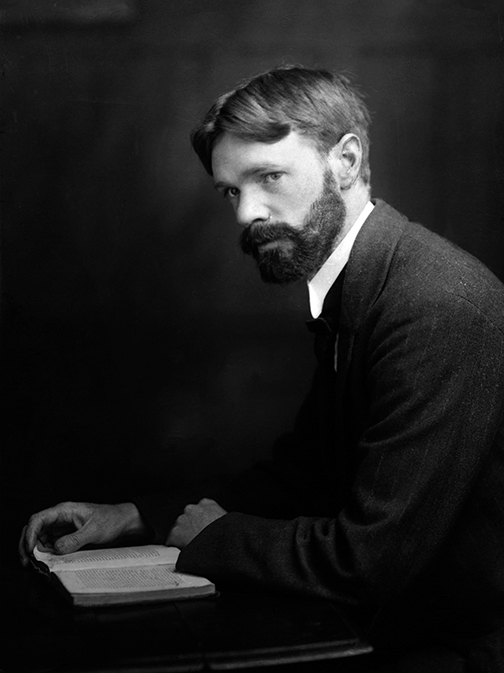
Written in 1925 but unpublished in his lifetime, DH Lawrence’s “Why the Novel Matters” is related to a batch of essays with overlapping concerns and titles which he worked on while recovering from an illness in Taos, New Mexico. Why this sudden surge of apologias for and celebrations of the novel? Well, it was almost nine years since Lawrence had completed a novel that mattered – Women in Love –and a year or so before he began work on the novel that came to matter enormously in the social and sexual life of Britain, Lady Chatterley’s Lover. So, a fallow period in terms of the titular subject. You don’t write a piece called “Why the Novel Matters” if you are preoccupied with the weightier matter of… writing a novel.
I first came across some words from the essay as a teenager in the same way that I encountered the poetry of WH Auden, without being conscious of the source, in the form of BBC documentary series. There was Look, Stranger – as in Auden’s “Look, stranger, on this island now” – and Man Alive, a phrase repeated so frequently in Lawrence’s essay that it could serve as an alternative title. The other word that comes up as much as the phrase “man alive” is “tremulations”: the piece trembles and tremulates with the word “tremulations.”
By Lawrentian standards the essay is fairly Ronsealish: it does what it says on the tin. His central, ringing affirmation and claim is that “the novel is the one bright book of life”. He goes on: “Books are not life. They are only tremulations on the ether. But the novel as a tremulation can make the whole man alive tremble.” He continues in this vein for a while longer before opening a new paragraph with, “I do hope you begin to get my idea, why the novel is supremely important, as a” – yep, you guessed it –“tremulation on the ether.” It’s often difficult in Lawrence to distinguish between an argument surging forward and its being circled back, as if reiteration were proof of progress. So let’s go back to the headline: “The novel is the one bright book of life.”
If this was the case in 1925 – three years after the publication of Ulysses, the same year that The Great Gatsby, Mrs Dalloway and The Trial (posthumously) were published – it’s definitely not the case now, and has not been for quite a while. Bright books of life come in all shapes and forms. In 1974, Annie Dillard won the Pulitzer prize for Pilgrim at Tinker Creek which she described as “a meteorological journal of the mind” – using a line from Thoreau’s Journal. “After all,” she had noted in a journal of her own, “we’ve had the non-fiction novel – it’s time for the novelised book of non-fiction.”

Note how the novel is still there, the sun around which other forms revolve; Lawrence’s belief in the power of the novel lingers as a residual gauge by which to assess how brightly her book might blaze. Any summary of what Pilgrim is about is likely to conclude that its overarching subject is the intense hum of Dillard’s consciousness. The singular fire of that consciousness is such that, as Eudora Welty remarked with some bewilderment in a review in the New York Times, there is no one in Dillard’s world except herself. That can be an impediment for a novelist since the novel, through its long and varied history, has an enduring connection and contract with the social landscape.
Staying with non-fiction and going further back in time, to the late 1930s, we have one of the biggest – 1,200 pages – brightest and darkest books of the 20th century: Black Lamb and Grey Falcon by Rebecca West, subtitled A Journey through Yugoslavia. West and Dillard both wrote novels but their reputations are not dependent on them, or rather are dependent on stuff that lies beyond this traditional arena of literary excellence. Which is a problem because we still look to the novel as the plinth on which reputations are built. But if certain non-fiction books blaze brightly then plenty of novels are relatively dim, have something the matter with them, often because their authors are unconscious slaves to convention, to unthinking assumptions about how novels are supposed to behave, which dials are meant to be turned up when. The adult imagination can be as mechanical as a set of Meccano. Clichés exist not just at the level of phrase but also of form.
The more general point is that the novel is not inherently or generically superior in the way that Lawrence claimed that he was superior to philosophers, scientists and so on because he was a novelist. But, to make a blindingly obvious point, some novelists are superior to – and matter more than – other novelists.
A mysterious, highly democratised elitism is at work here. Prominent thinkers are regularly defeated by their attempts to write a novel; as Dillard points out in Living by Fiction, intellectuals “discover that in order to write fiction that anybody might want to read, they must painstakingly conceal what is to them its very point”. At the same time, some of the people who can do it best are also the least able to do anything else, including the basic task of taking care of themselves.
By all accounts Jean Rhys was a hopeless mess, muddled and befuddled in her life, but with an unerring ability to transmute her failings into the slurred and glowing clarity of fiction. This kind of ability, a shambolic adaptation of negative capability, is best articulated by the narrator of Denis Johnson’s story “Triumph over the Grave”:
“Writing. It’s easy work. The equipment isn’t expensive, and you can pursue this occupation anywhere… You don’t have to be high-functioning or even, for the most part, functioning at all… Whatever happens to you, you put it on a page, work it into a shape, cast it in a light. It’s not much different, really, from filming a parade of clouds across the sky and calling it a movie – although it has to be admitted that the clouds can descend, take you up, carry you to all kinds of places, some of them terrible, and you don’t get back where you came from for years and years.”
So yes, it’s sort of easy but there’s one thing you absolutely need in order to have written that paragraph, which is to be… Denis Johnson, a gift and skill no one else had. Plenty of non-fiction books could have been written by anyone with a comparable level of expertise in and knowledge of a given subject. But novels should by definition tend towards uniqueness. This can go in one of two ways. We become dissatisfied with a novel if we get the feeling it could have been written by anyone other than the person who actually wrote it. But writers are sometimes praised for being original precisely because they’re not; they gain recognition because this originality has been seen before and is therefore recognisable. In the case of writers as distinctive and influential as Milan Kundera or WG Sebald it’s as if their once-patented software has become available for free download.
[Further reading: Milan Kundera’s identity crisis]
The usual way of referring to highly individualised style is voice. But it is, of course, more than that. Martin Amis points out that style is “intrinsic to perception”. I would go further and say it’s an entire consciousness. So what we get in the most acutely observed novels is a dramatised plumbing of that consciousness, even when the author’s style – unlike Amis’s – is unshowy, modest, invisible even. Anita Brookner’s, for example. The insistent sameness of her work, the sense of characters’ lives being squeezed by circumstances which, whatever their particular manifestations, are always and ultimately the same, mean that we are confronted by something like a highly domesticated philosophy of life, an internalised version of destiny or fate. The women in Brookner’s places – whether a lakeside hotel or a serviced apartment in Fitzrovia – are inhabiting, in a refined way, somewhere beset by the furies and gods of myth. With her place-settings, teacups, sherry and endless reserves of politeness, patience and restraint, Brookner is actually a borderline pathological writer who takes normalcy to such an extreme as to be unlike anyone else. No wonder she admired Patricia Highsmith.
I sometimes think that a sense of uniqueness in a novel matters more to me than quality, even though, ultimately, quality is all that counts. So how do we recognise quality? The process starts with publicity and reviews. An abundance of the former, or the sheer number of Instagram followers, can cancel out a lot of the punishment that might be dished out in the latter, so the distinction between buzz and judgement is blurred from the get-go. It continues with prizes (we can all think of truly implausible winners and unjustly neglected losers) and moves on, eventually, to survival – but how precarious that is, how close Moby-Dick came to not surviving! The fact that it didn’t become extinct reinforces our faith in the idea of eventual survival of the fittest – but we can’t know about all the biblio fauna that has disappeared from sight and lies in the unvisited tombs of libraries. What happens to these books? What are their chances of resurrection?
The good news is that this is such an excellent time for second chances that catalogues of forthcoming reissues are a source of as much excitement as lists of new books. Sometimes a novel such as Stoner by John Williams is belatedly restored to the pantheon. Other times a second or third chance confirms, like a retrial, that the original consensual verdict was sound. Henry Green is an example of this kind of Norwich City author, promoted and quickly being re-relegated, yo-yoing up and down between the top and second flights.
As well as actual reissues, another kind of rehabilitation is in constant progress by virtue of the ongoing appearance of new works which cause certain old books to align more closely with contemporary tastes – making us aware either that new trends in writing actually have a lengthy prehistory or encouraging us to see old works in a new way. For the last 15 or so years, autofiction by Rachel Cusk, Karl Ove Knausgaard and others has been considered a cutting edge of literary production, but one doesn’t have to go far back to think of precedents. It’s Me, Eddie, the “fictional memoir” by Eduard Limonov, was originally published in Russian in 1979 and in English in 1983. Going further back, there are the barely fictionalised novels of Christopher Isherwood – A Single Man, Down There on a Visit – and the earlier Berlin stories. Henry Miller’s Tropic of Cancer takes us back to the 19th century with its prophetic epigraph from Emerson:
“These novels will give way, by and by, to diaries or autobiographies – captivating books, if only a man knew how to choose among what he calls his experiences that which is really his experience, and how to record truth truly.”
I’d taken against Miller – without having read him – after being dissuaded from doing so by Kate Millett’s Sexual Politics. Having been effectively cancelled by Millett, Miller was brought back within range of my curiosity by the current vogue for autofiction – by which time, for me at least, he’d gone from being unread to being almost unreadable. That kind of call and response – or cull and lack of response – is part of the healthy working of the literary tradition which has to be a living, volatile thing, paradoxically strengthened by the absence of all guarantees of immunity; otherwise it becomes a mausoleum, filled with relics of the sacred.
This is nicely illustrated by the way that, when I read The Catcher in the Rye as a 16-year-old, I took the line about “all that David Copperfield kind of crap” unthinkingly to heart so that David Copperfield became synonymous with boring Victorian novels. I read David Copperfield as an undergraduate, thoroughly enjoyed it, as it happened, thought no more about it, and in my twenties became infatuated with conspicuously modish novels such as G. by John Berger with its famous line: “Never again will a single story be told as if it is the only one.” Michael Ondaatje uses that as an epigraph to his novel In the Skin of a Lion. As does Arundhati Roy in The God of Small Things.
Ondaatje shares Berger’s fondness for slipping in quotes, often unacknowledged and therefore unnoticed, into his own texts. In Divisadero someone recites a line which has a profound effect on the narrator, who says, “I know where those lines come from now” – without sharing this knowledge with the reader. These are the lines: “Whether I will be the hero of my own life or whether that station will be held by anyone else, these pages must show.” Wow, what a cool, postmodern idea – all the more remarkable because it’s from David Copperfield. As a result of these lines being discreetly quoted in Ondaatje’s fragmented narrative, Dickens’s novel leaps from the tomb of the past in which Salinger had embalmed it to come again to a vivid life – which had never actually left it.
The effect is similar to a sample in a piece of new music bringing the original from which it was lifted back to the sonic life of the contemporary. On a more extended scale, the same thing happens with novels offering a versioning or remixing of previous novels: Zadie Smith’s On Beauty – with its remixed first sentence from Howards End – Percival Everett’s James, or Graham Swift’s Last Orders, which endured a brief flurry of suggestions of plagiarism when, of course, Swift wanted people to recognise the Faulknerian template of As I Lay Dying. If I can invite myself into this party of high-class company, my Paris Trance is a version of Fitzgerald’s Tender Is the Night – same first and last sentences – while Jeff in Venice, Death in Varanasi is modelled, explicitly, on Thomas Mann’s Death in Venice, with touches of Henry James’s The Aspern Papers stirred into the mix.
There’s a flipside to this. Whenever I read on the back of a current novel that it bursts with a Dickensian cast of characters or some such, I think, “I’ll read Dickens instead.” Actually there’s a geographical exemption to this little stricture: the Dickensian novel has been alive and well and thriving in Indian fiction. There’s also what might be called a flipside to the flipside because novels no longer have to serve one of the functions that Victorian novels performed at such length. One of the reasons those 1,000-page whoppers were so popular in the 19th century is because the novel was the only form of home entertainment on offer. In the past decade the novel has been freed from the need to entertain because our hunger for entertainment is sated by all the football on telly, by amazing videos on TikTok. So either a novel has to try to become even more entertaining than stuff on our phones – impossible, surely – or it can dispense with trying to entertain. This is not at all the same thing as revoking the last of Wallace Stevens’s ukases in “Notes Towards a Supreme Fiction” because, yes, “It must give pleasure” and, ideally, be funny too – which is entirely compatible with being quite serious.
Leaving aside the diminished need to entertain, the skills a novelist needs have not changed much since Jane Austen. One of the reasons Cusk and Knausgaard succeed is because of the foundational abilities of scene building, character creation and storytelling. Experimental fiction can sometimes involve a sleight of fictive hand, a way of making up for a lack of what in Pilates are the core strengths of substantiating scenes and turning words on a page into living, breathing people. The same shortcoming can be felt in not-that-experimental fiction where brief paragraphs surrounded by acres of white space seems less like a liberation from the exhaustive conventions of naturalism than a way of avoiding the gruelling business of achieving full readerly immersion.
The term experimental fiction has unfortunate connotations of the laboratory: not the brilliant-white lab coat sported by Lester Bowie, trumpeter with the Art Ensemble of Chicago, but instead something of the crosswordy textual games of the Oulipo scene or the avant-garde journal TelQuel. Innovation is perhaps a more appropriate word. Experimental works are sometimes too easily recognisable to be genuinely experimental. How about invisible, unassuming or unannounced innovation: books which involve readers being genuinely confounded as to what they’re reading, who keep reading partly because of that uncertainty and curiosity? Which is why the Goldsmiths Prize should be expanded to include non-fiction. Restricting it to fiction is a kind of contradiction, as it abides by the generic conventions to which the prize is declaratively opposed.
In writing the goal is always to achieve a form uniquely appropriate to the subject-matter. For some writers this involves working on a bespoke edge or unsettled frontier (that’s where we find Kapuscinski and mid-period Naipaul, from roughly An Area of Darkness to The Enigma of Arrival); others find that the traditional realist novel suits them perfectly. Either way, the most difficult things for a novelist to do remain in some ways the simplest. This can be illustrated very easily by the moment in Edith Wharton’s The Age of Innocence when Newland Archer looks at Ellen Olenska and finds himself entranced by “the delicious details that made her herself and no other”. If writers can do that – enable us to see the details that make a character himself or herself and no one else – then they can do fiction, which will in turn be watermarked by the delicious details of style, perception and consciousness that make them them and no other. Similar skills are not the unique preserve of novelists. They’re also evident in the best memoirs.
[Further reading: Thomas Mann and the European disease of nihilism]
With Lawrence’s essay “Why the Novel Matters” in mind, it seemed a good time to reread Graham Greene’s The Heart of the Matter. I did so with some apprehension, worrying that it might have undergone a reputational wobble in the era of enhanced postcolonial consciousness. Mine are far from the best eyes to assess the novel in that light but it glowed with the same subdued, dimly lit mastery that I remembered from 35 years ago. The themes of the book could hardly be more vast, as Scobie, the protagonist, reflects: “If one knew, he wondered, the facts, would one feel have to feel pity even for the planets? If one reached what they called the heart of the matter.” How does Greene approach this heart of the matter? Through philo-theological wrangling? Partly, but as the Italian philosopher Giorgio Agamben observes in a different context:
“If there is somewhere today where an echo of the ancient mysteries can be heard, it is not in the liturgical splendour of the Catholic Church but in the extreme life resolutions offered by the novel form… [The] novel places us before a mysterium in which life itself is at once that which initiates us and that into which we are initiated.”
This involves the creation of a world of which we, as readers, do not feel ends at the edge of each page – in the same way that certain artists persuade you to believe that their depicted world extends beyond the frame of a given painting. The crucial point is that vastness of intent is conveyed through a textured narrative with a kind of invisibly high thread-count in which patterns and associations emerge which might be suggestively symbolic but which are always essentially incidental. Here is Scobie, his troubles mounting: “Driving slowly through the rain – his windscreen wiper had long ceased to function – he saw Harris struggling with his umbrella outside the Bedford hotel.”
Nearly 100 pages later he’s driving again, “through the bleak empty middle day. Only the vultures were about – gathering ’round a dead chicken at the edge of the road, stooping their old men’s necks over the carrion, their wings like broken umbrellas sticking out this way and that.”
Circling back to Lawrence by way of a favourite formulation of his – “I don’t care” – I don’t care whether books matter, only whether they matter to me. There is no correlation at all between the quality of a book and the number of copies sold. Some excellent books achieve a wide audience, some are read by hardly anyone. A novel can matter enormously to a reader without being important. What matters is the conviction that your life would be impoverished by not having read it.
One way in which this is manifest is that your ability to appreciate – or see through – other novels would be diminished, compromised. The Transit of Venus by Shirley Hazzard tests or even measures your abilities as a reader – which might explain the 20-year interval between my first trying to read it and actually managing to do so. I came still later to Elizabeth Taylor but there was no lag between buying and reading A Game of Hide and Seek. What would have happened if I’d not read that book? The most immediate effect would have been that I’d have missed out on a bliss-packed three months reading everything else by her. And that would have been a terrible loss. It may not have invalidated but it would certainly have compromised my entire reading life, which – and I’m aware that a Lawrentian rejection of logic is at work here – was in some ways leading to or preparing me for this experience.
Rather than say more about Taylor, I’ll broaden things out again by eliciting support from an unexpected quarter, a writer whose books I’ve not read. In 1983 Kingsley Amis was provoked to write a letter to the Spectator because Paul Johnson, a former editor of the New Statesman, had expressed astonishment at the inclusion of Angel by Elizabeth Taylor in a list of the 13 “Best Novels of Our Time”:
“Of course if you have no literary judgement, no ability to see a novel as it really is, you spend your time groping for guidelines like what reviewers have said or might say about it, what class it seems to fall into, where it seems to be aiming, whether its style strikes you as normal or not, above all whether it can be called important or not – which is far easier to decide than whether the thing is any good or not… And Angel is not important in the usual sense: it inaugurated nothing, summed up nothing, did nothing outside itself. But importance isn’t important. Good writing is.”
That is what matters.
An extended version of this essay, the New Statesman Goldsmiths Prize Lecture, was delivered by Geoff Dyer at the Southbank Centre earlier this year
[Further reading: Books of the year 2025]
Content from our partners



Related


This article appears in the 12 Dec 2025 issue of the New Statesman, All Alone: Christmas Special 2025
Join the debate
Subscribe here to comment