
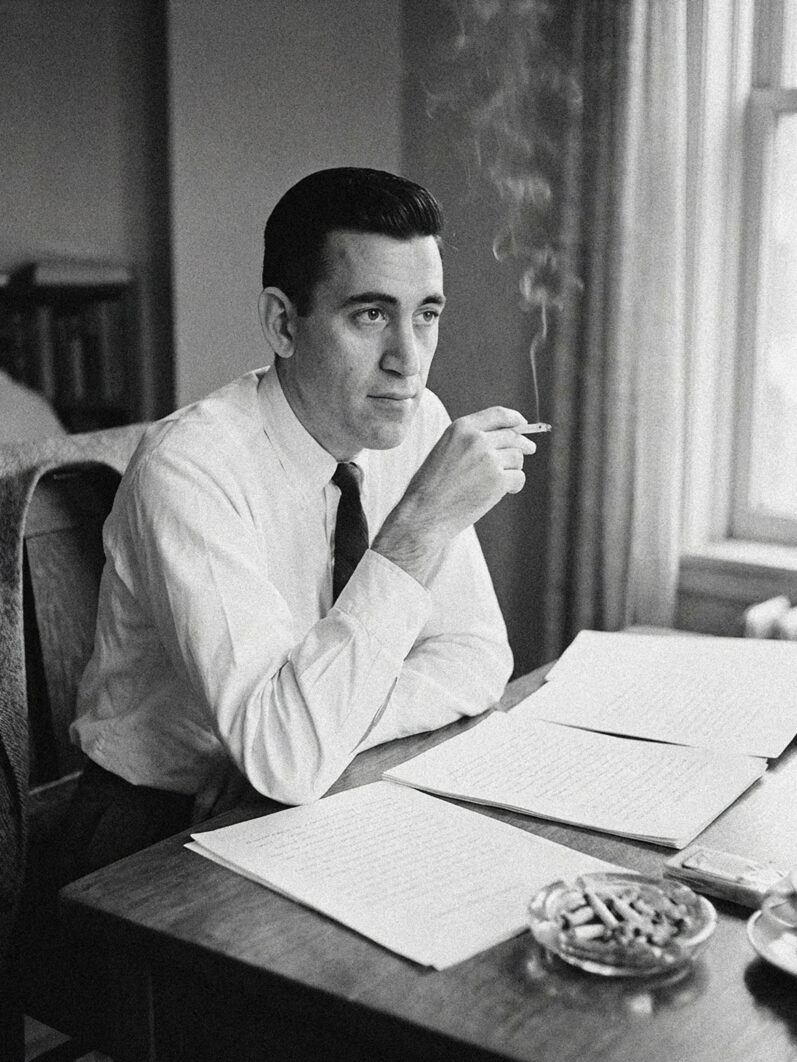
It has been said that you can assess the worth of a literary work by the fullness of a culture’s response to it. The reverse is also true. You can assess a culture by the way it responds to a major literary work. There has been a revealing flurry of commentary about JD Salinger’s The Catcher in the Rye on the 75th anniversary of its publication. As one group of critics has it, the novel’s protagonist Holden Caulfield, is an exasperating, or even downright annoying, teenager created by a reclusive author at war with the world around him. This adolescently alienated anti-hero sees all the world as “phony” and describes himself throughout the novel as being on the verge of “puking” in response to all the enveloping vanity and hypocrisy.
In this gimlet-eyed reaction to the novel, Catcher is the disturbed creation of its pathologically withdrawn author. The novel has accordingly been blamed for the 1980 murder of John Lennon whose assassin, Mark David Chapman, cherished the book and, by his own admission, identified Lennon with Holden’s definition of the sort of faker who makes life unlivable. Catcher’s assaults on the sanctimonious adult world have been reduced to the trauma with which Salinger emerged from the battlefields of the Second World War; Salinger himself has been depicted as a phony for being creepy with teenaged female admirers. Long before there was anything like cancel culture, Salinger’s novel was stretched on the rack of its author’s life and forced to confess its own fraudulence or, at least, moral inadequacy.
The pendulum naturally swung in the opposite direction. Another school of criticism, also reflected in the current celebrations, admires Catcher as the picaresque account of a teenager blessed with a preternatural emotional intelligence. At one point Holden’s elderly high school English teacher tells him: “Life is a game, boy. Life is a game that one plays according to the rules.” Holden replies with adult tact: “Yes, sir. I know it is. I know it.” Then he reflects to himself: “Game, my ass. Some game. If you get on the side where all the hot-shots are, then it’s a game all right – I’ll admit that. But if you get on the other side, where there aren’t any hot-shots, then what’s a game about it?” That is about a hundred years of modern sociological theory in a nutshell.
As this pro-Holden interpretation has it, Holden is to be congratulated on, among other things, escaping the fate of today’s toxic males. He tells his doctor (the novel is a feat of dreamlike association related to a psychiatrist in the mental hospital to which Holden has been committed after suffering a mental breakdown): “The thing is, most of the time when you’re coming pretty close to doing it with a girl… she keeps telling you to stop. The trouble with me is, I stop. Most guys don’t. I can’t help it…. The trouble is, I get to feeling sorry for them.” This vastly preferable Holden is a both pre-woke and anti-incel paragon of gentleness and caring.

The difference between the two responses to Catcher is really the difference between seeing it literally, as a transcription of Salinger’s personal neuroses, and regarding it as a work of autonomous and unduplicable human imagination. These contrary interpretations are nothing new. Ever since its publication in 1951, the book has gotten under the skin of literary mandarins – to such an extent that in 1963, a volume of essays appeared titled Salinger: A Critical and Personal Portrait, which was a sort of emergency critical intervention into Salinger’s fame and success. Heavyweight writers and critics like Joan Didion, Alfred Kazin, Leslie Fiedler and George Steiner – with an eloquent dissent by Ihab Hassan – concluded that Catcher was emotionally and intellectually stunted, vain, self-absorbed and merely “cute.”
For all that, every year something like 250,000 people around the world buy Catcher, which portrays the odyssey of 16-year-old Holden Caulfield as he travels to and around his native New York City after being thrown out of a fancy private school in Pennsylvania, a journey that culminates in his nervous collapse. It seems that a tale about love, madness, grief, and the search for truth still holds meaning for people, beyond recondite arguments by critics about the authenticity of narrative – not unlike, come to think of it, the gap between the elites who hurl empty populist arguments at each other and the ordinary humans who go untheoretically about their lives. Holden’s own criterion for honesty and authenticity in art is far more simple than the critical quarrels about the book. Referring to a “very old, terrific record” that a black singer “made about twenty years ago,” he cherishes the song for the way “she sings it very Dixieland and whorehouse, and it doesn’t sound at all mushy.” Pardon the jarring leap, but isn’t Trump, terrifying, soulless liar that he is, “very Dixieland and whorehouse”? There is a force in life, and in art, that is beyond morality, beyond rationality, beyond the ability of language to describe it. Such chthonic vitality – and here, we say goodbye to Trump – is what animates Salinger’s novel. Its spiritual ferocity is perhaps why so many cultivated, polite, polished people have no sympathy for it.
“Daddy’s going to kill you.” That’s what Holden’s beloved younger sister, Phoebe, says their father’s reaction will be when he learns that Holden flunked out of his fancy prep school. It is a wrenching double entendre. The father will be apoplectic. But the father himself has also sentenced Holden to death simply by bringing him into the world (the echo of Christ and his father is not accidental). Holden is death-obsessed; he has been devastated by his 11-year-old brother Allie’s death from leukaemia. When Holden thinks to himself, while talking with his history teacher, “but if you get on the other side, where there aren’t any hot-shots, then what’s a game about it?”, he is thinking about Allie who is on “the other side.” In this painstakingly layered novel, Salinger names Holden’s brother “Allie” because the child represents the “all” of existence: the primal curse of birth ending in suffering and death. Holden longs to redeem the vicious cycle of birth and death.
The novel turns on Holden’s misremembering of a line from a Robert Burns poem: “If a body catch a body coming through the rye.” Phoebe reminds him that the line actually reads: “If a body meet a body,” which, in the poem, refers to sexual intercourse. Substituting “catch” for “meet” Holden is replacing eros, whose couplings bring death into the world, with agape, the self-surrendering love of God and other people. This is why seeing “fuck” scrawled as graffiti on a wall sends him into a rage: it’s not the obscenity of the word, it’s what the word refers to, an act that creates life and death simultaneously. Turning the peak of his red hunting hat around like a baseball catcher, Holden transforms himself from a potential killer – that is to say, an impregnating copulatory – to an unearthly saver of children falling off the cliff of mortality, like Allie.
Salinger meticulously prepares Holden for his final epiphany. Invoking the word “horse” in various contexts throughout the novel – commerce, social life, sex, sexual predation at one point — Holden confers on it the “all” of life. (“A horse is at least human, for God’s sake,” he strangely says.) So by the time he finds Phoebe sitting “down on this big, brown, beat-up-looking old horse” on the carousel in Manhattan’s Central Park, in the pouring rain, Holden has fulfilled the destiny foretold by his name. He will “hold” in the “field” of life children tossed out of the embryo’s “caul” into the raging waters of mortality, just as Phoebe appears on the timeless, changeless wooden horse, rescued from the eternal cycle of birth and death. The human curse of fatal amniotic torrents has become a baptismal rain in the park.
Anniversary felicitations aside, there is certainly nothing reassuring about Holden’s renunciation of reproductive sex, about his hallucinatory vision of redemption from the cycle of birth and death in the form of radical withdrawal. It is the disturbing figment of a nervous breakdown. It is also a beautiful, and real, longing for peace and serenity. The critic TE Hulme once described romanticism as spilled religion. Our moment is dripping with the search for an abandonment of our puny selves that is religion’s cure for mortal anguish. The transhumanistic quest to transcend biology, the yearning to be rescued by interplanetary visitors, the ambition to inhabit other planets, the numbing drugs, the tranquilizing screens, the frictionless companionship of AI that comprise our emerging new civilisation’s principal escapes – Holden’s wish to leap beyond the limitations and afflictions of mortal life is ours, too.
The difference is that Holden is presented as a Christ-figure, half-human, half-divine; one side of his head, the boy tells us, “is full of millions of gray hairs”. This comes across as both his delusion and the living reality of his desire to be the saviour-catcher in the rye. No doubt literary theoreticians of different stripes will continue to debate whether The Catcher in the Rye is an eye-opener or an eye-roller. The quarrel is about as relevant as arguments about the “abundance” theory of liberalism in Trump’s morally impoverished America. The novel’s dreamlike, uncanny cry for a release from suffering and death, and Holden’s yearning to save and be saved, will continue to speak to humanity’s profoundest, and most enduring, desire.
[Further reading: What did women want?]
Content from our partners



Related


Join the debate
Subscribe here to commentA bit over the top in referencing Holden as a Christ-figure, catcher notwithstanding.
This book stands as a direct descendant of “Huckleberry Finn” in being primarily arresting for its voice. A voice unknown in 1945, when the first chapters were serialised in Harper’s Magazine, the voice of youth and the first teenager to speak his truth.
Generations of young people have been gripped from the very first sentence, and followed Holden in his picaresque journey through the nightmare of the teenage innocent rebel.
I recently re-read this book 55 years after first discovering it. This time round, as the mother of two daughters, I was more struck by the character of Phoebe. JDS was an early percipient of the undoubted fact that girls are generally speaking more grounded and sensible than boys.