
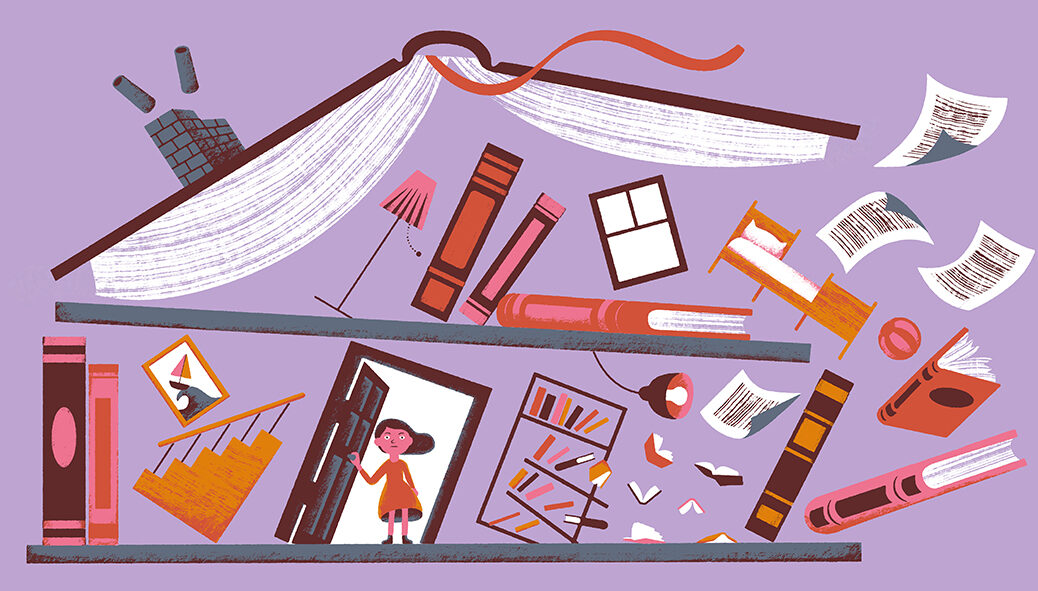
The calmest I feel on any given day is when I’m reading Peepo! to my two-year-old at bedtime. I could claim this was because of “co-regulation” or “bonding” or “language development” or “fine motor skills” or any of the other well-rehearsed merits of reading to your children. But it’s really because the house of the family in Peepo! is so relatably chaotic. There’s water all over the floor at bath time, clothes spilling out of drawers, dolls and rubber ducks and balls and building blocks strewn everywhere. There are crumbs and cups of tea on the floor, missing shoes and piles of laundry. Not here the creepy show-home countertops and immaculate make-up of mumfluencers on Instagram.
I still notice new details in Peepo! each time we read it, and feel less weighed down by the leftover mayhem I must soon return to from the nightlight glow of my daughter’s bedroom. The point is: the reading is just as much for me as it is for her.
The outgoing children’s laureate, and now our most vivid reporter on austerity Britain, Frank Cottrell-Boyce, calls the 1981 classic by Allan and Janet Ahlberg a “masterpiece” in his book A British Childhood: How Our Children Live Now. For him, the subtleties that stand out are less the mess and more the jolly domesticity of the working-class 1940s family amid an unmentioned world war. Spitfires fly overhead; a photo of Winston Churchill hangs on the living room wall; a gasmask is stored on the mantelpiece.
“It’s only after you’ve read it a couple of times that you begin to notice the things that aren’t mentioned in the text,” writes Cottrell-Boyce. “An ARP warden, a barrage balloon, Dad’s uniform.” This reminds the author – himself a children’s novelist – of WH Auden’s poem “ Musée des Beaux Arts”, on how the old masters understood that suffering “takes place while someone else is eating or opening a window or just walking dully along”.

Cottrell-Boyce has an even more emotional response to Judith Kerr’s beloved The Tiger Who Came to Tea, writing that the image of the dad in the book – who comes home from work to find a tiger has drunk all his beer and eaten supper – “both troubled and drove me”. He notes how “he takes all this in his stride and says, ‘OK, let’s go out to tea,’” and writes, “I had wanted to be that dad. So calm, so welcomed.” But there is a sadness, too, that he “seems to be walking into a wind that no one else can feel”, and in the café appears “forlorn – the weary breadwinner exiled from the strange adventures of the afternoon”.
Cottrell-Boyce takes his storybooks and children’s literature seriously – just as he approaches the theme of his book: the changing nature of childhood in Britain. He goes to a “baby lab” where they study the mysteries of infant inner life. He watches as a baby’s “messy brain” begins to mimic the relaxed brain activity of her mother when she is reading her a story. “This is what bonding looks like at a neurological level. I was watching the apparatus of happiness being built in real time.”
The problem, though, is that this simple act is being lost. Almost 50 per cent of children are arriving at school never having been read to. Many don’t even know how a book works – swiping at the pages or tapping to expand illustrations as though they are screens. It’s an injustice that horrifies Cottrell-Boyce. “Lullabies and stories are our first encounter with culture,” he writes. Children who have been read to are at a massive advantage; there is what’s known as the “million-word gap” between them and their peers who first encounter books in school.
Written almost as diary entries “mostly on trains and in Premier Inns” while touring schools, prisons, parent groups, community centres and young-offender units, Cottrell-Boyce’s book is a chronicle of fractured childhood and the people and spaces trying to repair it. Teachers tell him terrible things. Never mention the summer holidays to the children, because they dread the long break (school is the only safe place they have left). That there are children who don’t even have beds, let alone bedtime stories. One observes that pupils “won’t sing” any more.
And for Cottrell-Boyce, this isn’t simply the result of screens. He doesn’t dwell for long on our modern angst over social media, iPad parenting and screentime. A screenwriter himself, starting out on Brookside and eventually making his name with the London Olympics opening ceremony, he is a telly fan – applying the rich visual-textual analysis he brings to storybooks to children’s TV classics too. The Clangers occupies a “mini-Utopia”; The Magic Roundabout’s Dougal, in the five minutes in which the show is aired before the Six O’Clock News, acts as a “guard dog at the gates of Grown-Up Land”; there is a whole passage dedicated to the genius of Top Cat, which “grew out of the traffic between the different age groups”.
No, the problem isn’t that our children are screen-addicted, goes Cottrell-Boyce’s thesis. It is that their parents and the real world around them – Sure Start, youth workers, public libraries, health visitors, a safety net to bounce back from – have been torn away. The boys who joined in the 2024 summer riots weren’t being brainwashed by fascist content on their phones, he discovers from Rachel de Souza, the children’s commissioner – they mostly used their social media accounts “to contact real-world friends and [to get] updates on footy and fishing”. He is sceptical of Adolescence, the award-winning British TV drama about misogynistic violence that Keir Starmer said should be aired in all schools: “Unlike the boy in Adolescence they are not in thrall to any online Pied Piper.”
Cottrell-Boyce instead focuses on the “hyphenated poverties” that have dashed like Morse code through the post-crash austerity years: food-poverty, hygiene-poverty, even furniture-poverty. This shameful reality of 21st-century Britain is having a direct impact on children’s literacy, imagination and joy, in his view. “No one is going to believe there might be snow and Turkish delight in the wardrobe, if there is no wardrobe.”
Perhaps this is the Scouse-Catholic collectivist in him. As a child he spent the early Sixties sharing a room with his parents and brother in a flat off Liverpool’s Dock Road – a world he paints as both tiny and vast. It was a life so contained that he didn’t realise he lived by the Mersey until he spotted two red funnels of a vessel “shovelling great plumes of steam between the rooftops below”. (And even then he didn’t picture a river: just a ship trundling along the cobbles like a milk float.)
But it was also a land of “stories that had been told for thousands of years”: sailors and merchants from around the world coming in to port, like Sinbad or Odysseus, who then left the parrots and monkeys they’d brought with them behind to play on the washing lines of tenement balconies.
If A British Childhood has a mission, then it is this: helping families rediscover storytelling even in tough and tight circumstances. The mums in Knowsley, one of Britain’s poorest boroughs, who couldn’t read but were introduced at a session at a GP practice to Dear Zoo, which they could easily recount to their children (“You just needed to remember one sentence: ‘I wrote to the zoo to send me a pet and they sent me a…’ The pictures will do the rest,” Cottrell-Boyce told them). And the prisoners of HMP Featherstone in Wolverhampton, who were given the chance to buy a book for £1 for their visiting kids, guided on what to choose (“Let me introduce you to Where’s Spot?”), and then spend time reading. “You could see that the children were often guiding the dads as often as the dads were guiding the children. You could see broken bonds being repaired in real time.”
These are hopeful stories, and Cottrell-Boyce retells them with warmth and optimism (if a little cheese – “a book is not a meal, it’s a recipe” is one offending line). I myself have written in these pages about the collective benefits of the Bookstart scheme, which ensures each newborn cohort receives the same free book. But such tales left me wondering how you replicate and sustain the good work so that it becomes the norm of family life again. When the author, inspired by the community schemes he’d seen, finds himself musing “maybe you can fix the nation with a couple of copies of The Very Hungry Caterpillar and a Pritt stick”, he stops himself. “Of course this was nonsense.”
A British Childhood: How Our Children Live Now
Frank Cottrell-Boyce
Picador, 208pp, £14.99
Purchasing a book may earn the NS a commission from Bookshop.org, who support independent bookshops
[Further reading: Samuel Beckett’s Proustian moment]
Content from our partners


Related
This article appears in the 05 Aug 2026 issue of the New Statesman, Europe's shame
Join the debate
Subscribe here to comment