
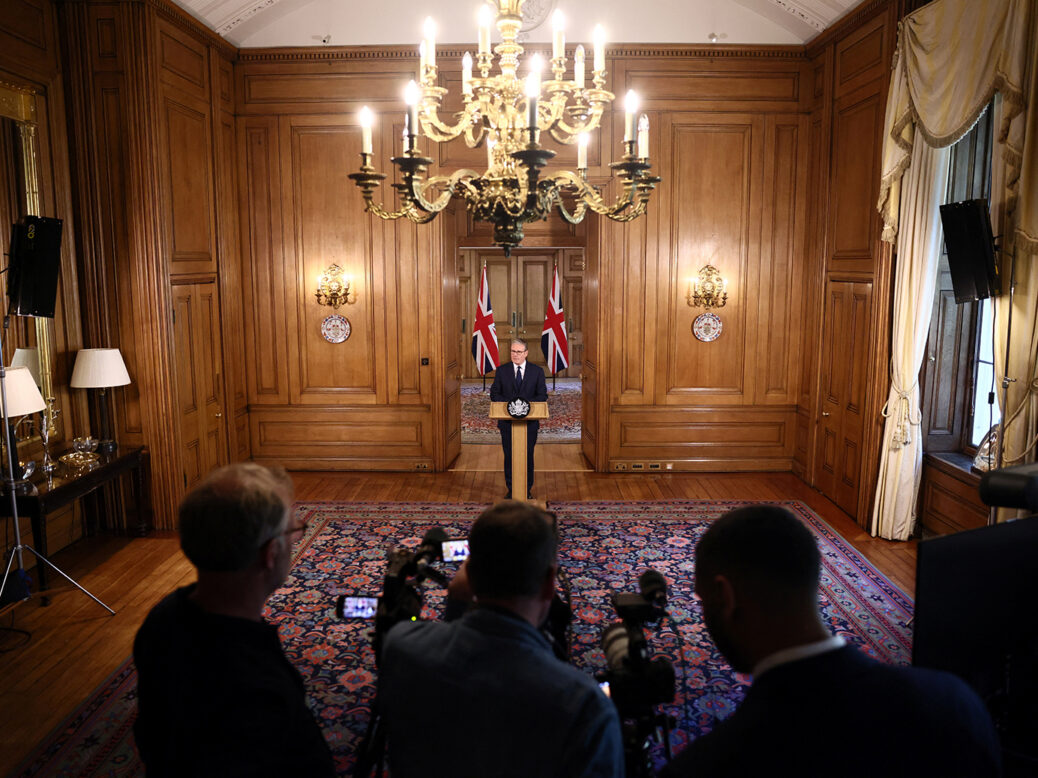
The UK is not a football club. Chopping and changing managers mid-season is the business of Chelsea and Tottenham Hotspur. It’s no recipe for success (I speak as a long-suffering Spurs fan); and it’s definitely not a serious plan for running a country.
Since the Brexit referendum in 2016, the UK has been a case study in political instability. We’ve had six prime ministers in ten years, including David Cameron; that’s on top of five defence secretaries, six chancellors and five Cabinet secretaries. The UK is starting to resemble Italy, except that Giorgia Meloni’s Italy looks like a paragon of stable government by comparison.
I hold no brief for Keir Starmer. He lacks the three essential qualities of leadership. He is a third-rate communicator with no ability to spot talent, build a team or fulfill a mission. He’s made more U-turns than a London cabbie hunting for a fare in Soho. From his first days in office, he has squandered political capital, too often blaming others for his own mistakes.
And yet. Despite the sound and fury of ministerial resignations and the mounting number of Labour MPs demanding a change of prime minister, there are good reasons why it would be wise to press the pause button — reasons which appear to be gaining traction tonight among the parliamentary Labour Party.

First, the UK is grievously exposed in an increasingly fraught international environment. Wars in the Middle East and Ukraine threaten our economic and political security. The US is no longer a trustworthy ally. We are part of Europe, but no longer a member of the EU. As MI6 chief Blaise Metreweli noted in December, the UK is operating in a space between peace and war.
The corrosive complacency over the state of the UK’s national defence may also have escaped the myopic plotters inside the Labour Party. But our precarious security should not come as news to the Cabinet. For all his missteps on domestic policy, Starmer has in fact been sure-footed on foreign policy, thanks in part to his experienced national security adviser Jonathan Powell.
But kudos to Starmer for getting the big calls right, latterly on the Iran war where he refused to join the US and Israel. In his two years in office, Starmer has also built solid relationships with European leaders, notably Emmanuel Macron in France and Friedrich Merz in Germany. A new prime minister would have to start over — not the best preparation should a post-Brexit UK wish to move closer to the EU, as I believe it should.
Toppling a prime minister mid-term would also likely prove a hard sell to financial markets. This week, borrowing costs on 30-year bonds reached close to six per cent, the highest level since the global financial crisis in 2008. Gilt yields on 10-year bonds also rose above five per cent. By comparison Italian yields are at 3.87 per cent, while Greece are just above four per cent. In the view of the bond market, the UK has already slipped into Europe’s second division.
The bad news is that it could get a lot worse. None of the putative leadership candidates — Andy Burnham, Angela Rayner, Wes Streeting or any other Tom, Dick or Harriet — have tested their economic programmes in public. Those who argue that the bond market will have to “fall in line” are deluded.
Whatever Rachel Reeves’ failings, and there are many, she has an economic policy framework with fiscal rules. Some of the pretenders to Labour’s throne sound like Groucho Marx: “These are my principles. And if you don’t like them, well, I have others.”
Faced with these criticisms, the Burnhams and Streetings will cry foul. In a leadership contest, say in the summer, they would have the chance to make the case for “Manchesterism” or any other new-fangled economic doctrine.
But herein lies the twist. The threshold for a leadership challenge — 81 votes — has not been met. More than one hundred MPs want Starmer out, but there is no unity behind a single candidate and Burnham does not occupy a parliamentary seat, never mind the small matter of actually winning against a resurgent Reform and Green challenge.
There can be no credible contest without Burnham’s participation. Starmer and his allies know this. Streeting supporters who want to short-circuit the process have incensed the Burnham-Rayner crowd, while Streeting himself plays an implausible innocent. All this points to a Downing Street-orchestrated fight back, with more than 100 Labour MPs calling on Starmer not to stand down.
Back to football. If Starmer were to survive, it would go down as one of the great escapes, almost as sweet a triumph as Leicester City avoiding relegation in 2014-15. (The following year, the Foxes won the Premier League title).
So much for fairy tales. I don’t see Starmer as a winner, and I cannot see how he survives the present level of discontent inside the party. But that’s no reason to avoid a serious debate about upending an elected prime minister with a 150-plus seat majority with more than two years left to serve in office.
[Further reading: Keir Starmer will be remembered as a pub quiz question]
Content from our partners



Related
Join the debate
Subscribe here to comment