
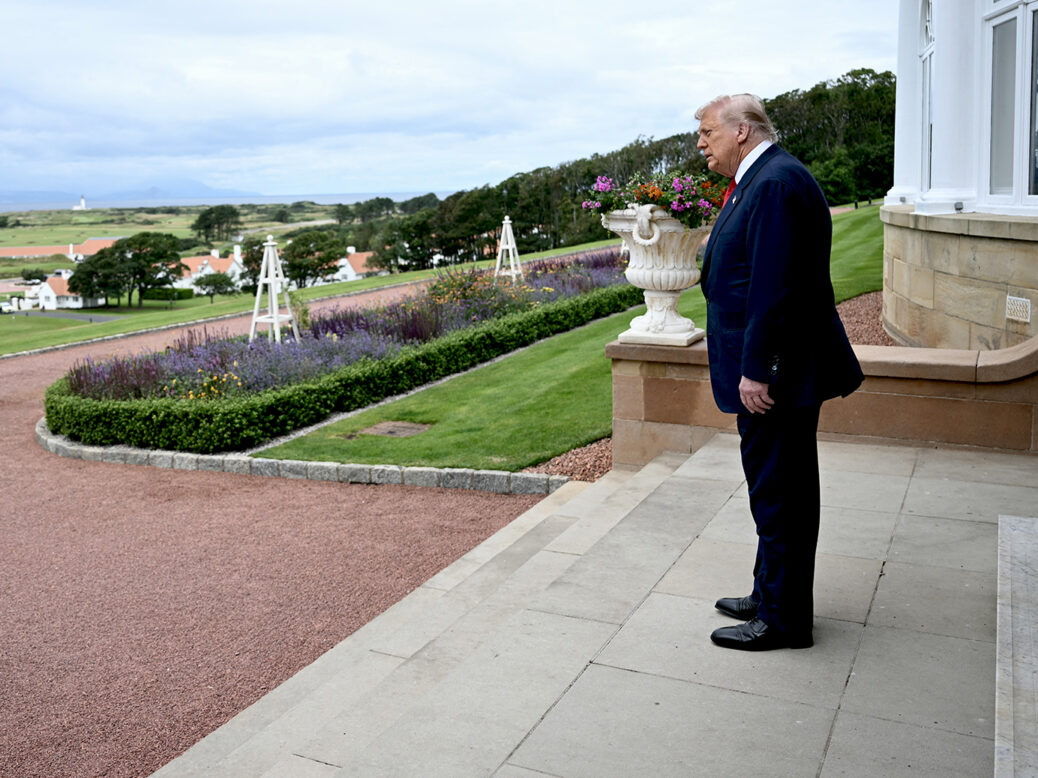
Donald Trump’s state visit to the UK was supposed to offer a vote of confidence in the British economy, a moment of respite for a Labour government so gaffe-prone and unpopular that it appears to have been taking PR advice from Prince Andrew. Before the wheels of Air Force One hit the tarmac at Stansted, a series of announcements had been arranged to showcase American investment in the UK: a new partnership on nuclear power; a £5bn investment by Google. Investment is the key to growing the economy, but it comes with strings attached, particularly when it comes from the US.
The main reason for this is that the US owns so much of Britain already. The most recent US Internal Revenue Service data (for 2022) records 1,369 multinationals reporting more than $836bn in revenue in the UK, a number equivalent to more than a quarter of that year’s GDP. Large chunks of what we think of as the British economy – from leading companies such as the AI pioneers DeepMind to everyday entities such as Boots and Morrisons, to energy suppliers and nursery chains – are American-owned.
This gives American business interests huge power over the UK economy, and consequently Britain’s politics. The investments recently scrapped by major pharmaceutical companies in the UK might suddenly be un-scrapped if the government decides to allow them to charge the NHS more for drugs. If the government allows Silicon Valley to keep helping itself to Britain’s intellectual property, the data centres will keep on coming. New deals on technology are on offer if we reconsider the laws our elected politicians made on online safety and taxing digital services.
We have already been making these compromises for a long time, and the cultural and economic consequences are now obvious. Nine of the ten highest grossing films in the UK last year were American. The only Brit on the list was Paddington, whose citizenship is, let’s face it, uncertain (Michael Bond never got round to writing Paddington and the Indefinite Leave to Remain). All the major online streaming platforms are US-owned. The UK spends more than three times as many hours watching YouTube as it does watching BBC iPlayer. Of the ten biggest-selling songs in the UK last year, nine were by Americans; the other was by an Irish person, singing in an American accent. On Britain’s bookshelves, the five biggest-selling print novelists of 2024 were Richard Osman and four American women.

The internet, as experienced by British people, is basically America. Of the 20 most visited websites in the UK, only the UK government and the BBC are British. Social media is America. The one social platform that wasn’t already American – China’s TikTok – is being switched to US-controlled ownership, because Americans are not stupid enough to let another country have direct, unaccountable control over their citizens’ main source of news.
After Elon Musk appeared via video link at a large far-right rally in London on 13 September, the Liberal Democrat leader Ed Davey wrote a sternly worded letter to Keir Starmer warning, in case the PM hadn’t noticed, that Musk was in his view “deliberately spreading misinformation, stoking anger and encouraging violence”. Davey then published this letter on X, the platform Musk owns, where the attention it generated made some more money for Musk. Davey continues to post multiple times per day on X, using his time as an MP to create free content for someone he believes wants to “undermine our democracy”. Musk both profits from Davey’s posts and controls the algorithm that decides by whom and in what context they are seen. The bile and ridicule to which Davey is subjected are variables for which Musk holds the dials.
Vying with Musk for the title of the world’s richest individual is Larry Ellison, a friend of Donald Trump and ex-CEO of Oracle – a strategic supplier to the British state – and a fellow investor in Britain’s culture and its politics. Two notable investments are £1bn in Oxford University and more than $350m in the Tony Blair Institute, which is highly influential on Starmer’s government. The Blair Institute is known for espousing technological solutions to social issues, a position that is not inconsistent with Ellison’s commercial goals.
America even helps to decide the price of our debt. When Rachel Reeves makes a decision, the yields on government bonds are checked hastilyto see if the shadowy forces of the market have been angered. In reality, these numbers are partly decided in the US. Trump’s tax cuts are adding trillions to America’s immense debt pile, and a market that is being asked to gorge itself on US Treasuries consequently has less of an appetite for UK gilts. If Trump manages to gain political control of US interest rates, then this too could have significant effects on the UK economy.
There is a huge amount to gain from Britain’s relationship with the US, but we should never forget the power relationship involved. What we do is of little consequence to the White House, but we have to deal with the consequences of American risk-taking. We are a mouse sharing a bed with a walrus.
Content from our partners


Related

This article appears in the 17 Sep 2025 issue of the New Statesman, Can Zohran Mamdani save the left?
Join the debate
Subscribe here to comment