
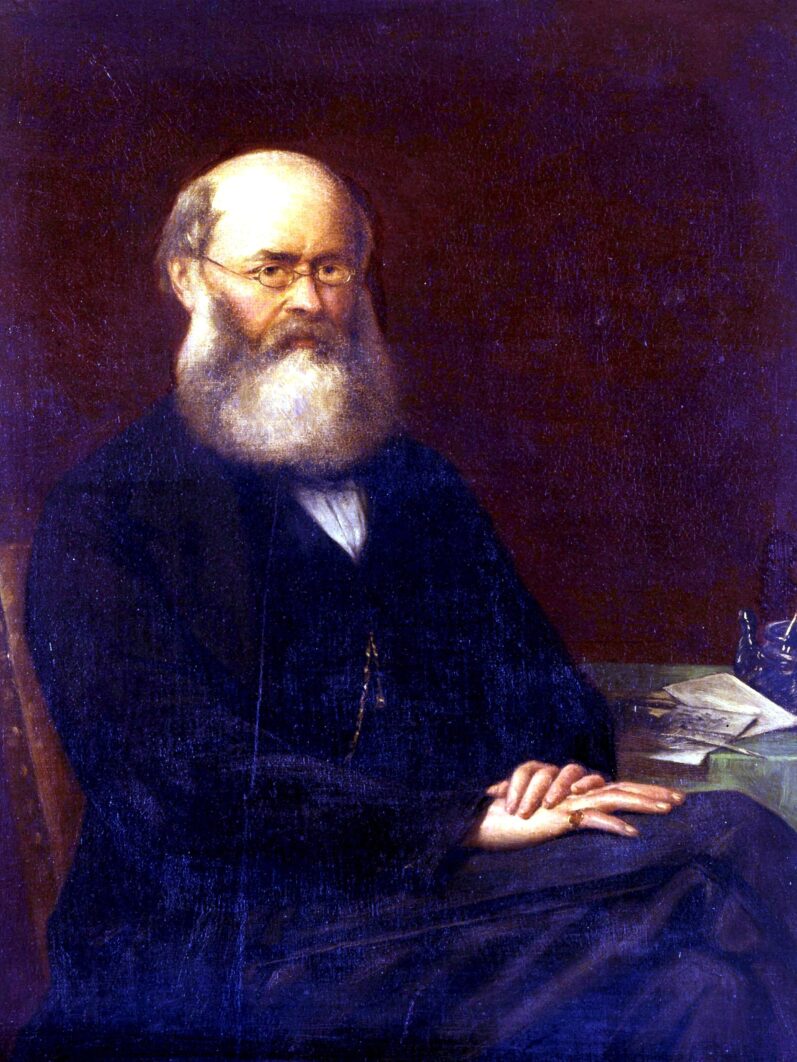
In 1876, the Victorian novelist Anthony Trollope read the 17th-century play The Old Law. In the drama, an ancient land was the setting for a new injunction: to euthanise males at 80 years old, and females at 60. In the winter of 1881, Trollope wrote a novella, The Fixed Period, set in the future on an island off New Zealand, where a similar but more modern plan was enacted. It was a fantasy of a society immunised against gerontocracy: to avoid rule of, by, and for, old people.
The plan in the novella was simple. At age 67, everyone – male and female – would enter a “College” where they retired from society in order to prepare to be put to death by their 68th birthday. Tripped out on morphine, and sitting in a warm bath, “certain veins” were to be cut in a painless ceremony. It was the first in a long train of utopias, or the opposite, dramatising future societies with age limits enforced by law. In 1947, one of Isaac Asimov’s earliest stories (drawn from a long unpublished first novel) took the scenario into outer space; and over the years a flurry of stories and shows have followed suit – including the inevitable Star Trek episode.
Trollope’s fantasy was a dark premonition of eugenic dystopias shaping populations — but also of what happens when we let our demography trend old without assessing and controlling the risks for creativity, fairness, or progress. Since the 1940s, psychologists have called “fluid” intelligence the kind of ability associated with originality and orthogonal thinking. It peaks in one’s twenties and goes downhill from then on. Its loss is compensated by the rise of “crystalline” intelligence, which mounts through one’s sixties before evaporating. It is based on acquisition of capacity over time as a cumulative process — at least up to a certain age.
The ancients developed the trope of the “swan song,” supposing (falsely) that the call of these feathered pop stars could become sweetest on the brink of death. In the Phaedo, one of his dialogues, Plato has Socrates recall that “swans, when they find that they have to die, sing more loudly than they ever sang before” – adding that humans have slandered them only in attributing sadness to their dirges. “A person who has not made his great contribution to science before the age of 30 will never do so,” Albert Einstein once countered. Alfred Adler set the age limit for mathematical breakthrough even lower: 25. Whatever is true of swans, humans do not get a last chance at genius or originality.

Kenneth Clark, in his beautiful essay “The Artist Grows Old”, dramatised how some painters, at least, could defeat expectations of decline. In the 20th and 21st centuries, indeed, a cottage industry emerged over the possibility of poets or musicians who capitalised on early fame to achieve a “late style” or “sublime senility” that allegedly contradicts any attempt to build a cult of people in their prime. But there are always exceptions that prove rules.
What if it is true that, as we age, we get set in our ways? It would mean that aging has, not just aesthetic consequences, but political ones too. Creativity – not merely unfairness – is at risk when old men control the future. And in a society like ours – with an unprecedented ratio of aging to young, with an 80-year-old occupant of the White House, and with an extreme concentration of wealth among the “boomer” generation – the first step is to think about why we should control elder power, while welcoming older people as our advisers and companions rather than our rulers.
The plot of Trollope’s pioneering version, such as it is, concerns how the frightening plan is derailed. When the first candidate for the programme approaches age, he tries to avoid the imposition of the law he had once supported. The main character and narrator of the novellais the prime minister of the island, Brittanula, an ex-colony of the British empire. And while he is absolutely stalwart in supporting the law – he is named John Neverbend – his own son and wife betray him, and the “retirement” plan ends up being stopped by the British empire, which sends a gunboat to the island and recolonises it.
Out with the old and in with the new is the best policy, Neverbend insists over and over. The rationale in Trollope’s novella is much the same as in “The Old Law”, which had pointed to the elderly overstaying their welcome in the world and exerting power accumulated over decades to stunt the lives of the young:
“Are there not fellows that lie bedrid in their offices
That younger men would walk lustily in?
Have you not places fill’d up…,
By some grave senators, that you imagine
Have held them long enough?”
Before she passed away in 2023, it was a good question for the 90-year-old California Senator Dianne Feinstein – except that she could not answer by the end.
Old people exercising political authority at the very top remains a big problem in The Fixed Period. Neverbend, the 50-ish president of the new republic in the south seas, accepts term limits for his loved ones and, he believes, himself. He imagines “with rapture the pride, the honour, and the affection with which, when the Fixed Period had come, I could have led my father into the college.” He had needed to wait for natural causes in that case, but Neverbend repeatedly professes to be more than ready to be led there at the appointed time.
The fly in the ointment is that he isn’t the first on the list – and the old men running Britain have imperial weaponry to disrupt progress and reinstitute prejudice. “The Prime Minister in Downing Street was seventy-two when we were debarred from carrying out our project,” Neverbend recalls, so “effete old age” on a global scale had the last laugh in end. Indeed, there was no better example of the “fatuous darkness of the old men” than when they put a stop to their own (permanent) disempowerment.
But it is outside political leadership, Neverbend and his compatriots believe, that the fixed period policy appeals even more. The “miseries” and “weakness” of old age – the degradation of the body even when it does not reach (as it regularly does) “imbecility” – strikes Trollope’s characters as simply worth editing out of the human experience, with irrational fear and religious superstition no answer. The Brittanulans, who had colonised their pristine island when they were all young, have a chance to revolutionise world affairs without interference from any political lobby of old people (who in America today have constructed the best funded and most powerful such group in world history).
Neverbend and his fellow pioneers convince themselves, however, that it is primarily for the sake of the elderly themselves that an enlightened policy of euthanasia, with full social honours for a life well lived, ought to prevail. After all, old age is a calamity before it becomes debilitating. “Can it not be brought about,” Neverbend wonders, “that men should arrange for their own departure, so as to fall into no senile weakness, no slippered selfishness, no ugly whinings of undefined want, before they shall go hence, and be no more thought of?”
And the consequences for those in their prime of the “prearranged ceasing to live of those who would otherwise become old” confirmed its promise. “Let any man look among his friends and see whether men of sixty-five are not in the way of those still aspiring to rise in the world.” The policy would not only clear obstructions before their path. It would instantly balance the national budget, and allow spending to make life even more worth living when it is still worth living. Not just for their own sakes but for that of the social good, some such controls are needed.
Trollope’s readers have often been afraid to admit the possibility that he supportedthe policy of his futuristic island – that, far from being a gruesome dystopia or a satirical “modest proposal”, he considered it a progressive ideal that centred society on fresh and productive youth rather than ugly and unproductive age. “When an intimate friend once ventured to refer to this Utopian euthanasia as a somewhat grim jest,” a biographer reported not long after Trollope’s death, “he stopped suddenly in his walk, and grasping the speaker’s arm in his energetic fashion, exclaimed: ‘It’s all true — I mean every word of it.’”
David Lodge, the late English novelist who knew a satire when he saw one, wrote that The Fixed Period “is certainly unique” among Trollope’s fiction, “but also oddly relevant to some of our own current social, economic and ethical concerns.” It trolls the dogmatism of reformers when their cherished utopias crash against the shore of human foibles. But it is satirical only up to a point, and deadly serious too. It is most of all a fantasy of what it might be like to embrace the degradation of our capacities as part of accepting our finitude and mortality – which should affect not just how people die but also what happens to their bodies thereafter.
Mortality was on Trollope’s mind when writing the book. When he had turned 65, in 1880, he retired to the countryside in West Sussex; snowed in there the next winter, he wrote the novella. It was the fruit of his own final preparations. With the hypertension and weight of a man who had sat day after day writing logorrheic Victorian novels too distended for anyone to read anymore, he explained to his brother: “The time has come upon me of which I have often spoken to you, in which I shall know that it were better I were dead.” In a little more than a year, he was; a stroke felled him and he passed away within weeks.
But Trollope’s concerns were anything but new or personal. Even before The Fixed Period, Trollope had been the Victorian novelist who most often featured older characters. In his novelistic way, he had dwelled on old age constantly as a systemic quandary. And he had seen nothing yet; when he was writing, people on average lived only into their forties, and those over 60 were only about 7 per cent of the population. In today’s America and Britain, that percentage has more than doubled and is on the way to more than tripling by 2060.
Over and over again across his career, Trollope noticed obsessively that age, along with a certain wisdom, brought inflexibility: his title for his novella refers to this problem as much as to the supposed solution. Trollope had been concerned for a long time with how society would manage the increasingly long-lived elderly. It wasn’t just that they lived longer in the century that increased their lifespan more than any other before or since; the fall in infant mortality of the same era, Trollope worried, raised the possibility that the extension of their lives blocked entry of the youth into their own exercise of productivity and power.
Indefinite extension of life as long as medicine could achieve it also exacerbated other problems. Who would take care of these survivors – and who would pay? Trollope understood that, with increasing numbers of elderly living indefinitely, care would necessarily become a massive enterprise. But the biggest problem was not getting almshouses funded and organised; it was solving that problem with resources that others could use better. Trollope didn’t anticipate the sheer amount of money our societies commit to the social safety net; he certainly didn’t foresee paying elders not so much for being poor but mainly for being old but also numerous and politically significant (even when they are wealthy).
The best proof that Trollope was serious in his concerns about a geriatric and gerontocratic society is that he extended his thinking to the disposal of the corpses, invoking a live reform proposal in his day. Cremation, previously associated with India, was prohibited in the global north until a few ex-Christians realised that it was the obvious modern way to dispose of bodies. Its introduction was a hallmark of cultural “disenchantment”.
Trollope was a founding member of the Cremation Society after it was formed in 1874, and read the tract by the great apostle of the practice (and Queen Victoria’s doctor) Henry Thompson in support of it. In The Fixed Period, the Brittanulan sexagenarians were to be unceremoniously burnt. Trollope even drew on Thompson’s attempt to calculate the savings for the country of adopting cremation in having Neverbend offer a similar cost-benefit analysis of the entire killing and burning program. (Cremation wasn’t legalised in Britain until two years after Trollope’s own death: you can visit his grave in London’s Kensal Green cemetery.)
Trollope’s vision was of a humanity in its prime. William Osler, a Canadian who cofounded the Johns Hopkins medical school in 1893 and finished his career as the Regius Professor of Medicine at the University of Oxford, agreed. He was perhaps the most renowned physician across the Atlantic at the turn of the 20th century. When he left Baltimore in 1905, Osler – then in his mid-fifties – argued that people over 40 were more or less useless.
“Take the sum of human achievement in action, in science, in art, in literature – subtract the work of men above forty,” he explained, “and while we should miss great treasures, even priceless treasures, we would practically be where we are to-day.” That was why society ought to be for the sake of those in the most creative period in life, “encouraged and afforded every possible chance to show what is in them.” After 60, having already had two decades of resting on laurels, most people were not worth allowing to work anymore.
He wasn’t the first doctor to make such assertions. Around 1873, George Beard had given a lecture to the Long Island Historical Society in which he touted the “superiority of youth and middle life over old age in original work”. It was odd, then, that “nearly all the positions of honor, and profit, and prestige – professorships, and public stations – and nearly all the money of the world, are in the hands of the old.”
When enthusiasm remained and experience had accrued, which Beard said occurred between 38 and 40 years of age, people were in the prime of life. Honour went to the sweet spot: the years in between impetuousness before and routinisation after. “In the whole recorded history of the human race”, Beard said with assurance, “no great invention or discovery has been conceived by anyone over sixty.” The next year Beard insisted that “the aim should be to give to the State the best of its manhood – to save it from the inflictions of callow youth and decaying age.”
Not the disempowerment part of Trollope’s vision of the future, but the death part purging the old from the present, shifted it into dystopian territory. Many have followed in his train in exploring the dystopian latent potential of his tale. And I have to record that beyond cremation – which since its controversial days has become a normal institution, much as Trollope hoped – Osler took his even edgier proposal seriously.
In calling for a society prioritising people in their prime, not past it, Osler wasn’t finished. He recalled Trollope’s “charming novel” 25 years after its already forgotten publication – and suggested institutionalising its plan. “That incalculable benefits might follow such a scheme is apparent to anyone who, like myself, is reaching the limit, and who has made a careful study of the calamities which may befall men during the seventh and eighth decades. Still more when he contemplates the many evils which they perpetuate unconsciously, and with impunity.”
Far more than when Trollope published the novella in the first place – it had been fiction after all – Osler’s speech set off an immense transatlantic hullaballoo, as opprobrium rained down on him. “Oslerising” became a euphemism for chloroforming men and women of a certain age. It didn’t help that no fewer than three old men across America appeared to have read Osler’s speech as a warrant to take their own lives, like the 72-year-old in St Louis found with a crumpled newspaper account of the lecture in his pocket and a bottle of chloroform by his side.
Osler was cancelled — or, in Osler’s own Victorian-speak, “placarded in a world-wide way” as the “sworn enemy” of everything good and right merely for saying “that the real work of life is done before the fortieth year and that after the sixtieth year it would be best for the world and best for themselves if men rested from their labours.” (The killing part had been a joke, Osler added unconvincingly.) The ideal of a society of, by, and for people in their prime, prioritising them over the old, got lost. Osler had only himself to blame. He deflected anyway. “Boys, do not read Trollope,” Osler warned his Oxford students more than a decade later, still wounded by the experience. “He is dangerous.”
Our society has chosen a different biopolitics than Trollope did. Our bias is to be haunted by the spectre of premature death that is avoidable – never mind that both government policies and individual choices are already implicated in how long people live and when they die. Government policies pick winners in a thousand ways, lengthening some lives and shortening others. The state inevitably has power over life and death. Laws are passed all the time that affect – even if only in minuscule ways – how long people live and how soon they die. And individuals themselves put their lives, and the lives of others, at obvious risk in almost all of their acts, and people die as a direct or indirect consequence of all of those choices.
Obviously, companies and consumers that have polluted for centuries are already affecting the terms of life – and the timing of death – of our children and grandchildren. We pretend that picking who will live and die, especially when it comes to old people and their perquisites, is a power too fearful to exercise. But everyone exercises it every day. When insurance executive Brian Thompson was gunned down in cold blood on the streets of Manhattan in late 2024, one viral post on a social media site critiqued the widespread schadenfreude in these terms: “No one on here is the judge of who deserves to live or die. That’s the job of the AI algorithm the insurance company designed to maximise profits on your health.”
These truths hardly mean Trollope’s remedy was in any way well founded. There are more than enough resources, we understand, to keep everyone in the world state-supported as long as medical progress allows them to live – that is part of why we find killing anyone because it is costly to allow them to live outrageous. Dystopias of young killing old like the New Yorker journalist Marya Mannes’s 1968 novel They (in which people are segregated at age 50 before finally being exited at 65) is one example. A more famous one, Argentine writer Adolfo Bioy Casares’s Diary of the War of the Pig, his novel of 1969 which was made into a film in 1975, was about an eldercide perpetrated by youth, premised on the intuition that no one is so unimportant or useless to die.
But this hardly means that Trollope’s concerns are irrelevant. To perpetuate life, especially alongside the revolutionary demographic event decreasing the numbers of younger people relative to older ones, is to change our social form, and therefore our social values. And it is to let social power trend grey. It is an illusion that gerontocracy in the various public and private forms Trollope worried about requires no remediation – even if doing so is costly in some ways for those who enjoy elder power. The question is how to give up his solution, without denying the reality of his problem. As the ageing of our societies continues, we will have to do so sooner or later.
[Further reading: Lawless in Gaza]
Content from our partners



Related



Join the debate
Subscribe here to comment