
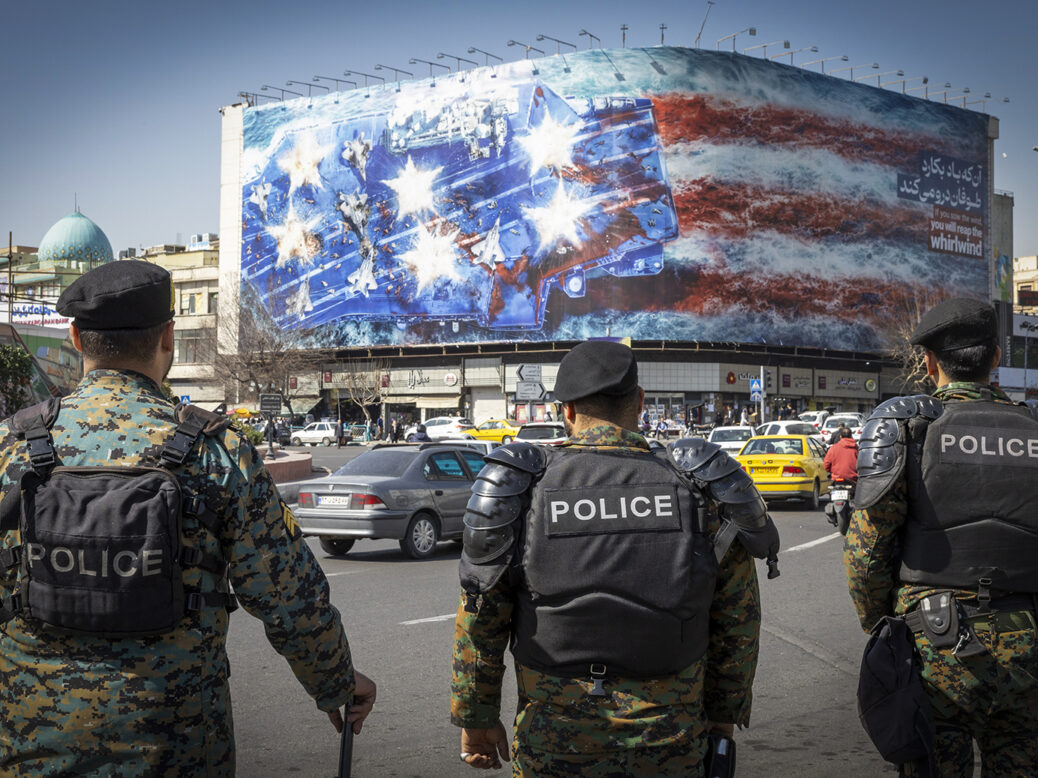
The omens are all there. Satellite images show Jordanian airfields filling up with tiny rows of American F-35s. Anonymous social media accounts chart the minute-by-minute movements of the transport planes crossing the Atlantic. Officials preach the evergreen reason to invade: that Iran is a week away from weapons-grade uranium. (To adapt TS Eliot, all is always a week before Iran gets the bomb.) And yet, that the president has amassed the largest military force in the Middle East since 2003 has not shaken Washington out of its eerie nonchalance. This city proves the principle that proximity makes you blind.
The reasons for this detachment denote an epochal shift in Washington politics. Now that international law is little more than a shibboleth in the capital, there aren’t any high-drama UN Security Council resolutions to catalyse a debate between the political elite. In a post-Caracas world, Trump ordering an invasion is not novel, and, in any case, the notion that waging war is up to the president, regardless of what the constitution might say, has been etched into the American mind since Congress last officially declared war in 1942. Most pressingly, the forum for debate on foreign policy has shrunk to the size of Donald Trump’s head.
All of this is helped by the media being much happier examining whether Trump will go to war than the reasons he might renege on his promise to be a president of peace. A clear statement of the motive for an invasion and a plan for what a post-war Iran might look like have eluded the administration. For many observers, the overthrow of the theocratic and misogynistic rule of the mullahs in Iran might be an outcome to be applauded. But Trump’s officials can’t decide whether this operation is part of a grand plan for regime change, a punishment for the massacre of protesters, or a way to pressure the Ayatollah into a deal on nuclear weapons. If the idea is to stop Iran making a nuclear bomb, then what happened to the propaganda spewed last year that claimed the bombing raid in June had wiped out Iran’s nuclear capability?
As a top official explained to me vis-à-vis Caracas, this confusion can be partly explained by different parts of the White House wanting to bomb Iran for different reasons. There are the residual neocons who want to plant democracy in the desert via the B-2 bomber; the Israel supporters who want to obliterate an existential threat to the Jewish state; the China hawks who want to prise Iran away from the Sinosphere and deprive Russia of its Persian drone factory. Trump sits above the competing interests of his coalition like Suleiman the Magnificent parsing his viziers’ schemes. Which way, Sultan – Vienna or Tehran?

But these decisions are subject to nothing more formal than the whims of a capricious president. As a White House spokeswoman said with what reads like an unfortunate attempt at humour: “The media may continue to speculate on the president’s thinking all they want, but only President Trump knows what he may or may not do.” Yes, that is part of the problem. And Trump’s psychology, ultimately, is much shallower than geopolitics.
Remember Barack Obama, and the Eve of America’s Fall. As the myth goes, Obama just couldn’t resist the temptation to mock Trump at the White House Correspondents Dinner in 2011, sowing seeds of vengeance that led Trump to run for president. In 2018, Trump would sink Obama’s deal with Iran which constrained its nuclear programme in exchange for reduced sanctions. Trump failed to replace Obamacare; now Trump perhaps sees an opportunity to finally replace Obama’s foreign policy crown jewel with his own concoction, whatever that might turn out to be.
A fresh tranche of interviews conducted for an oral history of Obama’s administration that was recently published sheds some light on the difference between Washington now and then. During the evening of that White House Correspondents Dinner, one of Obama’s aides approached the late-night comic Seth Meyers, whose speech that night had also mocked Trump. Together they laughed about how they had “really got him”. It is a moment freighted with light-hearted humour and epic hubris.
For those who grimace at the confidence with which Obama strode into the future with little regard for what he might unleash, remember that there was at least some respect for constitutional procedure, including on Iran.
One of those interviews in that oral history is with Obama’s deputy national security adviser, Ben Rhodes, in which he recalls how he tried to secure congressional approval for the Iranian deal. He would offer up European ambassadors to explain to members of Congress how the deal served America’s allies, human rights activists for those concerned about the regime, Nobel Prize-winning scientists to explain the technicalities and celebrities to text reluctant senators on the high-speed New York to DC train. Today, we are left looking at satellite images on social media.
Reading it now, laid out in transcripts as if it were a play, you can only appreciate the dramatic irony. Obama’s aides couldn’t have known that years later, on the precipice of war, Trump would be eradicating his predecessor’s legacy while Washington watches on in quiet bewilderment.
[Further reading: Putin will attack Europe next]
Content from our partners



Related


This article appears in the 25 Feb 2026 issue of the New Statesman, The Crumbling Crown
Join the debate
Subscribe here to comment