
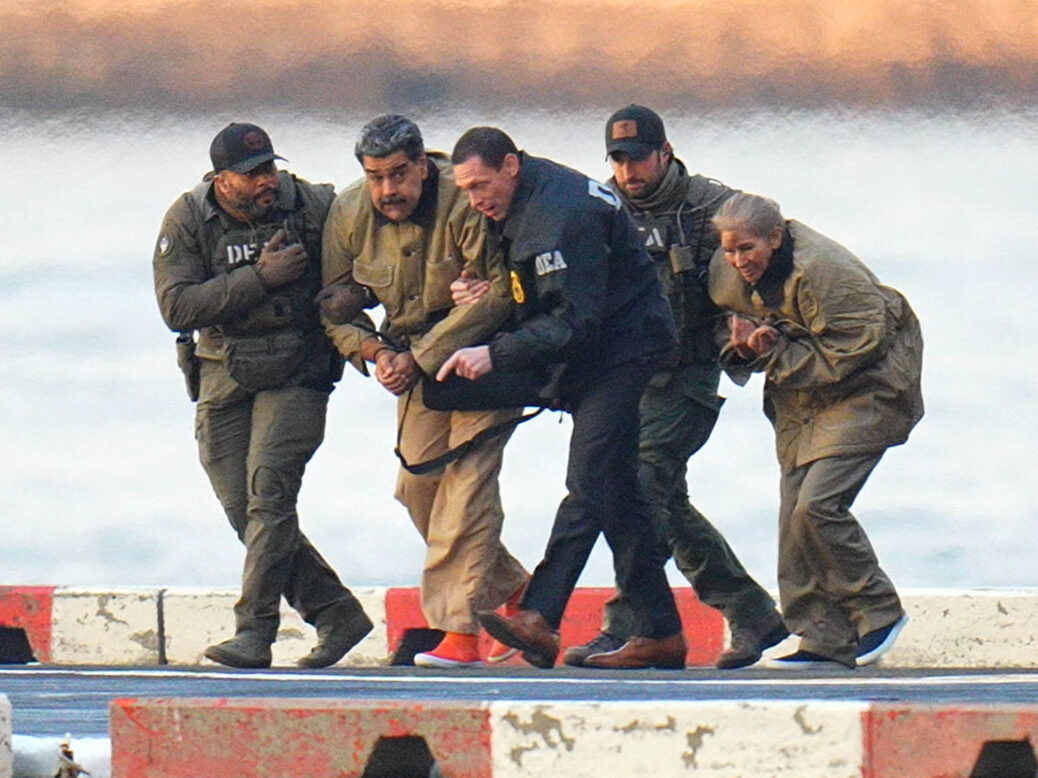
“The Monroe Doctrine is a big deal, but we’ve superseded it by a lot, by a real lot. They now call it the Donroe doctrine.” So said President Donald Trump at a press conference in his Florida home hours after bombing Venezuela’s capital and kidnapping its president. “Donroe” is the doctrine of the Don: the boss, the racketeer, the landlord with an air force. And it has now been enforced, with missiles and commandos, over the skies of Caracas.
We are told – again – that this is about law. About “narco-terrorism”. About defending democracy by kidnapping a head of state in the night and flying him to New York in handcuffs. This, from an administration that has just pardoned Juan Orlando Hernández, the former Honduran president convicted of drug trafficking, while embracing allies like Ecuador’s President Daniel Noboa, whose family business empire has been repeatedly linked to cocaine trafficking in Guayaquil. So much for the war on drugs.
The attorney general’s charge sheet includes “possession of machine guns” – a phrase of accidental self-parody. A country where guns are sold alongside breakfast cereal now proposes to put a foreign president on trial for possessing them. The Cabinet of the Progressive International called it what it is: “a criminal act of imperial aggression” – illegal, unprovoked and openly aimed at reasserting United States domination and seizing control of Venezuela’s resources.
Those words are not rhetorical embroidery. Trump has barely bothered with camouflage. He has said the United States will “run” Venezuela, and that American oil companies will “go in” and take “out a tremendous amount of wealth out of the ground”. Within hours, Wall Street was already gaming out the “opportunities”. In the old manuals of empire, this is the point at which the “civilising” slogans arrive. In the Donroe era, the plunderer announces himself plainly.
If you want the material base of this intervention, begin with crude. Venezuela holds the world’s largest proven oil reserves, and much of it is heavy, sour crude – the kind of heavy grades that many American Gulf Coast refineries are configured to process. That capacity has faced under-utilisation in recent years as sanctions have constrained flows of heavy Russian and Venezuelan crude alike. Securing Venezuelan oil also locks in a longer future for American-centred petro-imperial power, at a moment when Washington is rolling back renewables and watching China surge ahead in green technology and manufacturing.

But if you want the political base, you must look not to Houston but to a long history of coercion dressed up as “freedom”: efforts to break Venezuelan resource sovereignty, dismantle Bolivarian socialism and roll back an explicitly anti-imperial project of regional integration. In 2002, Washington backed a coup that briefly removed Hugo Chávez before a mass popular mobilisation reversed it. In 2019, the United States supported the installation of Juan Guaidó as “interim president” in an international farce that collapsed under the weight of its own fiction. There have been mercenary incursions, paramilitary plots and repeated efforts to fracture Venezuela’s armed forces. Each failed.
For over a decade, Washington has tightened economic warfare. Sanctions were designed to restrict access to food, medicine, fuel and finance. United Nations experts repeatedly warned that these measures were contributing to shortages and preventable deaths. In December 2025, Trump escalated further, seizing oil tankers and announcing what he called a “total and complete blockade” of Venezuelan oil. It was piracy dressed as policy. Trump admitted as much with a shrug: “Well, we keep it, I guess.” The novelty is not the lawlessness; it is the boast.
And what of democracy? In the United States itself, support for military overthrow was scant even before the bombs fell: 22 per cent in favour, 52 per cent opposed, in an Economist/YouGov poll taken 20-22 December. This was a policy imposed against popular will. But that is United States power in miniature: decisions made against the grain of public opinion, lubricated by media spectacle, executed by a national security state that treats the hemisphere as its police precinct – and then sold back to citizens as virtue.
The consent machine has already whirred into action. The Washington Post editorial board quickly praised the operation as a “major victory for American interests” in an article titled “Justice in Venezuela”. The Post has form. In March 2003, as Baghdad burned, it ran an editorial titled “Toward Liberation”. Then as now, the story was that the empire’s violence was an awkward instrument of emancipation. Then as now, the liberated were expected to applaud while their country was broken open for creditors, contractors – and the strategic fantasies of Washington’s ruling bloc.
Marx wrote that history repeats itself, first as tragedy, then as farce. The tragedy is familiar: a sovereign country attacked, civilians killed, a head of state abducted, the UN Charter mocked. The farce is not the pretence of legality, but its abandonment – replaced by naked force and openly advertised plunder. Consider the itinerary. Venezuela’s kidnapped president, Nicolás Maduro, was reportedly transported to Guantánamo Bay before being flown to New York. Guantánamo is not just a prison. It is a monument to the imperial present tense: Cuba’s occupied territory, repurposed as a legal black hole, now serving as a waystation for the kidnapping of a Latin American president.
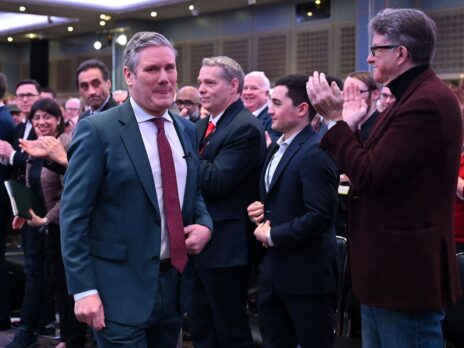
What should Britain do? Keir Starmer’s first instinct was the familiar one: avert his gaze and refuse to judge the legality of the bombing and abduction raid while paying lip service to the importance of international law – spoken in the tone of a man watching a burglary from across the street. Such evasiveness is not neutral. It is a posture of vassalage. Britain hosts extensive American basing and support infrastructure; our intelligence and foreign policy are deeply braided into Washington’s coercive power – so much so that our leaders behave as though condemnation itself were a breach of alliance discipline. When your closest ally bombs a capital and abducts a president, “waiting for the facts” is not prudence. It is complicity by delay.
There is a further danger: the precedent. If head-of-state immunity can be waived by an American press conference, then international order becomes whatever the strongest state can narrate at breakfast television. That is precisely the logic Karl Rove, George W Bush’s advisor, once articulated after Iraq: we create our own reality, and you will study it afterwards.
Caracas has witnessed this new reality. Trump is already threatening Mexico, Colombia and Cuba with the same. The Donroe Doctrine is not a one-off tantrum – and it’s much bigger than one man. It is a programme: a hemispheric protection racket, enforced in the language of “security” and “America First”, banked in barrels and balance sheets. Trump promised Big Oil a payday if it donated to his election campaign – and he has delivered a return for his investors.
Britain cannot stop the United States by issuing a perfectly worded statement. But it can, at a minimum, refuse to launder this crime with silence. The question is not whether we “shed tears” for Maduro, as Starmer put it, or our assessment of the gains and limits of the Bolivarian revolution. It is whether we accept that a capital can be bombed and a president kidnapped because American billionaires want its oil.
The United States is acting as a violent bully. If the British government cannot even say so, then we have already answered the deeper question – about our independence, our principles and our place in the world.
[Further reading: Vladimir Putin’s confidence game]
Content from our partners


Related
This article appears in the 07 Jan 2026 issue of the New Statesman, What Trump wants
Join the debate
Subscribe here to comment