
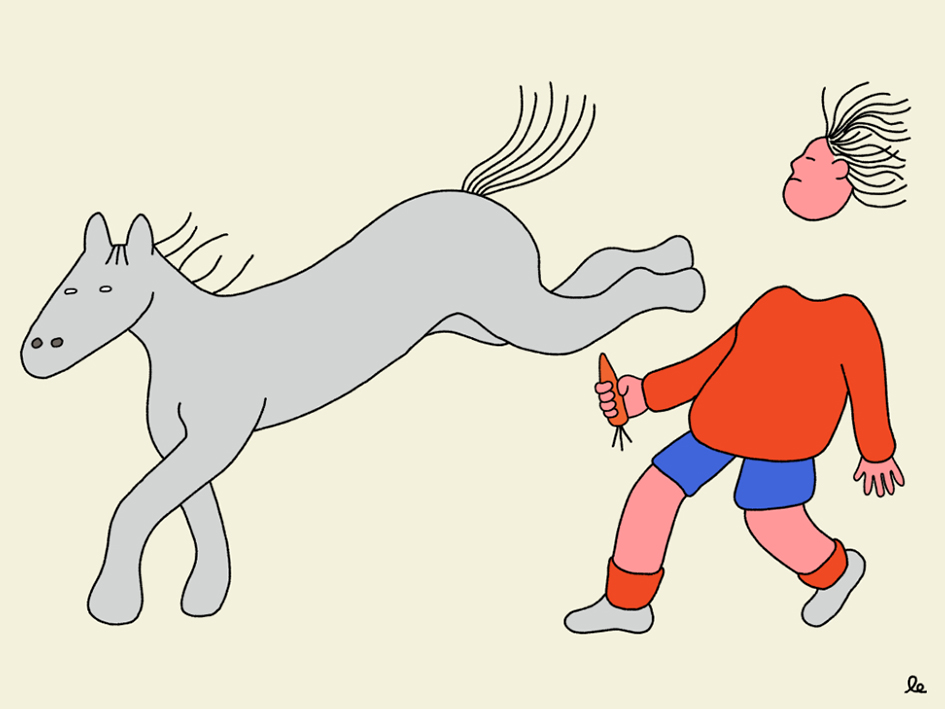
The buttocks of a horse are both its most amusing and terrifying feature. They are funny because they are enormous – no trouser ever built could contain such massive hams – but to be near them is to be in danger. Everyone knows you don’t stand behind a horse. It’ll kick your head clean off. A nervous farmer will have to tell the local news how he found your hoof-stamped noggin in a patch of cow parsley. These were the certainties that assailed me as my foot slipped and I skittered down the muddy hillside, steep as a church roof, towards the animal’s fearsome arse.
Decades earlier I had learned about mortality; it was a horse that taught me. I was a teenager on a beach trying to light a fire. And then that sound, the thunder of hooves, the ancient fear – it’s the nobility, coming to burn your hovel – and I looked up and the horse was ten feet away at full gallop. I dived left like a crap goalkeeper, the horse swerved in the same direction. A knee hit me in the chest, lifting me upward, then something (a fetlock?) caught me on the shoulder and I was thrown face down. A hoof thumped on the sand next to me, I rolled and ran pointlessly for a short distance. The whole thing took a few seconds but it was enough to relieve me of the cheerful indifference to danger I’d had as a child.
Anyway, that was a long time ago. I grew up and retained a healthy fear of horses, one that never needed to be questioned, until I heard about the Man vs Horse race. This is what happens when a middle-aged man is allowed a Wine Society account and full access to every episode of Expedition with Steve Backshall: he sits on the sofa and self-radicalises with ideas of adventure. He watches Backshall cheerfully sniffing a snow leopard’s urine on a Kyrgyz mountain and he thinks I could do that. Actually, I can’t even reliably pronounce Kyrgyzstan, let alone get there for a weekend. So I decided to join the race, to see if I could run faster than a horse.
I can’t, obviously. A horse, for those unfamiliar with the animal, is a half-tonne of muscled beast, evolved to gallop long distances across plains. It converts energy into movement more efficiently than a sports car. The first Man vs Horse race, held in 1980 in Llanwrtyd Wells, Wales, confirmed that a man is not faster than a horse, but there is no material in this world more durable than male overconfidence. Two per cent of British men think they could beat a grizzly bear or a lion in a fight, unarmed. And so each year the organisers made the 22-mile course gradually more and more horse-unfriendly until, 24 years later, the fastest human arrived slightly ahead of the fastest horse (and rider). The race is now in its 46th year, with the horses ahead by 40 victories to five, and about 700 runners competing against 70 horses (and their riders, but obviously the horses do all the work).

The key to designing a race in which a person has a chance of outrunning a horse is to make it extremely hilly. Horses can run up steep hills but they descend slowly, because it means putting a lot of weight on their weaker front legs. This means that during Man vs Horse the runners not only enjoy the terror of being overtaken – on thin, muddy tracks I cowered to one side as my equine pursuers thundered past – but also that having crested a hill, you can catch up to a descending horse, maybe get too close, and maybe get kicked in half.
I had woken early in order to get to the starting point in Llanwrtyd Wells, the smallest town in Britain, to eat a whole cake – it takes about 3,500 calories for a person my size to run Man vs Horse – and to begin catastrophising about the prospect of being trampled. In a field reserved for parking, runners and horses and riders gathered. The horse people, I noted, were wearing helmets. Of course they were! Horses are fucking dangerous!
I registered for the race, bought a coffee and a flapjack the size of a VHS tape, and sat on a bench to look at the very large, very steep hills that surround the little town. A man from the Builth and District Running Club arrived on the next bench and we had a nice chat; he too was nervous. “The waiting around is the worst bit,” he said, although it was later apparent that the worst bit would be when we were gasping our way up hillside while tonne after tonne of galloping horseflesh bore down upon us.
I tried to content myself that I’d trained around dangerous animals. Most of my runs had been around parks in south London, where unstable men gather to watch their unmuzzled XL Bullies defecate next to the playground; always by the playground, because these men derive a tickle of power from the fear their status animal inspires in young mothers and their tiny children. Can sharing a track with a few horses really be any more intimidating than that? Yes. As it turns out, yes.
To be honest, I hadn’t done my homework on the sheer level of horse proximity that would be involved. So I learned new facts about horses, including that they can, and do, defecate while running; on more than one occasion the terror of a steed thumping past me was made weird by the realisation that it was also shitting at me, clumps of digested hay flying out at face level. I also hadn’t realised what would be involved in the 4,224 feet of ascent the race involved, a climb almost equivalent to running up to the top of Ben Nevis from sea level. The first big hill – hilariously renamed “Cruella de Hill” by the organisers – reduced every runner to a stagger, the brutal gradient made more difficult by the ankle-deep mud.
A long run is an argument with the body: man vs hamstring; man vs lower back; man vs iliotibial band. The trick is not to try to ignore the parts that hurt but to try to listen and sympathise, savour the idea of quitting. For a mile or so I ran alongside a man who told me about the place he went to in his mind, a waterfall near his home in Kilkenny. His plan was to take the last plane back to Ireland that night and to lie in the waterfall’s pool for an hour the following morning. He did this last year, he told me, and the cold water removed all the inflammation from his muscles. “That sounds amazing,” I said. Actually it sounded freezing and uncomfortable and nothing like as nice as a country house hotel with a huge bath.
What is wrong with us, that we go in for this kind of masochism? Perhaps it is something in our cultural background, a relic of being ruled by people who were sent to weird public schools where they were made to traipse across the wilds, through waist-deep nettles with no pants on. Our officer class must be caned and brutalised on the rugby pitch. But then this isn’t just a British thing: there are now Man vs Horse races in the United States and New Zealand, marathons through jungles and deserts. We are all curious to know what we can stand.
As I came to the end of the race, a line of young boys yelled encouragement and held their hands out for high-fives. I whinnied with delight as we entered the final furlong. I had not been killed by a horse! I could have a bath! After 22.6 miles of running, there is nothing so delicious as cantering, at last, to a halt.
[Further reading: A modern Canterbury tale]
Content from our partners

Related
Join the debate
Subscribe here to comment