
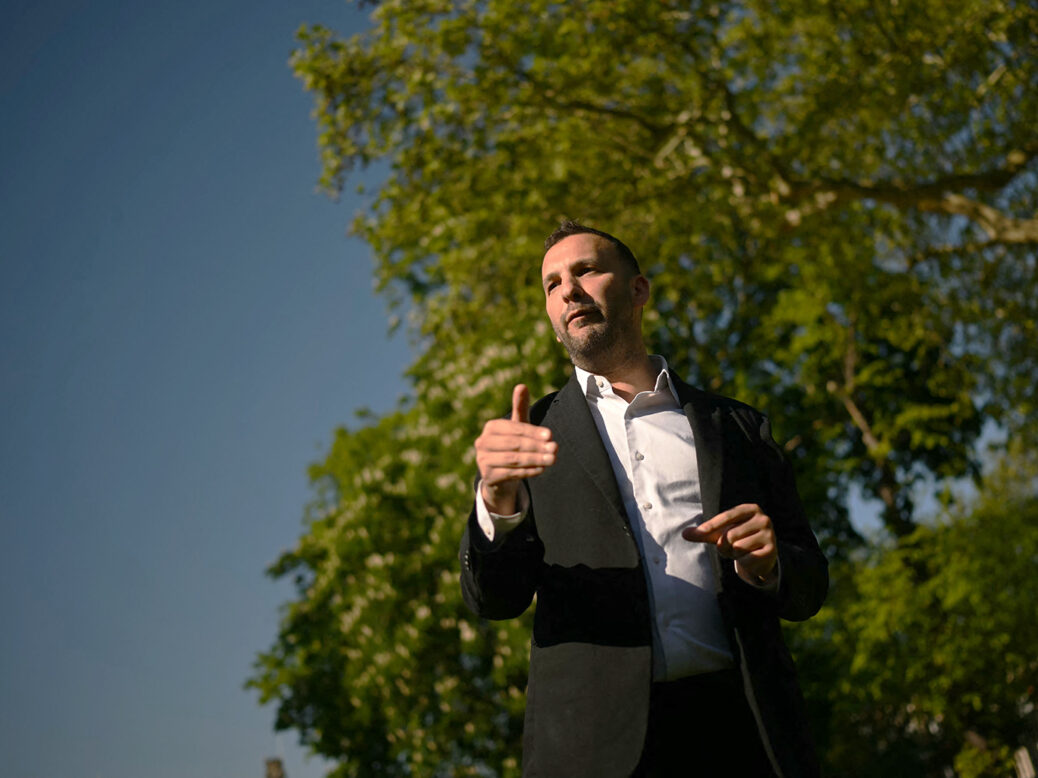
It was the most high-profile Labour-Green switch yet. In December 2025, Jamie Driscoll, the former mayor of North of Tyne went Green. Driscoll, 55, had been a Labour member since the early 1980s, joining with his brother in protest of the neoliberal policies of Margaret Thatcher. A career in local Labour politics followed.
By the late 2010s, Driscoll had risen up the ranks to become a high-profile Labour Party mayor, running the North of Tyne Combined Authority. But by 2023 Driscoll’s four decades in the Labour Party had come to an end. He was blocked from standing as a Labour candidate to be the mayor of the north-east after he appeared on a panel alongside the director, Ken Loach, who had previously been expelled from the party. So Driscoll left Labour.
This didn’t stop him from entering the mayoral race. In 2024, he set up his own left-wing splinter movement, Majority, and ran as an independent candidate – but lost. By 2025, he was involved with the initial efforts to organise Jeremy Corbyn and Zarah Sultana’s Your Party. But last December, that group descended into factionalism and Driscoll quit the project. Despite once being seen as a key ally of Corbyn, he had become disillusioned with his former colleague’s beleaguered new outfit. As a vacuum opened up on the left, Zack Polanski’s Greens grew to fill it. Driscoll saw a political future there. “I mean, Your Party is where it is,” he told me when we spoke shortly before he announced his decision. “There are some good people in Your Party, but exactly where we’ll be in a few years’ time, I don’t know.”
When I caught up with Driscoll on 23 April, on a bright morning in Newcastle, the Green Party was surging. Polanski and his deputies Mothin Ali and Rachel Millward had become national political figures. Gorton and Denton had fallen to the party in February – its first by-election win in 87 attempts.

But that momentum has shifted. The Greens are now in crisis: there are multiple accusations that Green candidates running for election in May’s local elections have been posting anti-Semitic content online. An attempt by Polanski to deflect the issue, when he told a journalist from the Israeli publication Haaretz on 21 April that there is “a conversation to be had” around whether British Jews’ fear is the “a perception of unsafety” or whether it’s “actual unsafety”, backfired – particularly after two Jewish men were stabbed in Golders Green in north London on 29 April in a terrorist attack. (The attacker, who appeared in court on 1 May, has been charged with three counts of attempted murder and one count of possession of a bladed article in a public place.)
The situation for the party got worse on 30 April. As reported by the Times, at a meeting of Greens for Palestine, a non-affiliated fringe group, the party’s deputy leader, Mothin Ali, said that Green candidates who had been suspended over accusations of anti-Semitism needed to seek “serious legal advice” and “put the party on notice straight away”. Ali declined the New Statesman’s request for comment, but a spokesperson for the Green Party has described his comments as “an appeal for people to stay in the party”.
Polanski was also publicly criticised by Mark Rowley, the commissioner of the Metropolitan Police, for resharing a post on X on 30 April that criticised officers for using force on the terrorist suspect in Golders Green. This prompted fellow senior Greens to distance themselves from Polanski. Anthony Slaughter, the Greens’ leader in Wales described Polanski’s re-tweet as “inappropriate”. On 1 May, Polanski apologised for “sharing a tweet in haste”. He added: “Everyone in leadership has a responsibility for lowering the temperature at a time of such tension.”
And on the afternoon of 30 April, two Green Party candidates in Lambeth were arrested over alleged anti-Semitic comments. The New Statesman understands that one of the candidates has now been suspended from the party. Speaking during the BBC’s Question Time on the same evening, the party’s deputy leader Rachel Millward described the alleged comments as “abhorrent”.
In Newcastle, Driscoll was cautious about whether the Greens could break through. Though the party is gaining in popularity, he told me they are not complacent. “I think it’s going to be: no overall control,” he told me when we met in a community-run cafe at the heart of Monument ward, where Driscoll is standing. He arrived dressed casually in jeans, a fleece and walking boots, carrying a red cycling helmet. He was accompanied by his former political adviser as mayor, Hugo Fearnley, who is also a Green candidate in these elections. I asked Fearnley whether this is his first time running: it isn’t. “I’ve lost many elections,” Fearnley said, grinning. He stood for election to parliament as a Labour candidate in 2019 in Scarborough and before that had tried for council seats, also in the north-east. “This could be the first time he wins,” chimed Driscoll. Some polling suggests this could well be the case. The latest MRP poll from JL Partners on the Newcastle City Council election placed the Greens out front with 30 per cent of the vote, ahead of Labour and Reform on 21 per cent and 19 per cent, respectively. Other polls suggest a tighter race.
A Green Party victory in Newcastle would be unprecedented. The city council has been largely Labour-run since 1974 (bar a seven-year stint of Liberal Democrat control). But Labour’s grip on power has begun to slip. In 2024, it lost its majority on the council after six Labour councillors – including the former leader Nick Kemp – resigned in protest of the Labour government. The group now sits as independents.
The Greens believe the damage this has done to Labour’s standing in the city will work to their advantage. The administration looks chaotic and divided, an unattractive quality for voters. “Labour have struggled since the mayoral election [in 2025],” Driscoll told me. “They’ve lost control of the council, loads of people have resigned… alongside that, residents are fed up with the cost of living and things not getting any better. The Greens have captured the progressive vote.”
The Newcastle Greens have faced their own crisis over anti-Semitism. So far, four candidates have been accused of posting such content online. On 17 April, one group of three candidates was accused by the local Labour Party of making “horrendous anti-Semitic” comments.
When I asked Nick Hartley, one of two sitting Green councillors in Newcastle, about the online content in question, he told me: “As soon as that material was shared, we shared it with the Green Party Council [GPC], who have a system in place to review such complaints. A decision will be taken soon. The only decision that’s come up on the doorstep that is to do with probity and the quality of candidates, is to do with Peter Mandelson because obviously that’s a massive issue all over the place.” The GPC is a 30-member committee formed last autumn that has responsibility over the culture and wellbeing of the party, its governance, party policy, political direction and political strategy. Polanski, Ali and Millward all sit on the council.
Shortly after my visit, however, another particularly egregious example of anti-Semitism from a Green candidate emerged. On Tuesday 28 April, Jewish News published a story about Tina Ion, a candidate in the Blakelaw and Cowgate ward of Newcastle. In a series of posts on social media, Ion is alleged to have called for the ethnic cleansing of Jewish people from Israel, described Zionists as “vermin”, and run an anti-Semitic spoof Anne Frank account on the social media platform Threads.
Ion denied that her comments were anti-Semitic. She said in a 900-word statement, sent to the New Statesman, that she has “consistently stated [her] solidarity with the Jewish people”, adding that her “concern has always been how the actions of the State of Israel not only devastate Palestinian existence but undermine Jewish identity itself”. Ion added: “I regret that lapse in vocabulary” in her online posts, not because she is afraid of a “mediatic pillory” (a media pile-on) but “because my choice of words gave the media an excuse to talk about me instead of the 14,000 dead children [in Gaza]”. Her statement does not refer to her links to the Anne Frank account.
A source within the Newcastle Green Party told me that several local members have reported Ion to the GPC. The source said that local Green members and candidates are “exasperated” by Ion’s comments, adding that the posts made by the Anne Frank account are “unconscionable”. They said there is a clear agreement among party members that “we need to deal with this”.
By this point, Ion’s comments had already caused a backlash. On 29 April, the Holocaust Educational Trust told Jewish News: “Comparing Jews to vermin and calling for their murder is straight from the Nazi playbook. Doing so under the persona of a Jewish teenager murdered by the Nazis is grotesque and a profound desecration of their memory. It is unthinkable that a national political party sees this individual as fit to be in any way associated with them, let alone as a candidate.”
A spokesperson for the Newcastle Greens said of all four incidents: “Newcastle Green Party will not allow anti-Semitism to go unchallenged in our party or anywhere else, including when it hides behind professed support for other oppressed peoples.” The local party is organising anti-Semitism training for members and plans to act on the GPC’s findings. A statement released on 1 May by the party’s four sitting councillors denounced Ion’s candidacy, adding that “robust action is needed”.
Comparisons have been drawn between the Green Party under Polanski’s leadership and the Labour Party under Jeremy Corbyn. When interviewed by the New Statesman on 23 April, Polanski said that despite criticising Corbyn at the time, he now thinks accusations of anti-Semitism were used against the former Labour leader.
He told the NS: “I was lost in the propaganda.” In response, Anna Turley, the chair of the Labour Party said Polanski’s “rewriting of history is beyond the pale. Not only is it downright offensive, but it is completely wrong.”
Driscoll was in the Labour Party when it was facing these allegations. As a Labour politician, he was seen as close to Corbyn. When I asked him about this directly when we met in his ward in Newcastle, he drew a comparison with his former party. “This is what didn’t happen in the Labour Party,” he said, “[these cases] are being investigated properly and with due process, following the rules of natural justice. That’s how it should be.”
How is the Green Party dealing with this nationally? More than 4,000 people are running as Green candidates on 7 May (the party currently has 946 councillors). Officials from the party’s management and communications teams are meeting daily to discuss ongoing cases. When asked how many individual complaints of anti-Semitism it had received against candidates, the party would not comment. A Green Party source told the New Statesman that there were a “handful of cases” and added “we’re looking into those and, indeed, starting to act on those”.
The Greens have an internal complaints process undertaken by GPC. They say any candidate found to be in breach of the party guidelines will be suspended. Suspended candidates are not allowed to campaign under the party banner, and the party will not support them.
After the process has concluded, suspended candidates are allowed to appeal. Following the appeals process, the suspended candidate must go through a rehabilitation and training process. Those that show no willingness to change, or those who have committed the most egregious breaches, will be expelled from the party.
A party source explained that owing to electoral law, once the deadline has closed for candidates, ballot papers go to print often within hours and then changes can’t be made. If an expelled Green Party candidate is subsequently elected, they will not be allowed to represent the party.
Polanski has been urged by his opponents to disown these candidates. Speaking in Newcastle on 27 April, he told the BBC that he condemned anti-Semitism and said he backed “99 per cent” of candidates. He said he would not comment on ongoing proceedings.
How much of an impact will this crisis have on the Greens chances in Newcastle? According to a local source familiar with the city’s political landscape, but not aligned to the Greens, dissatisfaction with Labour is still likely to be decisive. After more than 50 years of almost uninterrupted Labour rule, Newcastle residents seem ready for a change.
Even so, the local Labour Party still believes it can retain control. At the council’s civic centre, an imposing building to the north-west of the city centre, I met Adam Walker, a Labour cabinet member on the council. Walker is a softly spoken Geordie, who like the Education Secretary Bridget Phillipson, was an extra in the pre-teen soap opera, Byker Grove in his youth.
Despite the performance of his party in the polls, Walker seemed positive. But he didn’t shy away from what might be coming. “It’s actually been really positive against quite a difficult national backdrop,” Walker said. He echoed a sentiment put forward by other local Labour politicians, that this set of elections is not a “national election” or a chance to change the government. “It’s about who’s the best for you locally,” he said.
Walker accused both the Green Party and Reform – Labour’s two main rivals in Newcastle – of only focusing on national politics, rather than things that matter to local residents. “The policies they’re coming out with are crazy policies,” he said. “We’re the only party that’s actually trying to say this is where we’re at and be honest with voters.”
Still, the national picture is bleak. Nationally, Labour’s poll ratings are in decline: the latest YouGov poll from 27 April put the party on 18 per cent. Labour voters in Newcastle are furious with the government for the winter fuel payment, the appointment of Peter Mandelson and last year’s attempted welfare reforms.
“We’re not able to combat those negative messages,” he told me. Repeating a complaint I have regularly heard from Labour activists, campaigners and politicians on the ground, Walker called on the party to spend less time focusing on the negatives, and more time on what a Labour government has actually done well.
The race to take Newcastle City Council is a litmus test for a fragmenting political left. For Jamie Driscoll, it is a personal and political gamble – an attempt to prove that his brand of grassroots socialism, once rooted in the Labour movement, can survive his move to the insurgent Greens. The path to a Green victory is complex. Its anti-Semitism crisis – the unconscionable comments made by some of its candidates – has cast a shadow over the local party, with implications for the Greens nationally too. Polanski will likely face more questions about his party’s vetting and disciplinary processes and how it plans to ensure incidents like these do not happen again. Will he disown these candidates?
On 7 May, the city will not just be electing a council: it will be deciding whether the future of progressive politics in Newcastle belongs to the legacy of the old Labour guard, or the volatile promise of a Green future.
[Further reading: Is Ashab al-Yamin attacking British Jews?]
Content from our partners

Related
Join the debate
Subscribe here to comment