
I’ve heard it said that the two best days of your life are the day you buy a boat, and the day that you sell it. Owning a boat, in other words, is often more trouble than it’s worth.
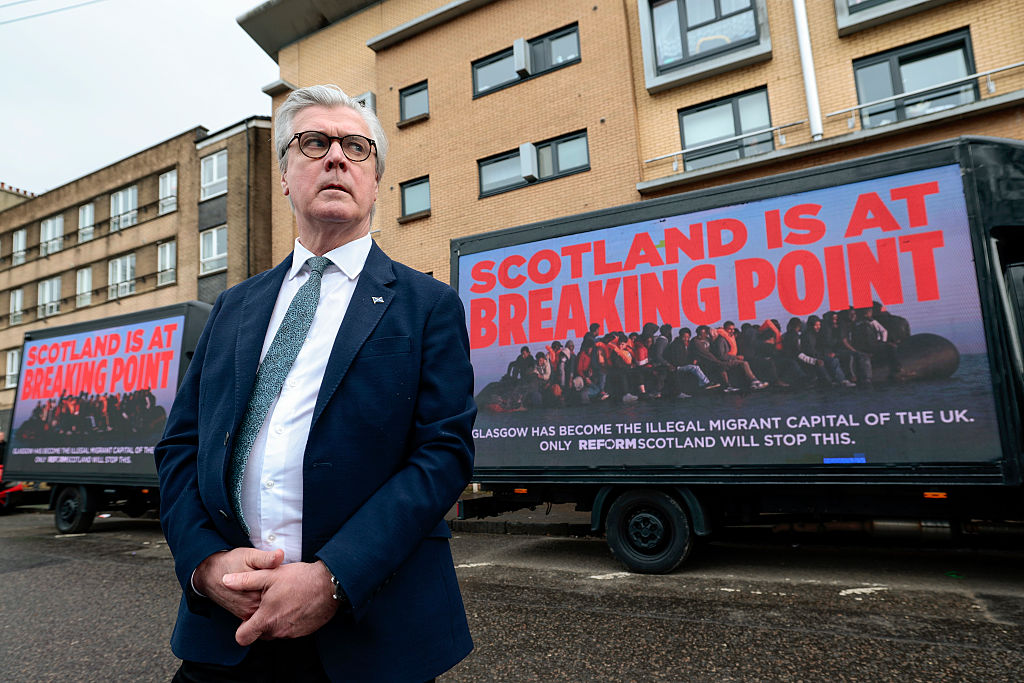
Malcolm Offord likes boats so much that he’s bought six of them – a revelation which, when Reform’s Scottish leader said it during a leader’s debate this week, caused a general intake of breath in the room and has since led to a degree of trouble for the man. Also, he said, I have six homes and five cars. Cue his opponents’ eyes lighting up in delight.
Offord, as the above illustrates, is a very wealthy man. He calculates that over his long career in private equity he has paid around £45 million in tax. Not quite at the level of JK Rowling or Paul McCartney, but quite a bit more than me or, I’d wager, you. All this, in a modern Scotland that is deeply suspicious of wealth, is being held against him. Offord, who was debating Ross Greer, co-leader of the Scottish Greens, asked, fairly enough, whether Scotland should have more or fewer people in his luxurious position. “Fewer,” was Greer’s predictable response.
Here I find myself, possibly dangerously, reaching for an old quote from Peter Mandelson: “We are intensely relaxed about people getting filthy rich as long as they pay their taxes.” I never saw much wrong with that sentiment, and still don’t – after all, the more taxes people pay, the better funded our public services are. It’s up to people to make money in whichever way they choose, and up to politicians to decide how much of it the state is entitled to.

There has been a great deal of discussion about Offord’s wealth during this Holyrood campaign. He has been asked to publish his tax records and has refused. He had, until this week, tried to avoid giving much detail about his financial worth. Perhaps this is because it is so much greater than that of most other Scots and he is running a party that claims to be standing up for ordinary people during a cost of living crisis – there might be a disconnect there. Perhaps, though, he knew what the response would be from the other parties, and didn’t want to open up that territory for them. Sure enough, John Swinney accused Offord of “boasting” about his wealth, which I don’t think he was doing. Swinney, as well as a number of his fellow leaders, declared that he owned one house, one car, and no boats. An easy – though perhaps cheap – win.
The point Offord was seeking to make, and has made a few times now, was that he had grown up in a tenement in Greenock, had experienced being skint as a student, had taken out an overdraft and headed to London in pursuit of his fortune, and succeeded. He is therefore free to enjoy the fruits of his labours in whatever way he sees fit. Ambition and success should not be viewed negatively. The fact that Offord is choosing to stand for Holyrood despite his wealth tells us something about his character.
All of us who have had successful careers at one level or another will have our version of “six boats”. I have far too many guitars, for example. I have indulged myself because guitars are my favourite thing and have – just about – been able to afford them at various times. I struggle to care that Offord wants lots of boats. I’m not sure what business it is of mine.
But as I say, Scotland has a problem with wealth. Its politicians certainly do. The past decade or so, in particular, has seen an SNP administration that has held its nose when dealing with business. The party has always revered public sector workers above those in the private sector, and which has viewed the phrase “wealth creation” as something to be sneered at, as something equivalent to “greed”. Scotland, and Scots, are more egalitarian than their neighbours in the south-east of England, we are told. We will happily pay higher taxes; we will embrace a larger, more interventionist state; we will spend more on welfare and benefits.
The policy has followed the politics. It has not been a success. Economic growth is minimal, while economic ambition has been limited. We have a problem encouraging business start-ups. High business rates are forcing companies to the wall. The tax base is too small. We don’t have very many ultra-wealthy people, the kind who will pay £45 million in taxes over the course of their careers. I disagree with Ross Greer: we need more Malcolm Offords. And we need more MSPs who understand business and who are economically literate rather than pursuing crackpot university politics.
I hold no candle for Reform or Offord, but as the former SNP MP Joanna Cherry said recently, the election of a tranche of MSPs from the insurgent party “may give Holyrood a much-needed kick up the backside”. This is a sentiment I hear regularly from people who would never vote Reform, but who have grown weary of the Scottish Parliament’s and the Scottish Government’s complacency, and their failure to turn the dial on the many challenges facing our nation. In short, let a gaggle of toerags in and hope they cause enough trouble on the economic front to change the terms of debate. This view is why it is entirely possible that Reform could come second when Scotland goes to the polls next Thursday, and Offord, with all his boats, is launched as leader of the official opposition.
[Further reading: The Scottish election is becoming a farce]
Content from our partners

Related


Join the debate
Subscribe here to comment