
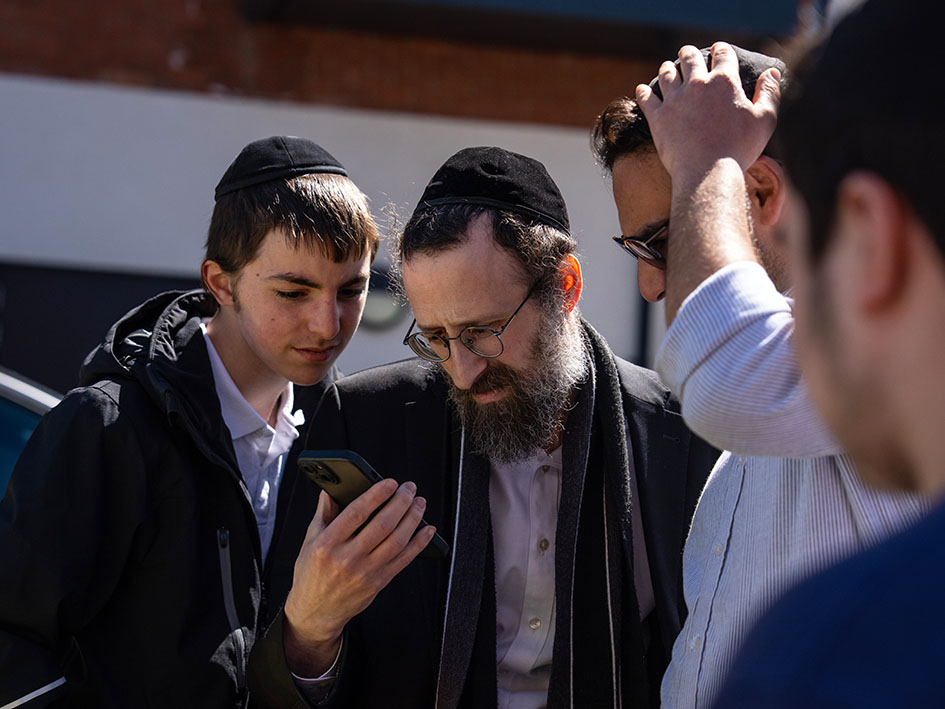
Golders Green is where the original Jews of London’s East End discovered suburbia. Handsome semis, kosher bakeries, kids huffing up hilly streets on scooters, space to park the family estate. The British dream.
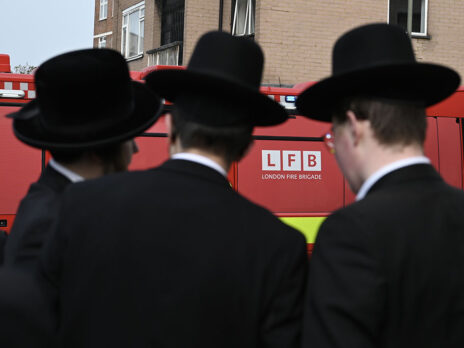
Now, it is in a constant state of emergency. All the arms of the state that are supposed to wrap around citizens are doubled up here – in the Shomrim volunteer officers with their hi-vis jackets and quasi-police badges, the local volunteer Hatzola ambulances – four of which were set alight by arsonists a month ago – and the security services provided by the charity Community Security Trust.
I was shown inside the entrance of one popular local Jewish primary school, with its complex system of code-pads and gates, CCTV and four guards on duty. The kids shrieked and laughed, tearing around the playground, not far from a sentry post occupied by a man all in black, with barrel arms and lines shaved through his eyebrows, who was watching on.
Synagogues, too, are gated and guarded, with private security vehicles parked outside heavy black railings. As recently as ten years ago, there were no guards. Parent volunteers would take it in turns to keep an eye on the school gates, I’m told, and there was just an ordinary fence around the vicinity of Golders Green shul, like any parish church. But times have changed. A plain-clothed man on the corner, with a walkie-talkie and baseball cap pulled low, watched as I walked up the road away from the school.

This suburban fortress – home to Britain’s biggest Jewish population – has yet again been breached. A man tore through its streets in the bright sunshine of a Wednesday afternoon and stabbed two Jewish men. He tried to stab the police officers and Shomrim guards who were first on the scene, too. “He’s got a knife in his hand and is waving it; he was saying things but I couldn’t hear what,” said a Shomrim volunteer who came face to face with the suspect. The Met has declared the attack a terrorist incident.
When I reached the scene of one of the stabbings, on the cordoned-off stretch of high road lined with cosily-named shops like Kosher Kingdom and Good for You and Posh Wash, there was a crowd. Boys in their school uniforms and kippahs ran up a stairwell to the walkway along the flats above the shops to look out at the scene. Chief Rabbi Ephraim Mirvis was surrounded by cameras. The Tory leader Kemi Badenoch arrived and did a sort of ceremonial walk back and forth across the crime scene flanked by Shomrim guards.
The atmosphere was almost that of an audience waiting for the main act, but in anger more than anticipation. Keir Starmer has said he’ll go as soon as he can. The Met commissioner Mark Rowley was heckled – “resign!” – after giving his statement. He blamed hostile states, foreign organisations, the extreme left and extreme right, and warned: “Legitimate debate about international affairs should never be allowed to legitimise anti-Semitism or violence… when that line is blurred, attacks become more likely.”
Sarah Sackman, the Labour MP and justice minister, was met with a chant of “shame on you” from a few as she told the gathered residents that an “attack on Britain’s Jews is an attack on Britain itself”, and that the Prime Minister would be holding a Cobra meeting. “Look, I’m made of tough stuff,” she told me afterwards. “I think in these moments, you have to face the music and deliver the messages that are important and principled, but also a politics that is unifying and constructive.” She said she had also received messages of “brilliant solidarity” from the Jewish community and beyond.
After the attack, she was “straight in a room” with the Home Secretary, Shabana Mahmood, and told her “what I thought the community needed in terms of policing, in terms of reassurance from the top of government”. Is the government giving enough of that reassurance? “[Mahmood] gets it, the Prime Minister gets it, the government gets it,” she said. “The anger and frustration is understandable, but I think the majority of community leaders understand that the government and the police has the community’s back.”
Reflecting on the “intensification” of both physical threats and an “atmosphere and environment in which hate can fester”, Sackman mentioned Iran-linked groups paying young men “small amounts of money to go and cause trouble and panic in the Jewish community”, as well as anti-Semitism that “has its roots in homegrown Islamist extremism, as well as on the far right and far left”.
“Something has changed,” said Ari, 27, who has lived in the area his whole life, gazing out at the empty road cordoned off with police tape. “This was a quiet neighbourhood, I never heard of any terrorist attacks or murders when I was growing up here as a kid. Sadiq Khan says this is the safest city in the world. Well, where’s the safety for us?”
Time and again, residents told me they felt more frightened to be visibly Jewish in London than at any point in their lifetimes. They spoke of the Golders Green attacks, the murders at the Manchester synagogue last October, the attempted bottle bombing of nearby synagogues in recent weeks. And, in every conversation, of pro-Palestinian protests, too – often described to me as “hate marches”.
“When you hear someone calling for ‘globalising the Intifada’, that literally means stabbing people in the street,” said Rabbi Sam Fromson of Golders Green synagogue, a tall man with a sturdy beard, embroidered sky-blue kippah, and sports jacket zipped up tight over his suit. “You firebomb my synagogue, that’s globalising the Intifada. You stab people on the streets of London, that’s globalising the Intifada. It’s not just a slogan.”
We sat in the stained-glass glow of the synagogue, under Israeli flag bunting left over from independence day celebrations last week. For Fromson, anti-Semitism has become “more mainstream” over the past ten years. Online radicalisation is part of this, he believes, and he also blames “political rhetoric becoming more extreme”.
“I’m not a political commentator, but there was clear expression of a commitment to change by the Labour Party, post-Corbyn, and I feel very let down,” he said. “Anti-Zionism is just a new permutation of this ancient hatred. It’s the job of any decent, civilised society to call out clearly and stand against and I don’t hear politicians doing that.”
With two weeks to go until England, Scotland and Wales go to the polls for local elections, Jewish identity is somehow on the agenda along with potholes and bin collections.
There’s the independent candidate, formerly jailed for terrorism, running for a seat in Birmingham who casually told the New Statesman: “This is becoming a Jewish state, not a Muslim state. But why isn’t that spoken about? You know why. Because who controls the media? They do.”
Then there’s the Reform council candidate who called Nazis “real visionaries” and the other who accused “the Jews” of “creating division by forcing other races on our societies”. And the Green council candidates who have called the government “over-represented with Zionist Jews”, suggested Israel was responsible for the Bondi beach shooting in Australia, characterised the 7 October attacks as “Palestinians inevitably trying to defend themselves”, and run a spoof “Anne Frank” account that posts about killing Zionists.
“Zack Polanski should be ashamed of himself,” Fromson said of the Green Party leader, who is Jewish and recently told the New Statesman that accusations of anti-Semitism against his party don’t “pass the smell test”.
“They should be worrying about local services and bins being delivered,” he said. “The fact that it’s even possible for somebody to win on a foreign policy issue that has no bearing on their local constituency… is really undermining of the beautiful democracy of the United Kingdom.”
Instead, the rabbi is feeling “less connected than ever” to the British Jewish identity he was once so proud of. His WhatsApp groups are full of messages from “not even super hardcore affiliated Jews” saying they are more and more likely to leave Britain for Israel.
I hear this from Ben Haffner, who teaches the Talmud to boys at Menorah Grammar School, and is standing with some pupils around the corner from the police cordon. “We’re British, we’ve been British for a long time, but the result of all this will be to pack off to Israel,” he said, as his pupils nodded around him. One added: “We will have to go eventually; this is not British any more.”
One non-practising Jew who works for a shipping company in north-west London, including in Golders Green, told me most of his work in the past year has been moving Jewish people from London to Israel – even those with no family there.
“They would rather be in a war zone. They don’t feel protected by the police, and feel pro-Gaza feeling takes precedence, and that the demonstrations are thinly veiled anti-Jewish marches in many cases,” he said. He is struck by the number of moving boxes he sees that are marked “Safe Room”.
“While I may not agree with everything the Israeli government is doing, I do believe in the existence of Israel as a homeland. People will jump on any cause to justify anti-Semitism – it’s been around forever.”
More British Jews have moved to Israel in the past year than they have done in any year since the turn of the century. And reports of anti-Semitism have hit record highs.
Concern about Muslim immigration came up in a few conversations I had through the day, but mainly amid speculation over Iran’s role (an Iranian-linked terror group claimed responsibility for this as it has for other attacks, though the evidence isn’t yet clear).
“Islamophobia is an issue, of course, but we should talk about anti-Semitism as something specific,” said the Talmud teacher. “We are targeted more than any minority.” (Jews are much more likely, per head, to be victims of religiously motivated hate crime, according to Home Office data released last year).
As the afternoon seeped into evening, protests prickled through the streets, with chants of “Keir Starmer, Jew harmer”. Reform’s deputy leader, Richard Tice, turned up. Two young men chatting about politicians were cynical, recalling reports of anti-Semitic things Nigel Farage is accused of having said as a schoolboy. “He doesn’t really like Jews, you know, he sounds quite anti-Semitic,” said one of the men, as the other nodded. “After the Muslims, we’ll be next.”
The British Jews of Golders Green – whose grandparents sought sanctuary in Britain from the Nazis, whose parents sought sanctuary in suburbia further up the Northern Line – no longer seem to find sanctuary in mainstream British political life.
On the Tube to Golders Green after the news of the attack broke, I had sat opposite an irritable-looking middle-aged man wearing a black kippah. He was refreshing his phone and reading updates and sighing. Footage of the stabbings flashed up on news sites. He didn’t look frightened, or angry. I wish I could write that he looked defiant. But he didn’t. He just looked like a man travelling home from work. For so many of his neighbours now, the question is where “home” really is.
[Further reading: We are under attack]
Content from our partners

Related
Join the debate
Subscribe here to comment