
It is ten years since Britain voted to leave the EU. As the national organiser for the left-wing anti-Brexit alliance Another Europe is Possible, I spent the final weeks of the referendum campaign on the stump. In an increasingly desperate attempt to goad progressives into action as the polls narrowed, I closed most meetings with a vignette, asking the crowd to imagine prime minister Boris heading to greet Airforce One and President Donald Trump stepping off. Generally speaking, they hissed at Johnson, and simply laughed at the prospect of a Trump presidency.
It all came true. Free movement has ended, the rivers overflow with sewage, and the authoritarian right so dominates our politics that it can rely on erstwhile social democrats to implement its agenda. One of Starmer’s first foreign visits as prime minister was to Italy, where he praised far-right Giorgia Meloni’s “remarkable progress” in tackling illegal immigration. Protesters are sentenced as terrorists for holding up signs opposing a genocide. Racist riots are a semi-regular fixture of our summers. The right’s next big target is the European Convention on Human Rights.
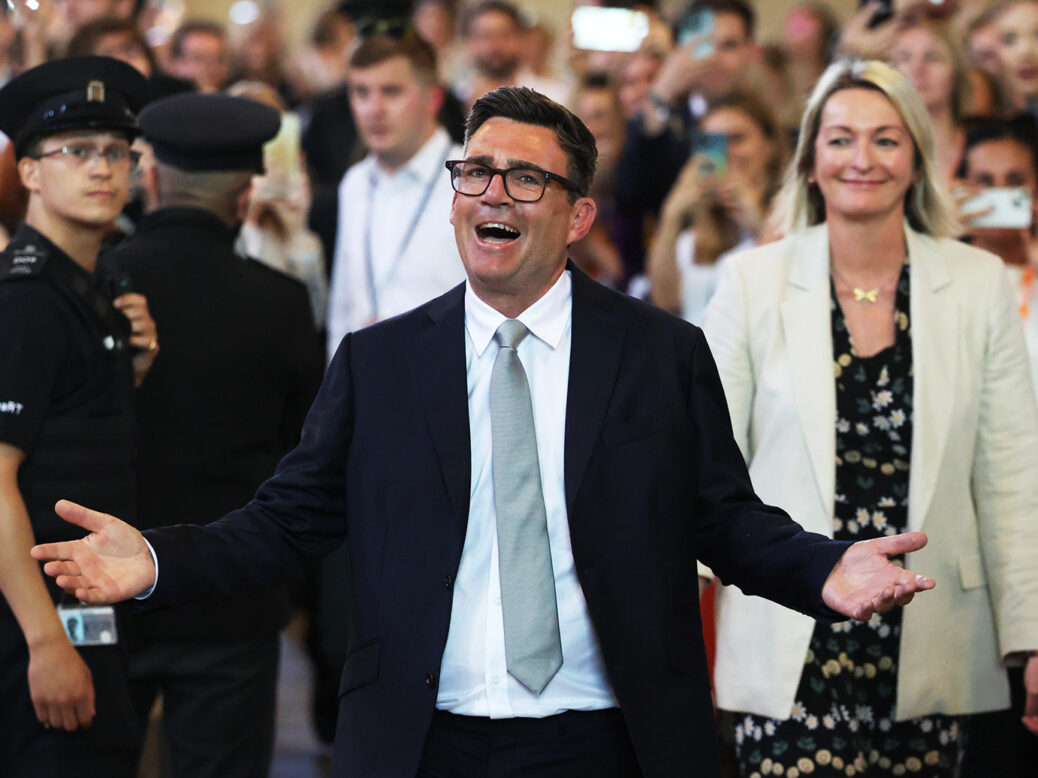
As if to come full circle, Andy Burnham, defeated in the 2015 Labour leadership contest, is now on his way to Downing Street. His popularity among Labour members and decisive win in Makerfield owes much to a perception that he has an answer to the Brexit project and the onward march of the new far right. Broadly speaking, it involves symbolically re-centring the North in British political life, and breaking with an economic orthodoxy that is still, somehow, clinging on at Westminster. “The four horsemen of Britain’s apocalypse,” he wrote in January, “are deindustrialisation, privatisation, austerity and Brexit.”
Burnham’s Manchesterism provides a practical rebuttal to the Starmer’s attempts to win back the “red wall”. The current government has shifted right on social issues while doing little to deliver for people’s material needs, its workers’ rights legislation and Great British Energy sandwiched between hawkish fiscal rules and an unwillingness to challenge private ownership over the natural monopolies. In contrast, Burnham’s record as Mayor – symbolised most clearly by the Bee Network of publicly owned buses – represents a kind of steady, imperfect progress that might just about capture the public mood.

But if Burnham claims he can exorcise Britain’s Brexit demons, he only has half the tools. On economic policy and public ownership, he has consciously positioned himself as an antidote to the status quo. On immigration, he is much hazier. Strikingly, he has publicly backed Shabana Mahmood’s plans to scrap permanent refugee status, a move which goes further than any Tory government. Reportedly, he plans to keep Mahmood as Home Secretary.
For the nationalist right, the demand for border controls is not just a vote-winning slogan. It is the essential narrative. In an era of falling living standards, housing crisis, and crumbling public services, it gives a clear answer on who is to blame. As the climate changes and people are forced to move (between 250 million and 1.2 billion people could be climate refugees by the middle of the century) it will provide an inexhaustible pretext for escalating inhumanity, racism and violence.
In the immediate aftermath of the 2016 referendum, Burnham went out of his way to promote the case for tougher border controls, arguing in a Guardian article that the referendum was “above all… a majority vote for an end to the current system of free movement”. The previous week, he had told the House of Commons that was “no longer prepared to be complicit” in Labour’s failure to confront the question of immigration, which “is undermining the cohesion of our communities and the safety of our streets”.
Burnham’s case against free movement in 2016 was mostly couched in a claim to know the will of the electorate, though he also made the case that immigration had driven down wages. At the time he was writing, UK median earnings had shrunk by 10.4 per cent since the financial crash, the second worst drop in the developed world. Burnham nodded to Bank of England research which showed that for every ten percentage point increase in the proportion of migrants in a given occupation, wages dropped by 0.3 per cent – a drop in the ocean of the overall wage depression.
Ten years later, the jury is in on this strategy. Abolishing free movement from the EU did not make the streets any safer, or reduce the salience of immigration as an issue. Shockingly, having a debate about migration on terms dictated by the people who went on to set up Reform did not stop the rise of Reform.
In succumbing to a narrative of migration suppressing wages and straining housing stock and public services, progressives rob themselves of the ability to point the finger at billionaires, slum landlords, and the political elite. This was less of a problem for Keir Starmer, who is uninterested in any kind of anti-establishment pitch, but for Burnham it is a deep contradiction and opens the door to a more generalised rightward drift.
Since free movement ended, net migration has rocketed. Migrants’ rights are not about whether or not people enter the UK, but about the rights they have when they get here. Placing people at the mercy of the Home Office or their visa sponsors simply makes them more precarious and exploitable – and less likely to stand up for themselves, their wages and their rights. Reform’s backing for economic deregulation and its demand for ever harsher border controls are two halves of a coherent whole.
Britain’s malaise is the product of a neoliberal economic experiment that began in the 1980s, curdled into austerity in the 2010s, and is now mutating again. Improvement will come when the state invests, wages rise and workers organise. Deportations don’t build houses, staff NHS wards, or enrich our culture and society. Migrants do.
Andy Burnham surely knows all of this, and he sometimes says it. Unlike Starmer – a composite politician with no discernible core, a prime minister seemingly held prisoner by whoever is his most right-wing adviser at any given moment – Burnham has the ability to think and communicate in a straight line. But innate to Labour, and especially to the soft left where he has pitched his tent, is a politics of mushy triangulation and deference to common sense. Hemmed in by a Parliamentary Labour Party that has spent two years cheering on authoritarian and anti-migrant policies, he will be tempted to take the path of least resistance.
Labour’s problem with immigration is not its unwillingness to talk about the issue, but its inability to root its response in reality and the values of social solidarity it claims to stand for. There are many outside the party, myself included, who view the prospect of a Burnham government with relief, and who are open to some sort of alliance to defeat Reform. That will be untenable for as long as Labour remains committed to implementing an immigration policy that strengthens the far right, brings misery to vulnerable people, and undermines the left’s narratives and class politics. Ten years on from the referendum, the Labour leadership in waiting must decide whether it wants to finally move on from the Brexit moment, or be doomed to repeat it.
[Further reading: The Prime Minister is resigning – so shut up]
Content from our partners



Related


Join the debate
Subscribe here to comment