
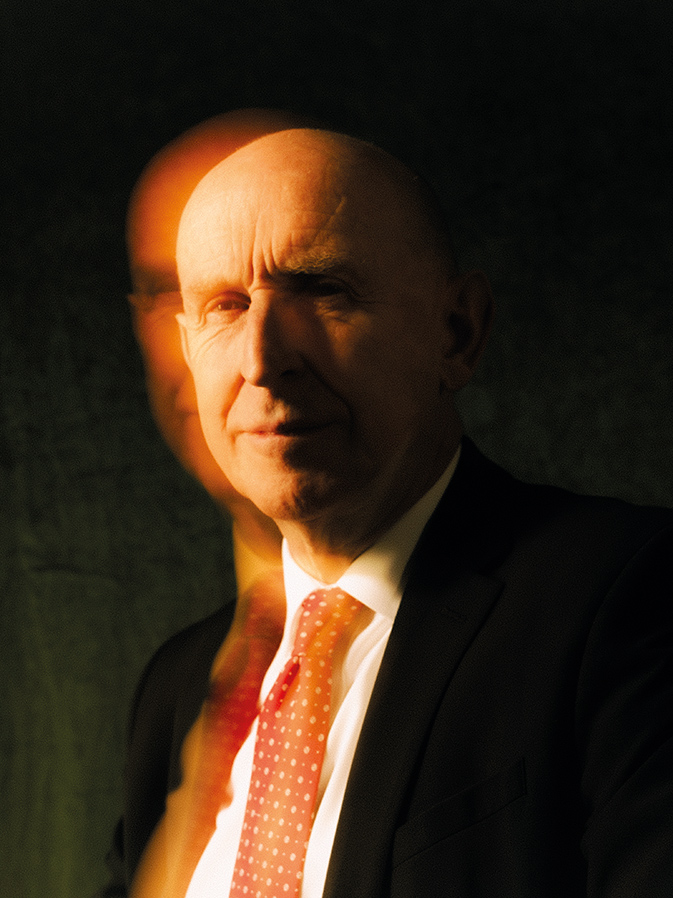
John Healey has been averaging fewer than five hours of sleep a night since the war in Iran began. He wakes in the middle of the night to take calls. And he rose at 3am on Monday 2 March, shortly after the drone strike on RAF Akrotiri, to give the go-ahead for family members and non-essential personnel to be moved away from the British military base in Cyprus into hotels in another part of the island.
“These are the most dangerous and uncertain times we’ve faced for decades,” he says, speaking in a snatched, nine-minute conversation over the phone after updating the House of Commons on the situation with Iran. “Not since the end of the Second World War have we seen such heightened threats.”
With war on two fronts – in Ukraine and the Gulf – Healey’s time is precious. His days are long, split between sensitive operational briefings, Cobra meetings and phone calls with counterparts from around the globe.
In our quick conversation there wasn’t time to ask about the future of Britain’s military bases in Cyprus, the deteriorating special relationship with the US or leaks from the National Security Council. Instead, with full awareness that the situation in the Middle East will likely have changed again by the time this goes to press, I ask him to tell our readers his thinking around whether Britain should let itself be dragged into another war in the Middle East, and how he is navigating these decisions, along with Keir Starmer, Yvette Cooper and senior advisers.

“There’ll be no repeat of the Iraq mistakes,” he says, forcefully. “And that’s really why I went out of my way to set out the principles on which our current decisions in the Middle East are founded.” He says British action must be “defensive”, coordinated with allies and with a sound legal basis. “It allows ministers sound choices, but above all, for me as Defence Secretary – you’ve heard Keir Starmer say this – it allows our military to operate with the fullest confidence that what they do is legal and what they do is in the best British interests.”
And with that, he is whisked away.
I began profiling John Healey, the 66-year-old Defence Secretary, before the war in Iran broke out. We had three interviews: one to a soundtrack of artillery fire several hundred miles inside the Arctic Circle; another in his Rotherham constituency; a third back in Westminster. Around those sit-downs, I accompanied him as he met troops, homeless veterans and international counterparts, taking briefings between stops before returning to his constituency for emotional exchanges with those struggling with the basics of life. All to build up a deeper understanding of the man who not only holds the crucial British defence brief at a time of high geopolitical instability, but who is increasingly talked of inside Westminster as a possible contender for the Labour leadership – and the British premiership – if a vacancy soon arises.
Healey has never done a profile before. In our first conversation, I tell him I would like him to tell me a bit more about himself. “I don’t really like to do that,” he responds with a smile-grimace. “I’ve always been someone who just feels I want what I do to speak for itself.”
But what is he doing, I wonder. “Is he running?” is the question his colleagues ask when they hear I am writing a profile of him. Read on, and you can make up your own mind.
My introduction to Healey’s world begins at a rainy, desolate RAF base on the outskirts of London, the cloud and rain so heavy it feels like the beginning of a Cold War film. This one is the world of defence, into which, I remind myself, he is an incomer – a “civvy”, who took on the defence brief at Starmer’s invitation in 2020, although he hides his outsider status well.
The plane – small, private with cream leather chairs – is yet further introduction into this world of power and order. His entourage aren’t merely aides and civil servants, but military personnel with firm handshakes and complex titles. In the bar later, they tell stories of taking out the operational head of the Taliban in Afghanistan, of running through the Afghan countryside under the cover of darkness while bullets landed around them.
Healey arrives, in his classic red tie and suit, and gives everyone a warm handshake. “Have you got a hat?!” he asks the photographer, a fellow bald man, and they laugh with mutual recognition; they wouldn’t want to be without one where we are going in Norway’s “high north”, where it is -20C.
When we land in Bardufoss, Norway, the plane door is frozen over. We drive through the snowy countryside in the dark until we reach Camp Viking. This is Britain’s base in the Arctic Circle, where troops are stationed, training in the extreme cold weather. We head to the bar with the biggest Union Flag I have ever seen on one wall, a darts board on another. Newsnight is on the TV. The room smells slightly of sweat and testosterone. A numbered list of “bar rules” are written out on a whiteboard: “Do not disrespect the Q. Don’t be a dick. No apropriate [sic] touching policy.” The “in” on “inappropriate” has been rubbed out.
We spent the night in the clean, slightly austere dorms, each filled with three bunk beds – only Healey gets his own room – before taking a military helicopter, a Chinook, even higher into the Arctic Circle, surrounded by dramatic scenes of snowy, remote mountains.
Healey seems at ease with the troops waiting for him, asking how long they have been here and where they were stationed before. “I bet six months ago when you were in Oman you didn’t think you’d find yourself here, in -200C in the Arctic,” he tells one of them. “What you’re doing couldn’t be more important,” Healey goes on. “It has a wider significance. The more we can combine, the more we worry the Russians.” The Norwegian defence minister, Tore O Sandvik, who travelled up with us, chips in: “We’re doing all of this to avoid war. War is expensive.” Gunfire reverberates around the mountains.
Healey is Defence Secretary at a crucial but difficult time. He has inherited British armed forces that are, by popular consent, “hollowed out” after a decade and a half of underinvestment. War might be expensive, but so too is preparing for it.
In Ukraine, Britain has committed to putting troops on the ground as part of a proposed peace deal. The UK is doubling its deployment of troops in the Arctic, too, where we were, in northernmost Norway. This is “the new front line with Russia”, Healey says, because this is where Moscow is focusing its most capable forces, including its nuclear presence. Climate change means that the region is of growing geostrategic importance, because new sea routes are opening up, and powers including Russia and China are eyeing its oil and critical mineral supplies.
While Healey insists Britain is not at war with Russia, he says we are under attack from Russian forces. To date, there have been around 90,000 attacks on British defence cyber systems, Healey says, “and a good proportion of those can be tracked or linked to Russia”. There has been an increase in Russian vessels protruding into UK waters, while European allies are seeing “increased threats to their critical national infrastructure in the Baltic”. Russian incursions into Nato airspace have doubled in frequency.
Donald Trump’s threats to invade Greenland, and wider criticisms of Nato allies, have added to the pressure. Healey says a key “part of being able to talk Trump down” over Greenland was the recognition that European members of Nato needed to step up security in the region. European nations “must do more of the heavy lifting within Nato”, he has long argued, and Britain intends to play a “leading role” in that. Defence sources say Britain “can’t afford to take its eye off the High North”, even as the crisis in the Middle East diverts attention from the region.
In this context, Healey was locked in a battle with the Treasury for more money for the military long before the Middle East crisis broke out. Rachel Reeves agreed an uplift in last year’s Spending Review, but much of that has already been eaten up by inflation and spending on the nuclear deterrent, leaving a reported shortfall of billions in the funds for the next four years. The Middle East conflict has only amplified those voices saying the British armed forces are weak and exposed, particularly after the drone attack on Akrotiri, and the delay in sending a destroyer to the region caused in part by the limited availability of warships after over a decade of underinvestment.
Reeves’s statement on Iran, that she “will always do what it takes to keep our country safe”, was perhaps a hint that he is winning the argument. Whether he can win the argument in the country, and within his own party, is another matter. The economy is stagnant, welfare spending is eating a growing chunk of the public finances, and inflation as a result of the crisis in the Middle East will only make the constraints tighter. Recent polling by YouGov found that only 25 per cent of voters would support tax rises to fund higher military spending, and just 24 per cent would support spending cuts in other public services.
Healey was born in Wakefield in 1960. His mother was an occupational therapist at Pinderfields Hospital and his father a prison officer at HMP Wakefield. They were “lower-middle-class public service workers, really”, who gave Healey and his two siblings a comfortable, unfussy childhood – no overseas holidays, but happy memories of piling into a van to drive to the seaside during school breaks.
He was taken to church growing up, but he didn’t inherit his parents’ Anglican faith. Nor did he take on their politics: in “true blue North Yorkshire”, where he spent most of his school days, Healey notes they were unlikely to be Labour voters, but they never talked about politics. Instead, he “took on their morality”: a deep sense of social justice and public service. He tells me about his younger sister, who had Down’s syndrome and died before she was six months old, having suffered from a serious heart defect. His mum then set up a playgroup for children with the condition. “This was the 1960s, so it was really unusual.” Healey credits this kind of “commitment to other people, to non-religious, pastoral involvement with others”, as the basis of his politics, which he hopes defines who he is as a politician.
He attended his local comprehensive, Lady Lumley’s school in Pickering, and then he moved to private school for sixth form. St Peter’s, York, “was just a revelation”. “I still kept my mates back in Moulton and Pickering and used to go out on the weekends with them, but this opened up a world that I’d never seen or believed in before.” He tried acting and rugby for the first time, and soon found himself starring in plays and captaining some of the sports teams.
“Completely remarkably” he then got a scholarship to go to Cambridge, where he seemed to spend more time on sports than studying, running the rugby club, playing lacrosse and rowing. It was at university that he also got involved running Nightline, the student equivalent of the Samaritans. He was “not remotely” involved in student politics.
Healey’s first encounter with the real-world impacts of politics came during one of his earliest jobs, as a nursing assistant in a “loony bin”, as it was commonly referred to then – a big psychiatric hospital. It was a place where, very often, the people he worked with “had been locked up because they just didn’t fit”, sometimes for their whole lives.
“I can picture them now,” he says of the people he worked with. Beryl, in her late fifties, who had been there since having an illegitimate child when she was 15. “We’d recognise her now as someone with learning difficulties.” Victor, “who was bloated with heavy-duty chemicals he’d been given for 30 years”, who Healey says “we’d recognise now as someone who had autism”. It was the 1980s, the era of Margaret Thatcher’s “Care in the Community”, except “in practice, there was no care” nor, he says, “any community waiting for them”.
Healey used to help these “deeply damaged, institutionalised people” shop, cook and do the “ordinary things in life”. Soon, though, he felt he had a choice to make. “Did I pursue that sort of track: a pastoral role, teaching, social work, mental health work, that sort of day-to-day involvement in helping people, supporting people, just making a difference to their individual lives? Or did I become a campaigner and try to change the system?” He chose the latter. First he led the campaign for the 1986 Disabled Persons Act to get through parliament under Thatcher, establishing in law a right for people who were leaving long-stay psychiatric care to have an assessment of their needs before they were discharged. Then, in 1990, while he was still a campaigner in the trade union movement, the Labour Party needed a candidate in Ryedale, in Conservative North Yorkshire, where he had grown up. There was no chance of him winning, but he had found his path. He was elected in the Tony Blair landslide of 1997. He emphasises that even now, what he does is guided by a sense that “I was a trade unionist before I was Labour. And I was a campaigner before I was a politician.”
We meet again in his constituency office, located on the high street of Wath-upon-Dearne, a small town in Rotherham in South Yorkshire. “It’s great that you’re here,” he beams when I arrive. “It doesn’t happen very often” that journalists visit him in his home of 30 years, where he feels more himself. He shows me around the impeccably tidy office and we chat with his staff, which is how I discover that Healey carries a bottle of HP Sauce with him everywhere. He brought it to the Arctic, then to Brussels, then to Munich, producing the well travelled bottle at dinner at the security conference, to douse his steak with on the night of his birthday.
Healey and his wife, Jackie, made this their permanent home over 30 years ago, when he was first selected as the area’s Labour candidate. “We wouldn’t have had it any other way,” he says. “I think I’m a better Member of Parliament for the fact I go to the same doctors, I drink in the same pubs, I go to Morrisons and get nobbled in the cereal aisle every time I go, and Jackie takes the trolley off me and goes and finishes off the list.”
I have never met a politician who refers as frequently or as fondly to their spouse as he does to Jackie. She comes up in conversation often: “Jackie and I–”, “If Jackie was here she would say–”, and so on. It is a charming rarity in the world of Westminster, where so many MPs struggle to maintain a happy home life, and infidelities abound in its boozy, long-hours environment.
He and Jackie fought to lead the life they have in Rotherham, and it came at a cost. She was once the bigger name in Labour circles – not a senior figure but established and highly regarded; “one of those people that makes organisations work”, as he puts it. She organised Labour Party conferences and exhibitions, as well as occasionally typing up speeches for Neil Kinnock (which wasn’t her job) and sharing her cigarettes with him (“because Glenys wasn’t allowed to know that Neil smoked”), as well as organising John Smith’s funeral in 1994. Healey, still a trade unionist when they got together, likes to say he was “Mr Jackie Bate”.
When they moved to Rotherham, Jackie continued to do her job as Labour conference organiser from South Yorkshire for several years. Then Margaret McDonagh, the general secretary, asked her to move back to London and, unable to do so with their five-year-old son, Alex, at school in Rotherham, Jackie lost her job. I say I read that she was made redundant three weeks after suffering a miscarriage. Healey just nods.
“That was, that was hard,” he says softly. “But we’ve never regretted or revised the view that, for us, the right thing to do was to be in the constituency we represented, and we wanted Alex to grow up here.” He rallies. “And he’s got a good Yorkshire accent.”
In the car afterwards, his team say they didn’t know that story. They start to wonder if his supportiveness as an employer of mothers with young children, like one of his special advisers, is informed by his and Jackie’s experience. I wonder to myself what it does to the politics of a Labour man to see his wife be both a victim of apparent workplace misogyny and of the hard-nosed brutality within elements of the New Labour project.
Take a cursory look at John Healey’s CV, and you quickly conclude he’s a Brownite. He was Gordon Brown’s parliamentary private secretary – his bag carrier and go-between with the Labour back benches – for two years from 1999 to 2001, then served under him at the Treasury for another six. In the last year of the Labour government, he attended Brown’s cabinet as housing minister. Look at who he nominated in Labour leadership contests past, and it’s a Brownite parade: Gordon Brown in 2007; Ed Balls in 2010; Yvette Cooper in 2015.
Given Brown’s current cachet as the conscience of the Labour Party, I expect Healey to dwell on the lessons he learned at the knee of the former prime minister. But instead I find that, for the purposes of our profile at least, this is not a political lineage Healey particularly wants to dwell on. “I worked really closely with Gordon, but I’ve always worked right across the full political spectrum in the parliamentary Labour Party. It’s one of the reasons that Jeremy Corbyn wanted me in his shadow cabinet.”
Healey is the only Labour politician to have served in every leader’s shadow cabinet during the last 14 years of opposition, a fact he wears as a badge of pride. Push him or his friends on his exact ideological position, and they say he is to be found on the centre-left, or soft left, of the party. But mainly he is a stalwart of the Labour mainstream: “Just Labour.”
He is critical of colleagues “in every period, in every parliament, who are elected and, in the end, aren’t willing to work for the single purpose” of delivering a successful Labour government. “We had it when Corbyn was leader, and we have it now.” Reeves, Cooper, Wes Streeting, Shabana Mahmood and many other current cabinet colleagues of Healey’s fall into this category, having declined to serve in Corbyn’s shadow cabinet – they would say for good reason. Healey sees it as a virtue that he remained a team player through those years. He revived the Tribune grouping inside the parliamentary party during that period, hoping to counteract the deep divisions that had emerged by bringing “different traditions and strands of Labour and Labour-movement thinking together”.
I next see Healey in more familiar territory, in his wood-panelled office in the House of Commons, Big Ben chiming outside. While he makes me a tea before we start (our new routine), we chat about the fourth anniversary of the war in Ukraine that had taken place the previous day, and end up talking about a visit he made to wards in a military hospital in Odessa with Volodymyr Zelensky.
He remembers how “these really badly injured troops sort of struggled to their feet when the president came in. He just made them so proud but at ease, and he presented them with the highest Ukrainian service medal. You could see their determination, even then, to get fixed and get back to the front line.” Fishing a teabag out of a mug and reaching into the fridge for milk, Healey says it has stayed with him as an insight into Zelensky’s character.
“He had that instinctive, innate leadership, but also that just instinctive humanity that allows him to deal with world leaders and injured servicemen as one and the same.” I think of Healey himself, switching from bilaterals with his counterparts to playing darts with troops, telling them why their service away from home matters. I can’t tell whether it’s a comparison he is inviting me to draw in my write-up or a purely absent-minded chat before our interview formally begins.
When we start recording, Healey’s implacable determination to be loyal to the Labour leader of the day is clearer than ever. Keir Starmer himself, I say to him, is now talking about what needs to change after a difficult few weeks for the party: he has lost his chief of staff, he’s faced calls to resign from the leader of Scottish Labour – a brief moment of real peril for him. Now Starmer is writing to his MPs and talking about needing to tackle structural misogyny, needing to listen to his MPs more, inviting them into No 10 to speak about policy. Some of his cabinet colleagues have been quite vocal, too, about what needs to change. What does Healey think needs to change now?
He sits back, arms outstretched, a new kind of energy. “Keir Starmer, 18 months ago, won a huge majority to become Prime Minister and he has already changed the party deeply, built it back to the point where we won that 2024 election. He’s changed deeply the way that Britain is respected and our role in the world. And he’s changing the country. We’re doing some really big Labour things in government, and if we’re not talking about those, nobody else will. We have to talk about what we’re doing, not talk to each other.”
I tell him I have a list of questions in front of me in that vein, such as: does he agree with Yvette Cooper and Lisa Nandy that there has been a boys’ club problem, or with colleagues who are arguing that Labour needs to be bolder? But is there any point in asking if he’ll deliver an answer like the one before?
He leans in, more animated: “Bold is an empty phrase. I just say to anybody making that argument, look at what we have done. Look at what you as a Labour MP have been part of.” He lists renters’ rights, employment rights, the cap on energy prices, the national minimum wage increase.
“After 14 years of being in opposition, many of the MPs just have to toughen up and get used to the fact that this is part of the business of government,” he says of recent crises, later adding: “Just in case anyone misinterprets what I say, I abhor what Mandelson has done.” He says they need to remember that “government is a gift”, and only 30 of the past 125 years have had the Labour Party in power.
Healey does feed back his concerns privately – “I’m pretty blunt” – but prides himself on being loyal and not making life difficult for Labour Party leaders. “I didn’t serve in every shadow cabinet for 14 years – and fight for 14 years – to get to that point where people were willing to put their confidence in Labour again, just to see that wasted with internal chatter and commentary.”
Healey has served the Labour Party quietly and solidly for 30 years. There are some politicians who, bluntly, reach their level as junior ministers, or in mid-ranking cabinet posts, and never progress further. Earlier in Healey’s career, that was maybe him – overlooked for big jobs, never mentioned as a possible leadership contender. He stood in the Labour deputy leadership contest of 2015, and withdrew before he even got to the starting line after falling short of the required number of nominations. “You’ve got to remember, I came to politics almost by accident,” he reflects during our conversation in Rotherham. “So that burning ambition you sometimes find with some politicians was never there.”
Yet, now in his mid sixties, it seems that Healey has decided there is more he can be. As Starmer’s leadership has faced scrutiny, with many expecting a challenge later this year, or at some point before the next general election, Healey’s name is mentioned as a possible “unity candidate”. Rumours abound of him quietly being on manoeuvres. His willingness, before the war in Iran broke out, to sit through the process of an in-depth profile for the first time, to push himself to boost his own profile and share more of himself – as possible leadership rivals like Wes Streeting are used to doing – is perhaps revealing in itself.
His reflections on the theme of Labour unity certainly help that case. “You have to build strength and a sense of purpose with the broadest group of people you can,” he reflects. “With your MPs in the Parliamentary Labour Party and actually, you know, as a leader within your ministerial team and cabinet.” No one would argue that Starmer has assembled “the broadest group of people” possible in his top team. Healey’s frequent mentions of Tribune are convenient, too, now that the grouping has revived under Starmer and is seen as an important vehicle in any future leadership contest. Has Healey found his “burning ambition”?
Clement Attlee, the great postwar Labour prime minister, was around the Labour Party for many years as other apparently more eye-catching figures came and went, burning brightly like comets while Attlee remained a steady, constant presence, and ultimately became the leader they turned to. Admirers of Healey see the potential parallel. Unbeknown to him at the time, Healey was within touching distance of being Labour’s caretaker leader in 2022, when Starmer was under investigation over “beergate” and had promised to resign if he was fined for breaching lockdown rules. In their contingency plans, senior Labour figures agreed a timetable to elect Starmer’s replacement and agreed, without consulting him, that Healey would serve as interim leader.
“There’s a logic by which I see John becoming leader,” one admirer says of the prospect now in 2026, noting especially the international context. “He has caretaker vibes: steadiness, no scandals. He’s a solid, reliable party man. There’s something in that. I guess he’s less captivating than other people, potentially. But he has a certain sort of granite-like quality.”
Healey is much more right-coded than his true politics are, perhaps not unhelpfully in a potential leader seeking to appeal to the country. He’s a middle-aged, straight, bald, white man who wears a suit, shiny black shoes and a red tie. He doesn’t speak the language of wokeness, despite the diverse teams around him and track record of campaigning for the vulnerable. He is straight-talking, serious and brisk, authoritative when talking about the safety of the nation, his security detail behind him. The defence brief seems to have helped to underline these qualities, whether by accident or design, and he appears to have realised it’s working for him. The question is whether, in a populist age, Labour would want a man who is, by his own admittance, “pretty boring”. He also represents a particular type of seat – Brexit-voting, former mining heartlands – that is trending away from the party after decades as a Labour stronghold. Whether Labour wants Healey as leader partly depends on what type of coalition Labour decides it wants to build at the next election, and which voters it most wants to hold on to.
If Healey does indeed harbour leadership ambitions, however, he is playing a much cleverer game than agitating to remove Starmer or obliquely criticising him in public. And it may go deeper than that: a friend says that Starmer has been good to him, and Healey will feel he owes him loyalty. Healey’s plan may well be to serve loyally to the last, in the hope that, if a vacancy then does appear, he will be well placed to fill it. The challenge is that his loyalty means he can’t give definition to what he would do differently to Starmer, beyond a subtle hint at being better at uniting the party.
I put the leadership speculation to him in the hut in the Arctic. Could he see himself doing the job of prime minister? “No. Eighteen months ago, Keir got that huge mandate from the public to be our Prime Minister and to lead our Labour government. My job, like everyone sitting around the cabinet table, the wider ring of ministers and those Labour MPs, is to make this the best possible Labour government we can be, so that we’re worthy of the confidence that we finally managed to win back from people.”
But does that mean he really wouldn’t want it? “Look where we are,” he says, gesturing behind him at the snowy Nordic mountains. “Why would you give this up? I’ve got the best job in government. I’d say people aren’t forming queues to be Defence Secretary just at the moment. But you can see for yourself just how special this is. And I want to be the British Defence Secretary that deploys British troops into Ukraine after that peace deal.”
His job has only become harder since he uttered those words. Whatever his ambitions, his political future will be decided by how he navigates this new war-torn moment. Leadership speculation will have to wait. Far more important questions are resting on John Healey than that.
[Further reading: Who is Keir Starmer without Morgan McSweeney?]
Content from our partners

Related

This article appears in the 11 Mar 2026 issue of the New Statesman, The Great British Crisis
Join the debate
Subscribe here to commentHe is one of those politicians who always believe that if you are not there (either in the cabinet or the shadow cabinet) you cannot influence what is going on. My own advice during the Corbyn years was to sit on the back benches and refuse to obey the whips. However one is heartened by John’s ability to manage a very difficult brief. His presence on TV is one of political acuteness and clarity and he certainly does not suffer foolish questions.