
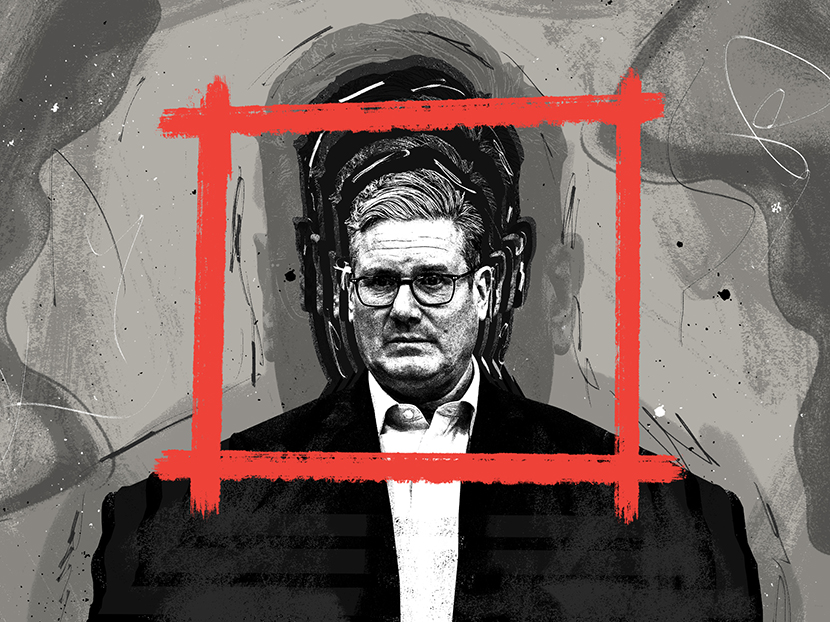
As Keir Starmer broke with Donald Trump over Iran in the House of Commons on 2 March, he did it with the quiet support of an old friend. Sitting above him in the gallery, directly in his line of sight, was Richard Hermer, the Attorney General, who listened carefully to every word with a sombre, intent expression on his face, his palm against his cheek.
More than two decades ago, Starmer and Hermer were barristers together, looking on as another Labour prime minister, Tony Blair, took us into war in Iraq. They marched against it, key voices making the case that it had no legal basis, and were instrumental in scrutinising the advice of Peter Goldsmith, then Blair’s attorney general. Ever since, Starmer’s enduring conviction has been that British armed forces need to know they have a sound legal basis for their actions, that attorney generals shouldn’t be leaned on to provide convenient advice to a PM, and that their robust challenges should be listened to.
When he became Prime Minister over 20 years later, Starmer had these lessons in mind. He surprised many by overlooking Emily Thornberry, who had been his shadow attorney general in opposition, and appointing Hermer instead, making him a peer so he could take up the post of the government’s top lawyer.
Starmer didn’t just want a politician with some legal experience, like Thornberry. As an experienced lawyer himself, the PM wanted a legal mind he deeply respected to provide robust advice on thorny questions of international law. If Starmer couldn’t do all the legal work himself, he wanted to outsource it to someone he trusted.

It was all for a moment precisely like this. On 2 March, these two former Iraq critics found themselves in a position to do things differently. “We all remember the mistakes of Iraq,” Starmer declared. “And we have learned those lessons. Any UK actions must always have a lawful basis and a viable, thought-through plan.” Hermer nodded from the gallery as Starmer underlined his break with Trump’s war: “This government does not believe in regime change from the skies.”
Starmer knows his Iran position is being attacked from both sides. The Greens are arguing against any military involvement – even as Iranian drones place British citizens at risk in the Gulf – while Reform and the Tories argue for uncritical alignment with Donald Trump. Yet the Prime Minister and his colleagues at the top of the Labour Party believe they are in the right place, both from a legal and political perspective.
This is a rare example of Starmer knowing who he is. Even when he entered No 10, he knew he wanted to be a prime minister who championed international law, who had learned from Iraq, whose government was defined by the finest legal advice. It was a small part of Labour’s agenda, in which Starmer displayed a sense of himself distinct from the advisers around him.
Now, the Prime Minister finds himself tasked with defining his political instincts. After years of counsel from Morgan McSweeney, his recently departed chief of staff, we are just starting to see who Starmer really is, in a context where he is fighting to maintain the support of his restive parliamentary party and to recover his poll standing ahead of May’s elections. The pressure on him to change – to engage more with MPs, to be “more Labour”, to shift left, or sound more stridently progressive – was already building, and has only been underlined by Labour’s defeat to the Greens in the Gorton and Denton by-election.
“Morgan was the architect of a strategy that said you can ignore and shit on your progressive vote and focus on Reform voters in the hope that, ultimately, the ‘squeeze’ strategy will mean progressives come back to you,” is how a minister summarises it. “[The by-elections in] Caerphilly and now Gorton and Denton have shown that won’t work.” The key person who used to tell Starmer and McSweeney that progressive voters had “nowhere to go” was Peter Mandelson.
Against this backdrop, the Prime Minister has been told by allies, including Hermer, that the solution is to be more “authentically himself”. As one friend puts it: “He is certainly more progressive than his government has appeared to be,” although they caution that this doesn’t mean he is “suddenly going to metamorphose into Ed Miliband”. Starmer believes in border control, an Israeli state (even if he is not a supporter of this Israeli government) and strong defence. He is not a natural ideologue. But on various issues, he is seizing the reins inside No 10 and reorienting his government in a more progressive direction.
One of the clearest changes Starmer has made – predating McSweeney’s departure – is a deliberate effort to call out racism, whether from Reform or others. Starmer has gone around No 10 pointing to his conference speech from 2025, telling colleagues, “This is who I am.” Downing Street insiders proudly cite Starmer’s criticism of the billionaire Jim Ratcliffe for saying the UK had been “colonised by immigrants” as an example of their change of approach – and their extraction of an apology from Ratcliffe as proof it worked. This shift has been welcomed by many within Labour, though many to Starmer’s left argue it isn’t enough on its own.
If there was a tug of war around Starmer over his European position, his natural instincts on the subject, combined with the departures of McSweeney and Paul Ovenden (another former senior adviser sceptical of the EU) mean a new consensus has been reached “organically” that Labour should shift towards Europe, a No 10 insider says. “Even Brexit voters are in a different place on this now,” they add, noting that the government’s pro-growth push means that Rachel Reeves is also on board. Tonally, Reeves demonstrated this shift in the Spring Statement on 3 March, when she attacked Tories who “opposed closer ties to Europe and backed Brexit. Wrong!”
Yet the matter is not settled. The critical precursor to further European integration is the youth mobility scheme, which is currently under negotiation. Starmer, like Reeves, is said to want to go ahead with the programme in a “bold” way, as an ally puts it, setting the cap high as a demonstration of seriousness to European partners. Shabana Mahmood, with her eye on immigration numbers, is said to be resisting it, arguing for the limit to be set much lower.
Another front has opened up with Mahmood, too. The Home Secretary, one of the last defenders of the “Blue Labour” approach that McSweeney also represented, is under pressure to dilute her immigration reforms. No 10 has been persuaded to ask for a change of tone from her, according to several people familiar with the conversations. “Gorton and Denton has helped,” one minister says. “It has animated the argument that we need to do these immigration reforms in a way that can hold our progressive coalition together.” Mahmood has been told to “rein in” her rhetoric by Downing Street, one insider says, a characterisation categorically denied by her allies.
Mahmood is expected to begin emphasising progressive aspects of her immigration reforms, though sceptics have questioned whether she will do so after defensive briefings have appeared in papers. “She is digging in while the politics shifts around her,” one critic says. Mahmood’s allies, meanwhile, say her speech has been planned for months and was always intended to make the case to Labour MPs, unconnected to the by-election.
Mahmood’s critics within the party don’t intend to stop at a tonal change, however. A rebellion is brewing over her proposed immigration reforms, with ministers and backbenchers alike pushing for a shift in substance. Miatta Fahnbulleh, the minister with responsibility for community cohesion and a key Ed Miliband ally, is understood to have concerns about the plans, arguing privately that parts of the approach don’t align with the government’s aim of bringing communities together. Colleagues have concerns, among other things, about the “slippery slope” precedent of retrospectively making changes to immigration status, as well as concerns about integration if refugees are forced to remain in a limbo status for decades. Mahmood’s allies say these critics fail to recognise the sheer scale of anger over migration in recent years, cautioning that the entire future of Britain’s asylum system will be in jeopardy without bold reforms.
The brewing rebellion is just one example of how emboldened many in Labour now feel to push for the changes they want to see from Starmer. The Culture Secretary, Lisa Nandy, took to the airwaves after the Mandelson fallout to describe what had been a “toxic” culture in No 10; Yvette Cooper expressed similar criticisms. Backbenchers and ministers cheerfully inform Downing Street that they will repeat those lines if they are on the broadcast round – and that No 10 is powerless to stop them. Miliband, at a recent event with colleagues, asked them what they wanted him to feed back to Starmer, because “he is listening” right now.
Inside No 10, this sometimes manifests as “jitteriness” and “reactiveness”, one insider says, with colleagues jumping at the slightest sign of discontent from MPs or stakeholders. Most agree that increased engagement with MPs was desperately needed, but some Downing Street sources are concerned there is a risk Starmer will be “buffeted around” without a clear sense of direction.
Starmer’s decision not to appoint a permanent replacement chief of staff immediately is significant. He has left the role in the hands of two interims, deliberately, to make sure his own values and personality are reflected, according to an ally. He isn’t expected to make a permanent appointment until after May’s elections, and is likely to split the job in two: one role for strategy and one for the day-to-day running of the Downing Street operation. In the meantime, the exact responsibilities and roles of senior figures inside No 10 are ill-defined, and insiders can’t answer who has replaced McSweeney as the key strategic brain. When I asked who is setting the strategy, one replied: “The PM himself, a bit, I guess?”
Starmer is doing his best to govern as himself, and giving us glimpses of what that means. His allies believe that is Labour’s route back to electoral success, if it is not too late. Others see this as their moment to push for what they have long wanted from a Labour government. McSweeney, meanwhile, looks on as his approach is slowly unpicked, dreading what will happen if the party returns to its instincts, and waiting to say “I told you so” if everything gets worse.
[Further reading: Was the Spring Statement dead on arrival?]
Content from our partners

Related
This article appears in the 04 Mar 2026 issue of the New Statesman, Trump's global terror
Join the debate
Subscribe here to commentWe’re being asked to believe that a grown man and sitting prime minister has spent years as a hostage to a strategist he supposedly never agreed with, and that he only becomes ‘authentically himself’ once he lines up with Ailbhe Rea’s own views. It’s an implausible story and a poor substitute for serious journalism or analysis.