
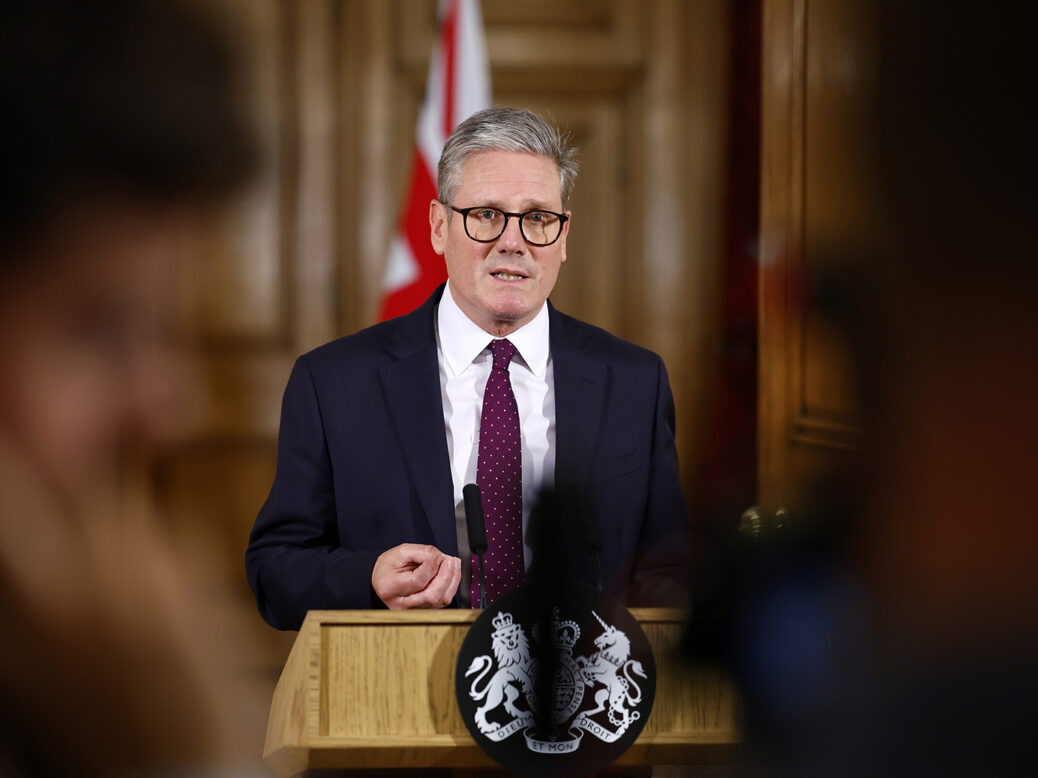
Today, the Prime Minister addressed the House of Commons following the revelation that Peter Mandelson failed security vetting before he was sent to Washington as British ambassador. Keir Starmer found out about this last Tuesday (14 April) and initiated a fact-finding exercise to discover what had happened. On Thursday (16 April), the Guardian reported on Mandelson’s vetting failure. No 10 has repeatedly said that neither the PM nor any other ministers were told of Mandelson’s failure to pass vetting. Olly Robbins, the permanent secretary to the Foreign Office who overturned the vetting decision and cleared Mandelson to go to Washington, was sacked on Thursday following the Guardian story. This is what we learned from Starmer’s statement today (20 April).
Keir Starmer is sorry
The Prime Minister once again apologised for having appointed Mandelson in the first place, while attempting to underplay this week’s story as one of process and Whitehall incompetence. He said: “I do not accept that the appointing minister cannot be told” about the outcome of the vetting and “the fact that I was not told even when I ordered a review of the UKSV [UK security vetting] process is, frankly, staggering”. He said that he would not have appointed Mandelson if he had known about the outcome of the procedure.
New details of Mandelson’s appointment
The PM set out a timeline that revealed new details of the affair, including that Mandelson was vetted over the course of a month from 23 December 2024 to 28 January 2025, and that Mandelson was interviewed twice as part of that process. He said that UKSV had recommended clearance be denied on 28 January and that Foreign Office officials approved his developed vetting the next day, 29 January. Starmer said he decided to appoint Mandelson on 18 December 2024 – and the story of that decision found its way into the Financial Times the very next day, 19 December (which, incidentally, helped to make it politically difficult for Starmer to reverse course).
The former cabinet secretary Chris Wormald was not told
Even when he was conducting a Whitehall review into the vetting process that had led to Mandelson going to Washington, the PM said that Wormald was not told. “Clearly, he could have been told, and he should have been told,” Starmer said.

Starmer continues to blame Robbins
He said it was “absolutely unforgiveable” that Foreign Secretary Yvette Cooper was not told about the outcome of Mandelson’s vetting when she, with Robbins, jointly signed a response to the Foreign Affairs Committee stating that the vetting process had been followed (which was not a direct lie, but an elision of the truth).
Questions of timing remain
Since the PM found out on Tuesday about the vetting decision, his critics have asked why it took until today for him to update the House. Kemi Badenoch said he had inadvertently misled the Commons but had not corrected the record as the first available opportunity, which would have been Prime Minister’s Questions at noon last Wednesday (No 10 says it needed time to carry out the fact-finding exercise first). Meanwhile, Jeremy Wright, the Conservative MP who leads the Intelligence and Security Committee – which is analysing the humble address materials for national security sensitivity – asked with a note of irritation why the PM had found out about the vetting decision on Tuesday but he and the committee only learned about it from the Guardian’s story on Thursday.
Starmer struggled to address a new revelation today
That was the smoking gun in the humble address papers released in March – a letter from the former cabinet secretary, Simon Case, in which he recommended that a political appointment for the ambassador role in Washington DC be vetted before the announcement was made. Starmer said that he was assured the right process was followed but did not elaborate.
The opposition parties smell blood
Badenoch quoted Starmer’s own words, while leader of the opposition, calling for Boris Johnson to resign as prime minister for inadvertently misleading the House of Commons over partygate. She said “he has thrown his staff and his officials under the bus” and that “all of these people [were] fired for a decision he made”. Putting Starmer’s own words back to him, she repeated a question that was often asked by the Labour leader when he attacked the Tories from the opposition benches: “Is there one rule for him and another for everyone else?” Meanwhile the Liberal Democrats also think Starmer is in danger. Ed Davey said the PM had committed a “catastrophic error of judgement” in appointing Mandelson and urged him to resign.
Within the PLP, the PM’s chickens might be coming to roost
There was a crackle of excitement in the Commons when Diane Abbott, long-standing critic of the PM, rose to ask a question following Starmer’s statement. She chose mockery instead of condemnation, simply saying that “Peter Mandelson has a history” and arguing that it was obviously foolish to have appointed him in the first place. In response to Starmer’s protestations that “nobody told me” about the vetting failure, Abbott said: “The question is, why didn’t the Prime Minister ask?” In turn, John McDonnell said that the Mandelson affair “has damaged the party that I have been a member of for 50 years”, attacked a “toxic culture” within the party under Starmer, and said there should be an inquiry into Labour Together. The pair have both been frozen out under Starmer’s leadership (Abbott is still suspended while McDonnell only recently got the whip back). Their implacable opposition to Starmer’s politics remains a minority view in the Parliamentary Labour Party. But if enough moderates get sick of Starmer’s leadership, this scandal might threaten the Prime Minister’s position.
Starmer asked Robbins why he overturned the vetting decision
In response to a question from the Tory MP Julian Lewis about Robbins’s motivation for acting as he did, the PM said that he had asked the civil servant before sacking him but was still dissatisfied enough with his explanation to sack him. He said Robbins’s explanation was that the process did not allow him to share the outcome of the vetting process with the PM. But what will Robbins say when he accounts for his actions? We will have to wait until 9am Tuesday, when he appears before parliament’s Foreign Affairs Committee after facing days of criticism from the bully pulpit of No 10.
[Further reading: Nigel Farage fights for the limelight]
Content from our partners



Related


Join the debate
Subscribe here to comment