
It was in 2019 that Donald Trump first expressed his desire to acquire Greenland. Dismissed as an absurdity then, this expansionist aim now represents the biggest threat to the postwar Western alliance.
As recently as the start of this year some refused to grasp the full implications of what was unfolding. Kemi Badenoch described Greenland as a “second-order issue”; Peter Mandelson chided European countries for their “histrionics” over the territory. Yet not for the first time it was prudent to take Trump both literally and seriously.
Keir Starmer, who always knew that events could force him into a confrontation with the US president, has no option but to stand with Denmark. Territorial sovereignty and integrity are the reddest of red lines. Would those Maga-aligned conservatives who urge Britain to relent say the same of the Falklands? Trump could yet extend his imperial ambitions to those islands – and their untapped oil reserves – or consent to a takeover attempt by his populist ally Javier Milei (who recently reaffirmed Argentina’s claim).

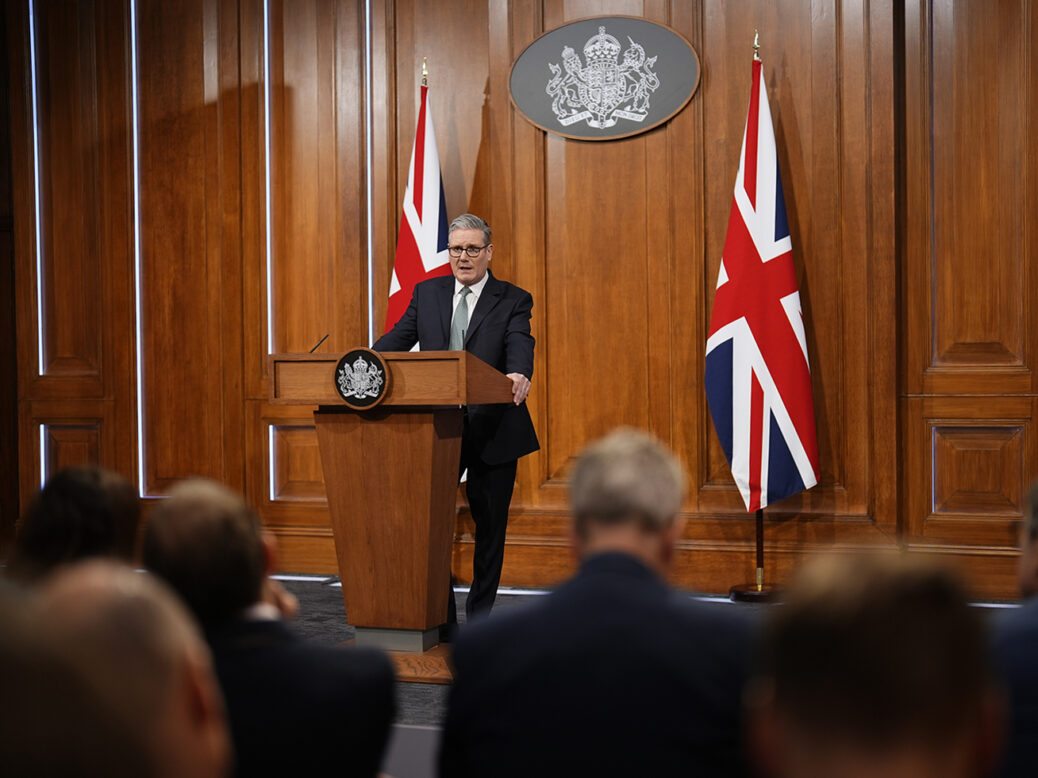
For reasons of self-interest, as much as internationalism, then, Starmer cannot afford to equivocate on this fundamental point. “Any decision about the future status of Greenland belongs to the people of Greenland and the Kingdom of Denmark alone,” he declared at his Downing Street press conference this morning (while insisting, in a hostage to fortune, that Trump is not serious about military action). The UK, which already incurs a blanket 10 per cent tariff on most exports to the US and 25 per cent on steel, now faces further economic punishment: an additional 10 per cent rate on 1 February, rising to 25 per cent on 1 June if a deal is not agreed for “the complete and total purchase of Greenland” (though the US Supreme Court and Republican senators may yet come to Europe’s rescue).
Starmer’s remarks today confirmed that his basic approach to America has not changed. He refused to provide the Mark Carney moment that some crave, deriding “commentary and gesture politics that harm the British people”, and unusually citing the UK’s nuclear deterrent – dependent on US-leased missiles and technology – as justification for maintaining a “good relationship”. In contrast to Emmanuel Macron’s talk of a “trade bazooka”, he offered no hint of retaliatory tariffs.
But there are those inside government who believe Starmer should seek to treat this moment as an opportunity rather than a cost. Firstly, as cabinet ministers such as David Lammy and Wes Streeting have long argued, Starmer could pursue a far more ambitious reset with Europe, reopening the question of single market and customs union membership, and forging a new defence relationship. Any notion that the UK can thrive as a freewheeling, buccaneering “global Britain” is being destroyed by events – and an increasingly pro-European electorate knows it. As the continent’s collective security is threatened, the possibility exists for a creative, dynamic negotiation in which traditional obstacles such as the return of unqualified free movement are overcome.
Secondly, Starmer could confront the reality that the UK must take greater responsibility for its own defence and level with the public about the end of the “peace dividend”. There is an argument for Rachel Reeves to turn her planned “Spring Forecast” on 3 March into a full fiscal event, recognising that the world has changed and filling the £28bn black hole left by a vow to raise defence spending to 3.5 per cent of GDP. A year ago, when Trump’s tariffs first loomed, Reeves declined to take the advice of Ed Balls and others to deliver a British Zeitenwende and revise her fiscal approach – events may have given her another opportunity to do so.
All of this would lend new purpose to the government at a time when Starmer and Reeves, both enduring record unpopularity, desperately need it. “You never want a serious crisis to go to waste,” Rahm Emanuel, Barack Obama’s chief of staff, said in the aftermath of the 2008 financial crash. “It’s an opportunity to do things you think you could not do before.” That was good advice then and it’s good advice now.
This piece first appeared in the Morning Call newsletter; receive it every morning by subscribing on Substack here
[Further reading: Zack Polanski: Trump’s threat to Greenland must be a wake up call for Britain]
Content from our partners


Related

Join the debate
Subscribe here to comment