

In October 2019 Chris Philp was a freshly minted immigration minister who believed that judges “cannot be subject to any form of political interference”. In a Westminster Hall debate he spoke warmly of “the principle of judicial impartiality that has prevailed in all four corners of the United Kingdom for so long”. A big concern for Philp in those days was that so few court judges were from ethnic minority backgrounds; he committed to “working generally to improve diversity” in the courts. Two years later, Philp was telling the House of Commons how important it was that judges had the independence to ensure “that justice is not only properly done, but fairly done”.
In the years since then, Philp has been on a journey – from government to opposition, from power to ridicule, and from faith in the judiciary to a new belief that Britain suffers beneath what he called, in a speech this week, “the tyranny of the courts”.
As journalists and policy wonks waited in the lobby of Policy Exchange, the right-wing think tank at which Philp was due to speak, a protester with a guitar was escorted from the building. It is very important that men who aren’t particularly good at the guitar are kept at a safe distance from the general public, but in this case, it might have been worth letting him in: he would have at least bumped up the numbers. Despite the billing – a major speech by the shadow home secretary – there were so few people in the room that I worried for a moment if I’d turned up to a meeting of Liz Truss supporters, or a surprise birthday party for Dominic Raab. The minutes ticked past as the organisers waited to see if anyone else – perhaps a stray Westminster tourist with an interest in border control? – wanted to wander in. The front row of seats was held empty by a superfluous line of “Reserved” signs; Philp arrived and sat on one, his speech twitching in his hand.
For those of us with a taste for uncomfortable silences, the big question was whether Philp might have another go at being funny. At last year’s Conservative Party conference he had arrived on stage with a handful of jokes that sounded as if they had been copied diligently from The Bumper Book of Best-Man Banter. He began with a particularly well-used gag about his wife not fancying him – if you’ve been to more than two weddings, you’ll have heard a version of it – and followed this with series of observations which he clearly thought were very amusing, each of which was followed by a spectacularly awkward pause in which a handful of people would clap while the rest of the audience tried to pretend it wasn’t happening. Amid the banter, he promised to deport 150,000 people per year.

This week’s speech was a chance for Philp to repeat this promise, but with more detail. The details added included observations about the awful crimes he believes could be entirely avoided by cutting illegal immigration, and the idea that it is far too difficult to deport foreign criminals. The really key detail, however, was that although Chris Philp was a policing minister at the time when many of the crimes he talked about were committed, and an immigration minister when the number of people coming into Britain from non-EU countries rose to over a million a year, none of this was Chris Philp’s fault. At one point, when asked about this period, he actually said: “You’d have to ask the people who were in charge at the time.”
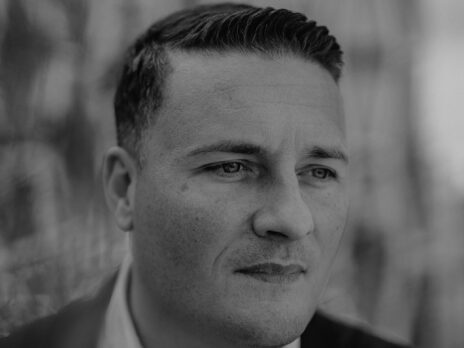
He is spindly, with a nervous energy, shifting from foot to foot in his polished black wing-tips as he speaks. He’s been compared to the previous shadow home secretary, Robert Jenrick, in that when you mention him to people they often say: “He’s trying to be like Robert Jenrick” – although he seems to lack his predecessor’s nasty edge. Philp grew up on the mean streets of West Wickham and cut his teeth in management consultancy before becoming a property developer, the archetypal late-stage Tory. In 2022, when he was chief secretary to the Treasury (for just over a month), it was reported that Philp had persuaded Liz Truss and Kwasi Kwarteng that it would be a good idea to remove the additional 45p rate of income tax from the highest earners in their autumn Budget (the first policy to be ditched when the Trussonomics project imploded). His tie is a light electric blue, the colour you’d get if you painted something Reform teal and then hastily tried to scrub it off again.
He is at least blunt about his own opportunism: “mainstream political parties,” Philp told us, have to impose “radical and sweeping change” on the immigration system, “or the public will turn away from the mainstream”. He is right that a significant majority of British people (68 per cent as polled by Ipsos) believe current levels of people seeking asylum in the UK are too high, and more than one in five Britons consider immigration (legal and illegal) as the top political issue; the UK is more concerned about immigration, according to Gallup, than any other country in the world.
“We must start by asking why this issue has not been fixed”, he said, before providing the answer: judges have achieved “near unlimited power” over the immigration system, apparently as politicians looked elsewhere (again, this man was a Conservative minister for five years). This power grab gave rise to a catalogue of absurdities: the paedophile who couldn’t be sent back to Zimbabwe because the people of Zimbabwe are hostile towards paedophiles; the drug dealer who couldn’t be deported to Iraq because he was “too Westernised” to live there. Migrants would often arrive in Britain claiming they face persecution as Christians, he claimed, having undergone a hasty and cynical conversion (Philp has an eye for a hasty and cynical conversion) that is, he said, “very often signed off by a well-meaning but misguided vicar”.
Or so Philp’s reading of these cases went. What he’s selling is not the idea that we could achieve a greater understanding of why these cases take so long and end so unsatisfactorily, but that we could avoid trying to understand them at all. He raises the tragic case of Rhiannon Whyte, who was murdered by a Sudanese man staying in the asylum hotel where she worked. Philp’s position is that this crime would never have happened under a Conservative government because the murderer would have been eligible for a deportation flight to Rwanda, and therefore Keir Starmer is personally guilty of – as Philp has previously put it – “virtually treason” for failing to have foreseen that the man was going to commit a terrible crime.
And so Philp’s simple solution is to assume guilt much more widely, pretty much universally, by sending everyone who arrives by an unofficial route such as a small boat back to their country of origin. I asked him if he had costed this plan and he said it would involve just an extra £800m on immigration enforcement; the Rwanda plan, for context, cost £700m and deported a total of four people. In the US, Ice recently received $73.3bn in additional funding.
But for Philp it’s all simple: just end immigration tribunals, seize power from the woke judges and get people in the Home Office to make snap decisions on who stays and who goes (the implication being that it would be mostly the latter). What could go wrong?
[Further reading: Elon Musk is the bastard heir of liberal capitalism]
Content from our partners



Related


This article appears in the 17 Jun 2026 issue of the New Statesman, The Race
Join the debate
Subscribe here to commentI suppose the difficult thing about immigration is that many older immigrants are the most ardent supporters of repatriation and restricting future immigration. The big question is where will the line be drawn. This could get very ugly.