
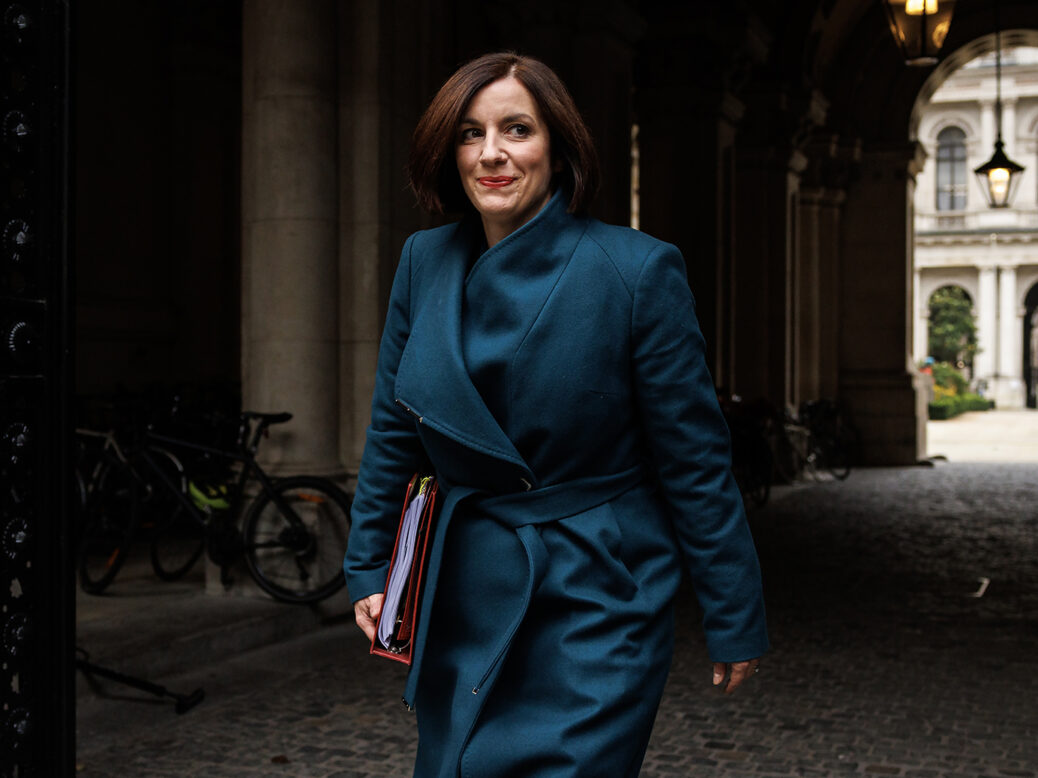
Bridget Phillipson was in her Sunderland constituency when Keir Starmer called with the news that defied so many Westminster briefings: she would remain Education Secretary. Back in May the Sunday Times had reported that Phillipson was set to lose her job over her handling of schools reform.
“It was upsetting,” says Phillipson of that fraught weekend, which followed Labour’s heavy defeat to Reform in the local elections. “But later that day Keir got in touch and told me not to worry, which was very reassuring” (“Keir really, really likes Bridget,” a No 10 source remarked in the aftermath).
Some would be content with one of the cabinet’s top jobs – at £109bn, the education budget is second only to health – but not Phillipson. On 9 September she announced that she would be standing to succeed Angela Rayner as deputy leader.
To plenty this was a surprising, even brave, decision. Polling had shown that most Labour members believed the government was heading in the wrong direction. A serving cabinet minister, the thinking went, would have little chance of victory against an unrestrained backbencher. But if Phillipson is having any doubts she keeps them hidden.

“I just felt it was the right thing to do, that I was the strongest candidate to unite the party, take the fight to our opponents and be that campaigning voice at the cabinet table for members,” she says.
“You had Angela Rayner, John Prescott, Harriet Harman who were all phenomenal deputy leaders who combined that with roles in government and were most effective because they could get things done.”
Powell, who was sacked by Starmer as leader of the House of Commons, is widely regarded as the frontrunner – having won 268 Constituency Labour Party nominations to Phillipson’s 165 – but Phillipson disputes this analysis. “It’s far closer than people imagine, the one serious poll we’ve had showed that and I’ve secured significant trade union support, which carries a lot of weight” (both Unison and the GMB endorsed Phillipson, while Unite declined to nominate).
We’re speaking at a café in Oxford, where Phillipson, wearing Nike sneakers for campaigning purposes, studied history and modern languages and served as co-chair of the university’s Labour club. Though she has fond memories of this time she also encountered snobbery and prejudice as one of the few northern students (with many baffled to learn that Washington, her hometown, is in Sunderland, not the United States).
“In the time before university they’d been off skiing or working abroad or living in their dad’s flat,” she recalls of her contemporaries. “I’d spent my summer working in a supermarket, so different experiences and a different worldview”.
Phillipson frames herself as the unity candidate, taking care to praise local MP Annelise Dodds, who resigned from the cabinet over foreign aid cuts, and arguing that she is best-placed to rebuild Labour’s cross-class coalition. “I come from a traditional Labour seat where Reform is pushing hard [Phillipson’s majority is 7,168] but I also came to university in Oxford where the threat has been from the Lib Dems and the Greens.”
Her unashamed warning is that Powell, who has demanded a “course-correction” and has pledged not to serve in government, threatens party unity. “We can’t be airing our dirty linen in public. We’ve got to do it in a way that doesn’t energise our opponents. And I think there is a genuine risk of the party being destabilised if we have the unusual position of the deputy leader being outside government”.
Senior sources inside Labour complain that Andy Burnham’s recent comments on the bond markets to the New Statesman cost the UK £1bn as borrowing costs spiked. Is this the sort of instability Phillipson has in mind?
“I am worried about the impact it could have, I know what members want more than anything else is for this Labour government to be a success and for there to be a second term because we know it’s going to take time to turn the country around.”
But Phillipson is determined to dispel any impression that she is an unthinking loyalist. “I’ve had to fight tooth and nail for some policies,” she reveals. “Expanding free school meals to half a million children didn’t happen by accident. I was pushing for that and I made it happen and that’s what Labour members can expect to see more of.”
Who were these fights with? Rachel Reeves, the guardian of the government’s fiscal rules?
“I’ll have those fights behind closed doors and I’ll make my case but I won’t come out the other side and betray confidences,” she replies diplomatically. But Phillipson is clear that she is prepared for more conflict if necessary, including over the abolition of the two-child benefit cap. “I’ve been consistently clear with colleagues in meetings about what we need to, what the evidence tells us… I experienced what it was like growing up in poverty, the fact that four-and-a-half million children are now experiencing the same is a blight on our country, it scars our country.”
Phillipson also implies that Powell has been less forthright than she now suggests. “We all sat around the same cabinet table. If you take an issue like child poverty it’s something I’ve campaigned on, delivered on, consistently over many, many years and I’ve got a strong record to tell. I’m not sure that would always be the case for my opponent.”
Phillipson, 41, who never met her father and saw her mother pushed into poverty for want of childcare, often invokes her own background when discussing her political outlook. “It was a really tough community, I saw lots of really brilliant people who were my friends not achieving all that they could because their families didn’t have much money and because crime was high. I felt a sense of fundamental unfairness.” (Her Catholicism, evidenced by the cross round her neck, is another source of her commitment to social justice.)
Before becoming an MP in 2010 she worked at Wearside Women in Need, the domestic violence charity her mother founded. “I always have in my mind those children who were badly let down by a system that should have been there to protect them and who were exposed to abuse and trauma that no child should ever witness, so much of that shapes what we’re doing around children’s social care reform.”
Early in her political career Phillipson was often identified as a “Blairite” owing to her links to Progress, the group founded in 1996 as the campaign wing of New Labour. More recently some have labelled her “soft left” due to her school reforms, which will force academies to teach the national curriculum and only employ qualified teachers (something Michael Gove has likened to “Rome’s approach to Carthage – a salting of the earth”).
Phillipson accepts neither label and, refreshingly, roots herself in a distinctive philosophical tradition: “We should reclaim the cause of freedom for the left. The right use the language of freedom but I believe that as Labour we should be using the power of the state to give people the freedom in their lives to make the choices that are right for them, the ability to choose your own path, to not be constrained by your economic circumstances, by your family background.
“For me, that’s the socialism of freedom: can you give people the chance to live the life they want to live?”
She cites Choose Freedom: The Future for Democratic Socialism (1987) by former deputy leader Roy Hattersley as a particular influence. “I like to spend time in the House of Commons library occasionally between votes and it was a book that I spotted on the shelf,” recalls Phillipson (who contributed essays and columns to the NS as a backbencher).
“I thought it was a brilliant articulation from someone who’s seen as being on Labour’s traditional right of how to recapture the politics of freedom for the left.”
A belief in the enabling state, she says, should be central to the government’s argument for digital ID cards. “We’ll need to make the positive case for the benefits that it will bring. Of course it will allow us to be clear around enforcement of rights at work and the immigration system. But selling the benefits will be more important.”
When I ask Phillipson what changes she would like to see if elected, she suggests, intriguingly, that Labour’s mayors should have a bigger role. “I’m not sure we hear our mayors as much as we should for our party decision-making. I think we should consider a stronger role for them in our internal processes because they are people that are also delivering for their communities.”
If Phillipson wins she will gain a seat on Labour’s National Executive Committee, which oversees candidate selections. Would she welcome back Burnham?
“That’s a question for Andy but I’m sure he’s got a lot to contribute once his term of office is up in Manchester and if there are vacancies I’m sure he’d be a strong candidate to stand.”
Unlike Burnham, Phillipson says that she opposes electoral reform on the grounds that first-past-the-post delivers “stable governments”. But Labour, in its first year, I point out, has hardly been a model of stability.
“Being in government’s hard,” she replies with a knowing laugh. “It’s a big adjustment. But give me the worst day in government over the best day in opposition because in government you actually get to change people’s lives.”
[Further reading: Lucy Powell: I’m already moving Labour leftwards]
Content from our partners

Related
Join the debate
Subscribe here to comment