
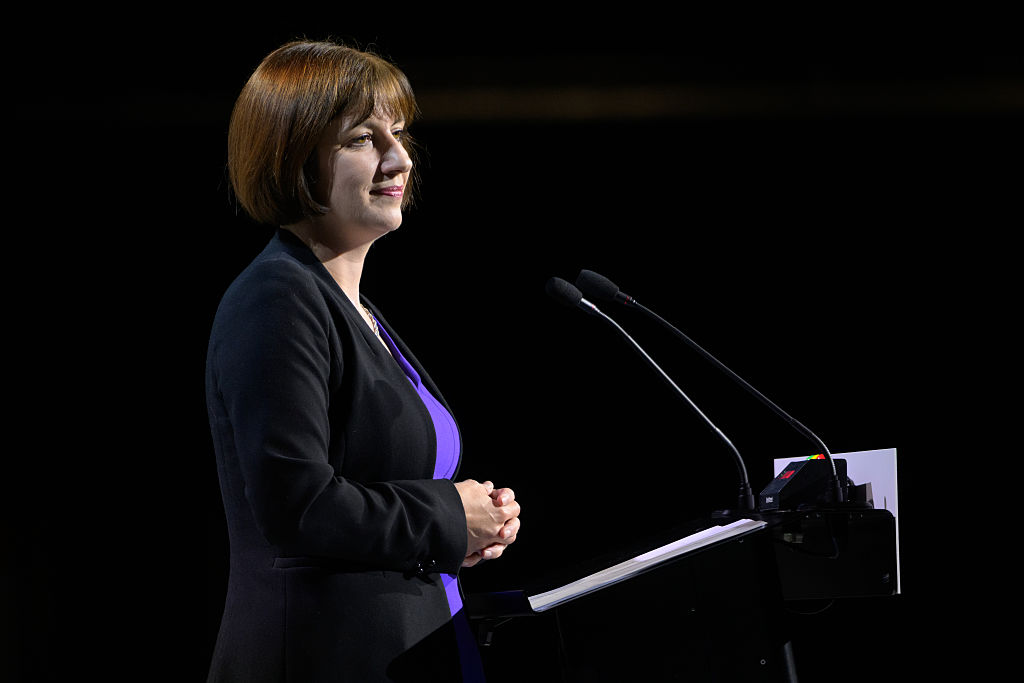
A week into Labour’s deputy leadership contest, the first poll of members projects a healthy 17-point lead for Lucy Powell.
It’s just one sounding of highly engaged members, a quarter responded “don’t know” and there is over a month until the result. But it reflects a conventional wisdom in Westminster: that Powell, the recently sacked Leader of the House, is the Starmer-critical option while her opponent Bridget Phillipson, the distinctly un-sacked Education Secretary, would be a quiet, loyal and perhaps even supplicant deputy leader.
Phillipson has been quickly painted into this corner and it may be tricky for her to break out of, not least because she is bound by the constraints of Cabinet collective responsibility. Expect coded messages about “listening” rather than any explicit rebuke of the government’s record.
For what it’s worth, I think this may be a rather unfair reading. Both candidates served in government, took the line and obeyed the whip through all the episodes of the past 14 months that were most unpopular with members, starting in order of severity with welfare cuts, through the winter fuel cut, foreign aid cuts and on down the roster of bitterly remembered grievances.

Powell did not resign and her transformation into an open critic of the government was a decision made for her by Keir Starmer in the reshuffle.
And it is not really fair to cast Phillipson as a nodding dog. Within government she has had to fight some unpleasant battles to preserve her education programme against several internal critics. She has now won. Despite relentless briefing to newspapers, she was not sacked at the reshuffle and her critics have either gone quiet or left government altogether. Her work at the DfE remains, among Labour party members, one of the few broadly popular parts of the Starmer government’s programme.
It is also worth remembering that while Phillipson pursued her agenda at education, Powell, as Leader of the House, was responsible for getting the government’s most unpopular legislative proposals through parliament.
Nevertheless the candidates must deal with the assumptions that have been made about them in the early days of the contest, and Phillipson has struggled so far to set out her “real” beliefs. Luckily here at the New Statesman we have a wealth of evidence on that point, all of it contained in our archive. For a number of years, Phillipson wrote intermittent essays and columns when she was a backbencher and later a shadow minister.
In them she gave a broad range of opinions on current affairs, but also more tellingly on the art of politics itself. They reveal a politician who proudly spoke of a battle for “our socialism”, praised “machine politics” as the way of getting there and wrote about the importance of disagreeing with voters on big issues when you are trying to win their votes.
Her instincts on some of these issues do not seem to be shared by the current No 10 outfit.
No to Blue Labour
On the eve of the 2019 election, Phillipson warned colleagues that a moving towards a culturally conservative version of Labour would not help the party gain power or solve problems. It seems oddly prescient now, as Labour argues the merits of the increasingly preeminent “Blue Labour” approach, with its focus on “flag, faith and family”. While Phillipson didn’t identify the tendency by name, she described such an approach “soft Toryism” and “neither social democracy nor socialism”.
She wrote about her “deep aversion” to social conservatism in the party because of “my suspicion that for people like me it would have been a social, cultural, and economic prison. My grandparents were immigrants. My mother brought me up alone.”
In contrast Phillipson demonstrated brass-plated liberal instincts. In our pages she described the contraceptive pill as “the greatest of all modern technological breakthroughs, an invention whose socially and culturally transformative power, I’d argue, ranks alongside electricity, the internet, and antibiotics”.
Having the argument
Far from being led by opinion polling, Phillipson once believed that arguing for unpopular positions might be necessary. In 2016 after the Brexit vote, she wrote “I take the view that the right decisions for Britain’s future are not invariably the ones that are immediately and universally popular. If they were, all politicians would be redundant. Sometimes things that are true are deeply unpopular, and sometimes things that are popular would be catastrophic as policy choices.”
“My beliefs,” she said, “have not changed just because I have discovered others disagree with me.”
Following the rise of Ukip she suggested Ed Miliband’s focus on immigration controls went against “simple political common sense”. According to the Phillipson of a decade ago, “we should not be banging on about an issue which divides our own potential support in two, nor encouraging and enabling others to do so.”
Her main lesson from the Blair years was, she wrote, “that voters do not need to think our values are completely identical to theirs, to be convinced that ours is nonetheless the right party to lead Britain.”
This approach extended to internal Labour battles. Though a Blairite, she was implacably opposed to plans – supported by the former prime minister – to create a new “centrist” party as an alternative to Jeremy Corbyn. She wrote: “Any Labour MP who has ever flirted even in the darkest recesses of their mind with leaving our party, the greatest vehicle for social justice ever invented, to join some imagined ‘centrist’ party need only remember that liberal Conservatives like George Osborne declare themselves ‘proud’ of the violence done to the social security system in this country. They need to be defeated, not embraced.”
Machine politics
When Labour members cast their ballots they might be thinking about the deputy leader’s responsibilities as a bridge between the members and the leadership. On the subject of party organisation and electioneering, Phillipson has said she is a big fan of “machine politics”. She wrote in these pages that “machine politician” was, for her, not a term of abuse but “the highest praise”. In her view “ultimately a machine – that is, a tightly-run but rule-governed democratic organisation that seeks to win elections for Labour and win votes in Parliament whilst keeping people on board with each tough decision – is a precondition for success”. She summed up her position thus: “Placards do not fund hospitals. Banners do not tackle child poverty. Rallies do not provide decent, humane social care.”
On leaders who lose
While she was a backbencher Phillipson did not hold back from chiding her own side.
She was coldly critical of Labour’s performance in 2015 and 2017 while writing in the NS. Reviewing the 2015 defeat she said, “people who don’t read the Guardian or the Mirror were not convinced by our message”. In 2017 she was withering about those who praised Corbyn for increasing Labour’s share of seats and the popular vote while depriving Theresa May of her parliamentary majority. She wrote: “I am sitting on the same green benches listening to the same Tory ministers take decisions about the future of our country. I have 30 more colleagues than I did six months ago, and that’s great, but I never forget we still need another 60 or so before we can hope to govern Britain.” She also called the Remain campaign, which she supported, “a dreary campaign of numbers and people prophesying doom” that was “apparently tone deaf” to charges of being an establishment stitch-up.
If the Education Secretary can convince party members that she would take the same approach as deputy leader, her chances may improve markedly.
[See also: The Mandelson debate was an embarrassment for Keir Starmer]
Content from our partners



Related

Join the debate
Subscribe here to comment