
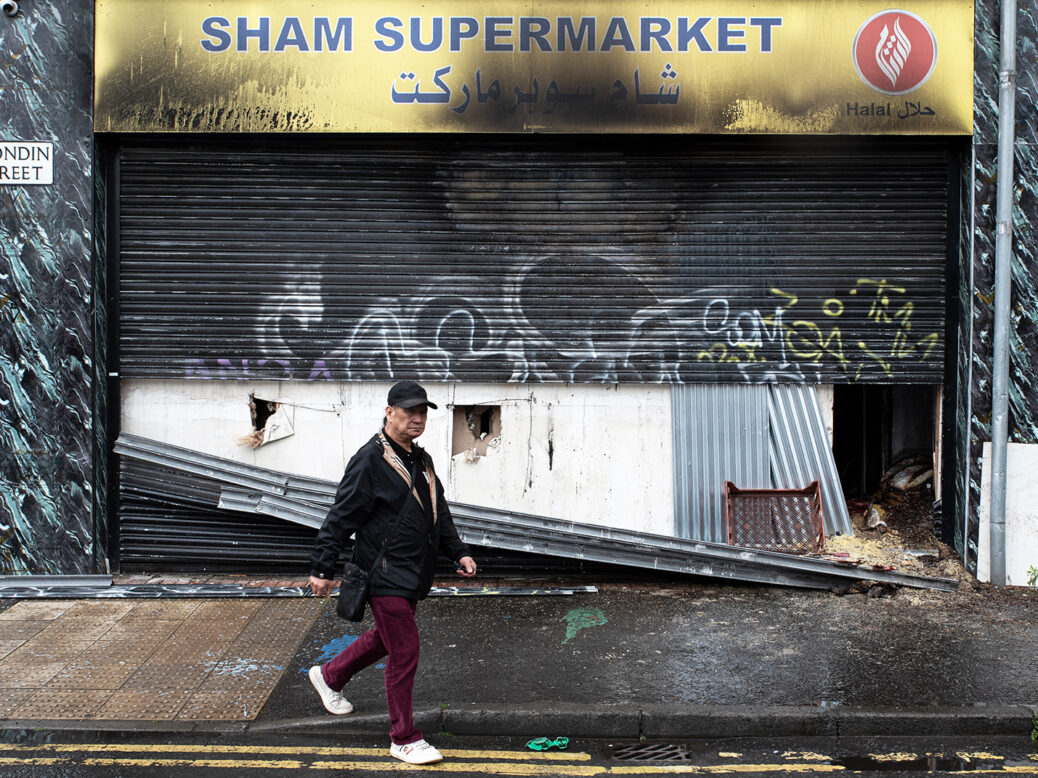
For more than a decade I’ve lived in a spot that is perhaps the perfect confluence of east London communal life. Within a two-minute walk of my flat is an old-school West Ham pub, a gay leather fetish bar and a mosque. Something for everyone, I used to joke. The frequent and sometimes surreal meeting of these worlds and their various distinctive uniforms would have been rich material for Martin Parr.
It’s not often in my reporting these days that I get to write that everyone rubs along, but in my day-to-day life in Tower Hamlets – the borough with the largest Muslim population in the country – it’s a cliché that is true. It can be disorientating to spend a long, hot weekend sitting in the shade out the front of our block, our toddler playing with the Bengali children next door, only to return to work to report on a Britain fracturing along ethnic lines.
But recent stories have taken me to the streets of Golders Green to report on stabbings of Jewish people, and to parts of Wigan where resentment has been directed towards asylum seekers. The fortnight that began with rioting in Belfast, where masked men went house to house hunting for migrants, also brought the lockdown of a mosque in Glasgow as police protected it from “white lives matter” marchers, the firebombing of an imam’s home in Bolton and a knifeman raging around Edinburgh reportedly targeting a takeaway, a minicab and a delivery rider, shouting about “protecting the country”. (A man has since been charged with attempted murder linked to terrorism.)
Young worshippers at mosques have felt especially unsafe, I hear, since a video was released last September by the far-right agitator Tommy Robinson in which he responded to the rape of a Sikh woman in Oldbury (the first of three racially motivated assaults of Sikh women within a few weeks of each other in nearby West Midlands neighbourhoods last autumn). John Ashby, the rapist who followed a Sikh woman home and broke into her house in Walsall, subjected her to an anti-Muslim tirade during his attack. Robinson condemned violence against “Sikhs” and “Indians” specifically, but this made some Muslims watching his response feel they were seen as fair game.

This fear of being the unacceptable minority – the target – is now a familiar one in modern Britain. When two Jewish men were stabbed in north London in April, one resident told me, “Islamophobia is an issue, of course… [but] we are targeted more than any minority,” while another countered that far-right Islamophobia was their problem too: “After the Muslims, we’ll be next.”
It is perhaps little wonder that attacks on visible minorities in Britain are rising, given the recent rhetorical drift of even mainstream politicians into intolerance. It’s not just the Reform council candidates that have called the Holocaust a hoax, or Muslims “rats”, and suggested that Nigerians be melted down to fill potholes. Or the X posts about “savage third world animals” made by Rupert Lowe, the former Reform MP who now heads the far-right alternative Restore and is amplified by Elon Musk – a man apparently radicalised by his own platform. And it’s not just the statements from previously liberal Brexiteers such as Douglas Carswell who now crow “let’s make England Abdul free”, nor the call from Nigel Farage after the sentencing of a Sikh man for the murder of student Henry Nowak for “pure, cold rage”.
It’s also the Conservative shadow justice secretary, Nick Timothy, accusing Muslims praying in Trafalgar Square at an annual public Eid iftar of “an act of domination and therefore division”. It’s the Conservative Party leader, Kemi Badenoch, talking about her “respect” for Lowe and allocating him a seat on the Public Accounts Committee of MPs. And it’s the party line from Labour cabinet ministers on Robinson’s first Unite the Kingdom march that it demonstrated free speech was “alive and well” and “a very fine British tradition”.
We now live in a country where racist and religiously motivated violence on public transport has risen 67 per cent in three years, according to data I obtained under the Freedom of Information Act. Where synagogues and mosques are targeted, UberEats couriers are mobbed by men in balaclavas, and people with black and brown skin or in religious dress feel the mood had changed. A country where, according to new research by the British Future think tank, the majority of British Muslims experienced prejudice last year – and one in six Britons now hold hostile views towards them.
The normalisation of everyday racism in high politics is a threat to social harmony, but it’s also becoming a political headache. One Reform figure expressed genuine shock to me recently at the vile racism in social media comments on a photo they had posted online. “It really surprised me,” they said, blaming Restore. It hasn’t gone unnoticed that the splinter party picked up nearly 7 per cent of the vote in the recent Makerfield by-election – not enough to influence the outcome, but enough to match the high watermark of BNP support in the area in 2010.
This year marks 15 years since the then Tory party co-chair Sayeeda Warsi rattled the establishment by claiming bigotry against Muslims had “passed the dinner-table test”. She observed that it had “crossed the threshold of middle-class respectability” and warned this shift could “lead down the slippery slope to violence”. A decade and a half later, and Britain is slithering down that slope.
[Further reading: The northern conquest]
Content from our partners
Related
Join the debate
Subscribe here to comment