
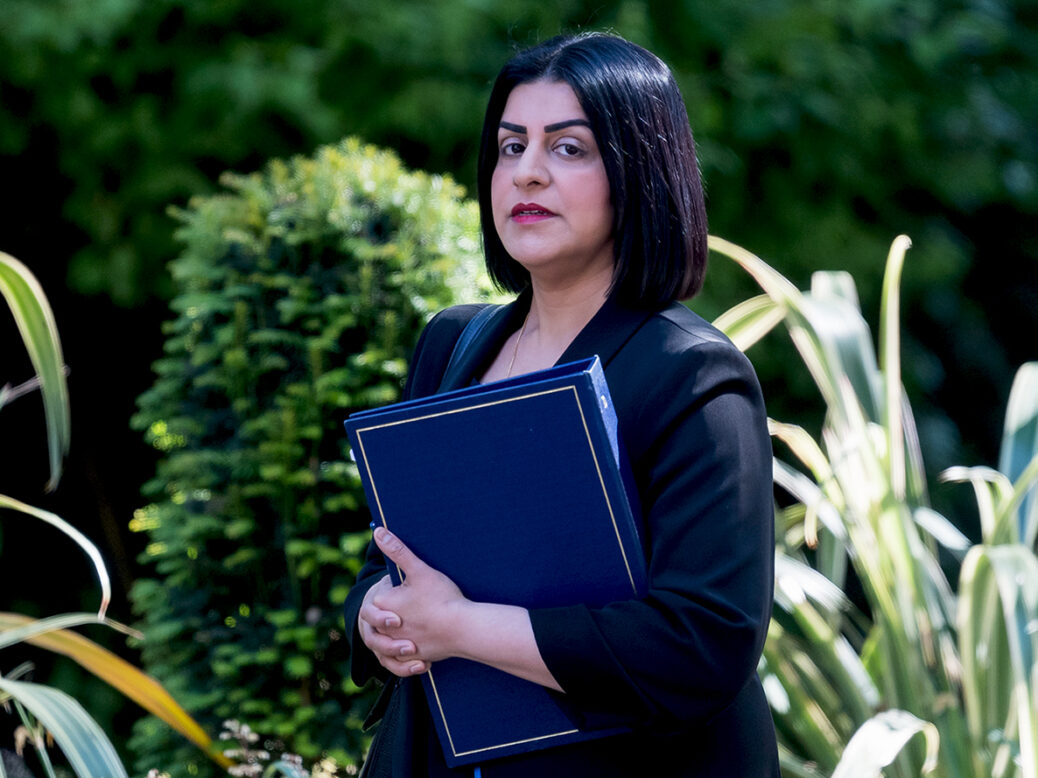
“Quite possibly the most dangerous cabinet appointment in British history.” When Shabana Mahmood was appointed Home Secretary on Friday (5 September), this was the response on parts of the political right. Not a political objection, but a hysterical and moral one – and one with ethnic overtones, coming alongside a slew of pictures of Mahmood wearing the hijab. Other observers have described the move as a well-deserved promotion, citing Mahmood’s effectiveness and firm approach during her tenure as Lord Chancellor. Yet on social media – particularly X – some voices have focused not on her record but on her identity as a “Pakistani Muslim”, and raising unfounded concerns about whether this might compromise her stance on the grooming gangs scandal.
There have been comparable attacks on David Lammy: the former SAS: Who Dares Wins star Ant Middleton called his appointment as Justice Secretary an “attack on British Culture, heritage and identity”. (It was also noticeable how the attacks on Labour politicians at Reform’s conference coalesced on Lammy, as well as Sadiq Khan, or “Mayor Khan” as Lee Anderson calls him.) Given the state of X these days, it is hardly surprising to see trolls pile on. But what stood out, however, was the overtly racial nature of many of the replies. Few, if any, acknowledged Shabana Mahmood as British in any meaningful sense. And this doesn’t stem merely from anxiety over demographic change. I believe it reflects something deeper: the Americanisation of the British right. Traditional British markers of civic inclusion – manner, service, locality – are being displaced, and, even for those born in this country, racial identity is becoming a test of belonging and loyalty.
This Americanisation has accelerated as the borders between their politics and ours have become more porous, with the internet profoundly accelerating cross-cultural formation. Over the last decade, we’ve seen movements like Black Lives Matter replicated almost identically across the globe. American culture has long held global hegemony – Hollywood being one of its greatest exports – but the advent of social media has intensified its reach. American framings now enter British discourse instantly and often uncritically.
Even at the level of everyday speech, British urban slang increasingly borrows from American vocabulary. As a result, US culture wars – once distant – now shape British political life. One striking shift is the move from British habitual belonging (manners, shared institutions, tacit codes) to American identity politics (race, ideology, representation). “Optics” now dominate a public discourse that is filtered through racial symbolism, and representation is judged visually before it is evaluated morally or institutionally.

As a result, British political discourse online now prioritises visible identity over civic contribution. We see this clearly in how Shabana Mahmood is received: despite serving as a cabinet member and representing a Birmingham constituency, she is being regarded in some quarters online as less British than someone with white skin but no local roots or record of public service. This isn’t to suggest Mahmood is above criticism – far from it. But the critique isn’t aimed at the substance of her worldview. Instead, it hinges on the assumption that her ethno-religious background renders her inherently incapable of putting Britain first.
This shift reveals that ethnic essentialism isn’t confined to the progressive left. Right-wing influencers increasingly copycat American racial hierarchies, suggesting that Britain is – or ought to be – a visibly white nation, rather than one defined by cultural disposition (Englishness) or civic practice. Their rhetoric often echoes American conservative talking points, complete with race-baiting and culture wars. It’s the collapse of a more generous moral imagination – one that once allowed Britishness to be inherited biologically and culturally. For many in this camp, that layered understanding no longer seems intelligible.
Britain once enabled subtle forms of integration – through service in the NHS, participation in the Anglican church, the public school system, the BBC, local institutions and symbolic loyalty to the monarchy. Belonging was performed, not proclaimed. And while it’s fair to say that some ethnic minorities remain culturally distant, does that really apply to Shabana Mahmood? Her father was once a chair of the local Labour Party, she was educated in ancient British institutions, she’s a lifelong Labour supporter – she has inhabited the script of national life more thoroughly than many of her critics. Yet this older, metaphysical sense of nationhood – a belonging woven through custom, duty and locality – is fading under pressure from globalised media and ideological rigidity. And these parts of the right also go after politicians of their own persuasion: think of the recent furore over whether Rishi Sunak is English.
One might argue that much of this remains an online phenomenon – that the cross-cultural formation described earlier is largely confined to digital spaces. And indeed, in everyday life, most people accept Shabana Mahmood as British. They wouldn’t invoke her ethnicity or religion as a reason to exclude her from the national story. But as we’ve seen, ethnic essentialism – particularly from the American progressive left – has already crept into British institutions. There is no guarantee it won’t do so from the right as well.
Britain is approaching a quiet but pivotal moment. The story it chooses to tell about itself – about who belongs and why – will shape its national future. The idea of Britain as a civic and moral project, not just an ethnic one, is worth preserving.
[See also: Nigel Farage really means it this time]
Content from our partners
Related

Join the debate
Subscribe here to comment