
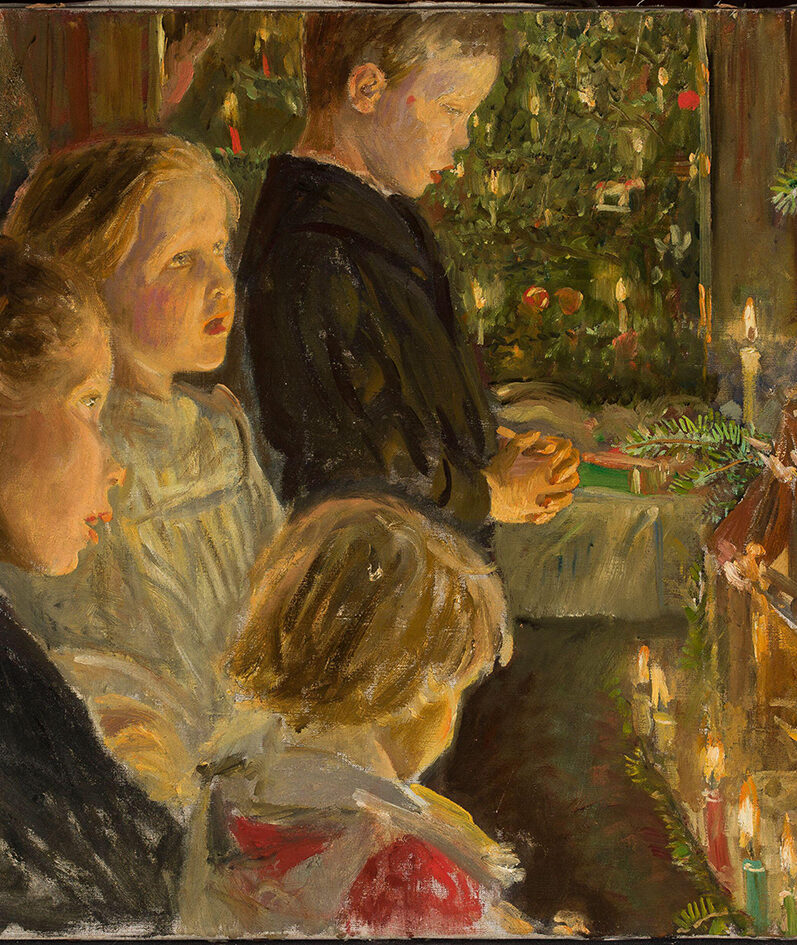
The familiar Christmas arguments have resumed. Some people lament that the season has been hollowed out by consumerism, a complaint that has real force. Others insist that Christmas was “originally” a pagan festival and, therefore, has little to do with the birth of Jesus. And this year, even the Christmas tree has been dismissed as un-Christian or spiritually devoid of meaning.
But this latter framing misunderstands both the Christian imagination and the cultural life of symbols. In the UK, the Christmas tree has become something unique: a domestic myth. It is a practice that gathers families, anchors memory and quietly shapes moral imagination, regardless of one’s beliefs.
The claim that the Christmas tree – along with other festive customs such as feasting or the choice of 25 December – is “pagan” usually rests on its association with older winter solstice festivals such as Saturnalia or Yule. This is not entirely wrong. Christmas emerged through a complex layering of Christian meaning and inherited cultural practice. While the core religious claim is unmistakeably Christian, many of the season’s customs were adopted, adapted and reoriented from pre-Christian life.
But this raises the wrong question. The issue is not whether the Christmas tree once had pagan parallels, but whether that history determines its meaning now.

Traditional Christian thought consistently answers in the negative. Symbols are not defined by their origins, but by how they are used. Wood does not worship; people do. Historical literalism collapses meaning into archaeology, but the Christian moral imagination has always recognised that matter is morally inert until ordered towards a purpose. The Christmas tree is a classic example of this re-signification. The evergreen became a sign of eternal life in Christ, and winter was reframed, not as cosmic despair but as the stage upon which Light enters darkness.
UK Christianity, in particular, has long been comfortable sanctifying ordinary material life – homes, seasons, habits and rhythms – rather than confining the sacred to explicitly religious spaces. By contrast, both religious purism and modern secularism share a curious suspicion of enchantment. One fears contamination, the other dismisses meaning altogether. The result in both cases is a flattened world.
Beyond theology, the Christmas tree has been absorbed into the British way of life and rendered almost invisible through familiarity. Since the Victorian period, it has mostly belonged not to the public square but to the living room. It is about intimacy, not spectacle.
I was reminded of this recently while walking to my local church’s carol service. Through uncurtained windows, Christmas trees stood quietly in living rooms across the neighbourhood, lit, decorated and waiting. Few of these homes shared the same beliefs, yet the ritual was recognisable in all. The tree has become one of the last remaining practices that bind the country together, however loosely.
This reflects a wider British pattern: meaning embedded in restraint, privacy and the everyday. The Christmas tree anchors the season. It slows time, gathers dispersed families, and creates shared memories across generations. Such practices subtly resist loneliness and fragmentation. In an age shaped by global technology and restless capitalism, the Christmas tree should not be dismissed as a hollow or nostalgic myth. It remains one of the few rituals capable of reordering time around human presence rather than productivity.
The beauty of the Christmas tree is that it does not require enforced belief. For Christians, it gestures towards the Incarnation; for others, it remains a shared and intelligible ritual. Its power lies not in what it proclaims, but in what it quietly forms.
What is required is attentiveness to the formative power of habit and symbol. Few public examples capture this better than Liverpool FC’s Mohamed Salah, a devout Muslim who each year shares an image of his family gathered in matching pyjamas before a Christmas tree. The gesture is neither ironic nor confessional. It is simply participatory.
The tree does not preach; it gathers. This is why it endures, even as formal belief declines, and why the UK’s cultural life would be poorer without it. Perhaps what the country most needs are not new values, but the courage to take our inherited symbols seriously again.
[Further reading: How the far right co-opted the cross]
Content from our partners



Related



Join the debate
Subscribe here to comment