
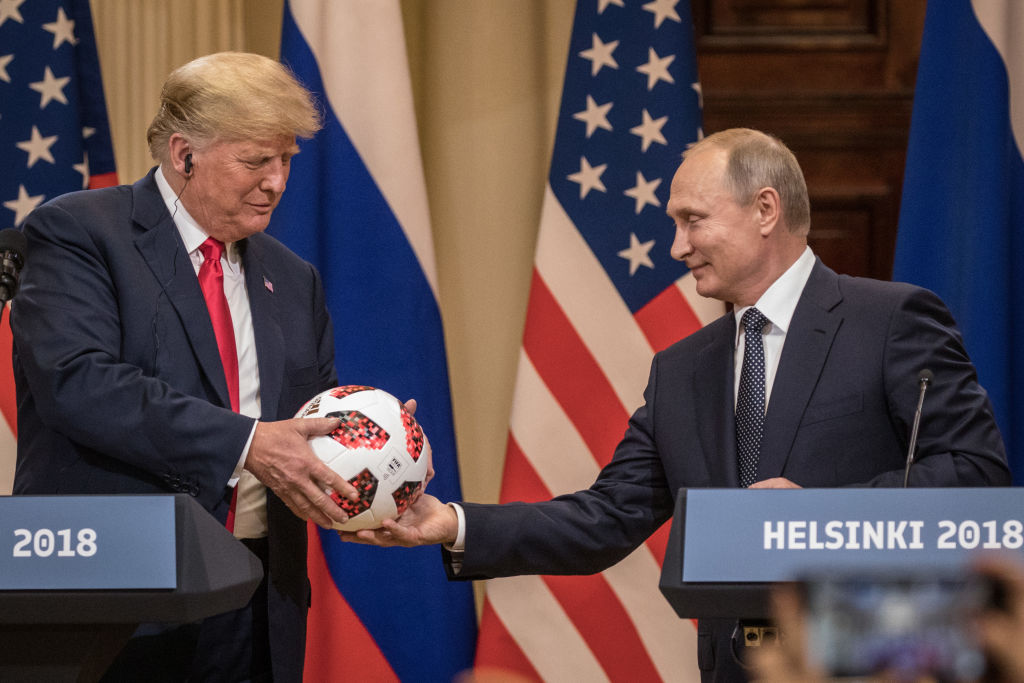
There is, to put it mildly, a fair degree of uncertainty as to what to expect from Donald Trump’s summit with Vladimir Putin in Alaska on Friday. Last week, as Trump’s latest deadline for Putin to cease his assault on Ukraine or face crippling sanctions came and went, the US president appeared to suggest that a major breakthrough was imminent, with the outlines of a potential peace deal taking shape. “We’re going to get some back, and we’re going to get some switched,” Trump said of Ukraine’s occupied territories on 8 August. “There’ll be some swapping of territories to the betterment of both.”
These expectations seem to have originated with Steve Witkoff – Trump’s longtime golfing buddy and fellow real estate developer turned roving special envoy – who emerged from a three-hour meeting with Putin at the Kremlin on 6 August with reports of the supposed Russian terms. According to the German newspaper, Bild, Witkoff misunderstood Putin’s call for a “peaceful withdrawal” of Ukrainian forces from the partially occupied territories of Kherson and Zaporizhzhia for an offer to withdraw his own troops from the two regions, perhaps in exchange for Ukraine surrendering control of Donetsk, where the most intense fighting is currently taking place and Kyiv still controls close to 30 per cent of the territory.
Witkoff clarified in a call with European officials on 8 August that, in fact, Russia was merely offering to pause fighting along the current lines in exchange for the Ukrainians unilaterally withdrawing from Donetsk. Further negotiations could then take place on the exchange of some land, but it was not clear how much territory Ukraine could expect to regain or would be expected to cede. Ukraine’s president, Volodymyr Zelensky, has pointed out that such an arrangement would be illegal under the current constitution, insisting that, “Ukrainians will not gift their land to the occupier.”
Whether Witkoff was deliberately misled during his meeting with Putin, or simply misunderstood the terms on offer, Trump has since noticeably played down expectations for the summit. In a press conference on 11 August, during which he mistakenly said he was “going to Russia on Friday” – Alaska has been part of the US since 1867 when it was sold by Tsar Alexander II for $7.2m, the rough equivalent of $156m today – he characterised the encounter as a “feel out” meeting. “I’m going to see what he has in mind,” Trump said of Putin. “Probably in the first two minutes I’ll know exactly whether or not a deal can get done.”

Initially, there were reports that Trump would not agree to meet Putin unless he also agreed to sit down with Zelensky, but Trump himself has since dismissed these concerns. Instead, he plans to call the Ukrainian president after the summit, along with other European leaders, to tell him what was discussed.
The meeting alone is a gift to Putin, who can now point to his grand summit with Trump as evidence that Western efforts to isolate the Russian president and render him a global pariah have failed. In truth, this was the case from the outset of the conflict in much of the Global South. It also allows Putin to claim that he has forced the US to acknowledge him as an equal – the leader of one of the world’s great powers. Since Trump’s return to power in January, Putin has been hinting that he was keen to meet. The US could have extracted something meaningful in return – the 30-day unconditional ceasefire that was proposed by the US and its European allies in May, for instance – to demonstrate that Putin was serious about negotiating peace. But instead, Putin has got what he wanted despite stepping up his bombardment of Ukrainian cities in recent months and continually ignoring Trump’s previous deadlines and forlorn appeals for him to halt his attacks.
At a minimum, Putin will hope to use the opportunity to impress on Trump the validity of his claims and the extraordinary business opportunities that await, if only they can agree to put the tiresome issue of the war in Ukraine to one side, and that Zelensky is the real impediment to peace. He will, presumably, clothe this appeal in paeans to Trump’s personal strength and character – he has previously praised him for behaving as a “real man” after the assassination attempt in Pennsylvania last year, and told Witkoff that he had rushed to church to pray for his recovery when he heard that his “old friend” had been shot. Putin is likely to tell Trump exactly what he wants to hear during their on-on-one, echoing his claims that this is “a Democrat war” that would never have started if he had still been in power, and reminding him of their shared history during what the US president calls the “Russia hoax” – as he describes the credible evidence of Russian interference in the 2016 presidential election. He has reason to believe this will work. Trump emerged from their earlier summit in Helsinki in 2018 repeating Russian talking points and publicly siding with Putin over his own intelligence agencies.
Bewilderingly for a man who prides himself on his own negotiating prowess, Trump has already given up much of his own leverage ahead of the talks by repeatedly signalling his disdain for Zelensky and his determination to end US involvement in the conflict as quickly as possible. It would be one thing if the US was clearly communicating to Putin that the alternative to peace would be a massive increase in US military aid to Ukraine and more sanctions on Russia and its biggest trading partners. But Putin knows that Trump has failed to follow through on his previous threats, and that he is desperate for a deal to burnish his own legacy and realise his long-held ambition of winning the Nobel Peace Prize.
On 11 August, four days ahead of his summit with Putin, Trump reiterated that he “very, very severely” disagreed with Zelensky’s actions to date and implied that he was at least partially responsible for starting the war. Dismissing Zelensky’s insistence that he would need to “get constitutional approval” to cede Ukrainian territory, Trump remarked, “I mean, he got approval to go into war and kill everybody.” The previous day, his vice president, JD Vance, was unequivocal during a Fox News interview that the US was “done with the funding of the Ukraine war business.” Hardly a stirring invocation of the US commitment to defend Ukraine – or the rest of Europe – from Russian aggression.
All is not lost. For all of the incompetence and incoherence on display ahead of this summit, there is still a faint possibility of extracting meaningful progress for Ukraine from the current morass. In the best-case scenario for Kyiv, Putin overplays his hand, and Trump perceives him to be arrogant and disrespectful. During his talks with Kim Jong Un in Hanoi in 2019, Trump proved he was prepared to walk away mid-summit when he believed they were getting nowhere. (Although on aggregate, the process was still relatively productive for Kim, who succeeded in defusing tensions with the US, at least temporarily, and forged ahead with his nuclear arsenal.) It is always possible that Trump finally comes to understand that Putin has been playing him all along, and as he conceded recently, feeding him “a lot of bullshit.”
It has been widely reported that Putin might be prepared to offer an “air ceasefire” at the summit – perhaps also extending to the sea. This would not be an act of charity on his behalf. While many Ukrainians would surely welcome a respite from the barrage of Russian air raids, this would also shield Russia from the long-range Ukrainian strikes that have increasingly targeted Russian military and energy facilities and brought the war home to Russian citizens far from the front line. Such an agreement would satisfy Trump’s need to be seen to elicit some sort of deal and negate his oft-expressed concerns over the television pictures of Ukrainian cities in ruins and civilians being bombed.
This would not mean an end to the war. Even if a full ceasefire was offered, it would be functionally meaningless without meaningful security guarantees. As Ukrainians have learned from the recent history of Russian invasions, Putin is likely simply to pocket any concessions, rebuild his forces, and when his military and his economy has stabilised, come back to try again. The Kremlin might well also hope that a temporary halt to the war would enable elections to be held and Zelensky, whose image has been tarnished at home by his mishandling of recent legislation targeting the country’s anti-corruption agencies, might finally be toppled and replaced by a leader who is more palatable to Moscow (and ideally corruptible). Putin has no particular desire to fight to subjugate Ukraine if, as has been the case in the past, it can be achieved by other means.
Yet what Putin – and Trump – have repeatedly failed to understand since the start of this conflict is that they are not the only ones, as the latter would put it, who hold the cards. Ukraine has agency. Europe has agency. The Russian and US leaders might believe that we still live in a world where the future of independent nations is decided in secretive summits in foreign lands. But Ukrainians have been fighting and dying for more than a decade now to prove that wrong – to demand the right to determine their own future and defend their sovereignty. In this sense, the coming summit in Alaska should be a clarifying moment for European leaders too. The US, in its current iteration (and who knows what is to come in a post-Trump world) cannot be relied upon to defend Ukraine, or European security. That responsibility, and the outcome of this war, now depends on the continent itself.
Regardless of the outcome in Alaska, whether it turns out to be little more than a high-profile handshake, or the first glimmers of a halt to the fighting in some form, this summit should be a clear indication that neither Zelensky, nor his European counterparts can afford to trust the future of their nation to the vagaries – and vanity – of the current US president. If a ceasefire does follow, it will be merely the next phase in the long battle to secure Ukraine’s future, not the end.
[See also: The Cotswolds plot against JD Vance]
Content from our partners


Related
Join the debate
Subscribe here to comment