
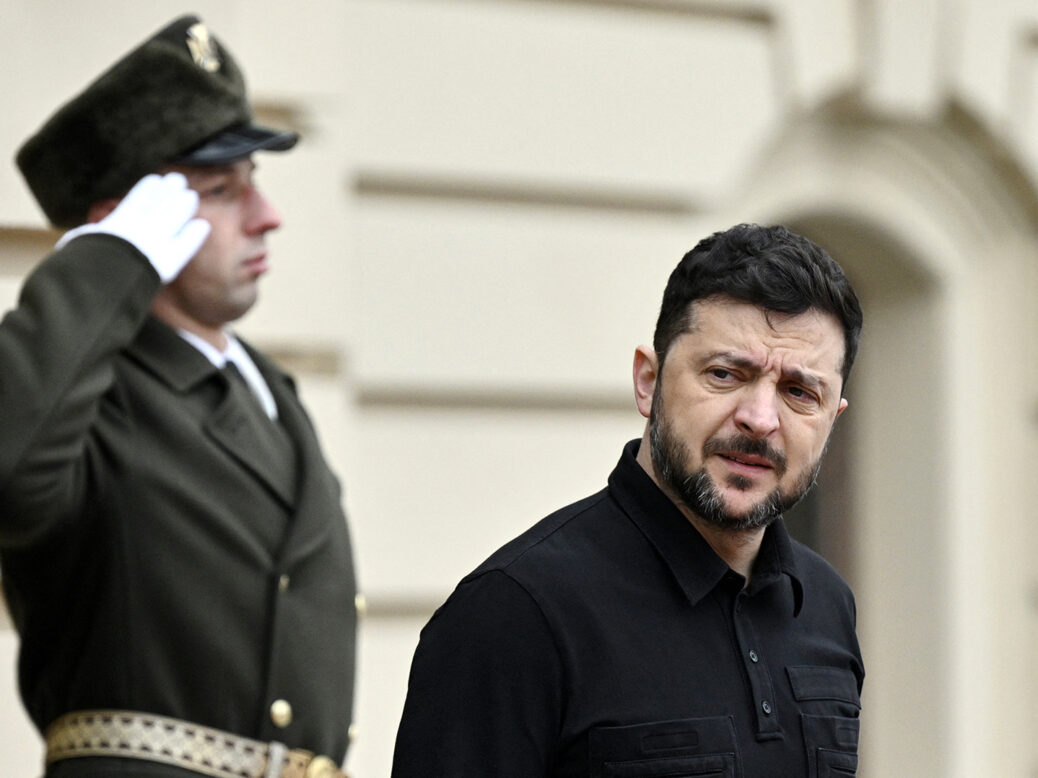
During his six months as Ukraine’s defence minister, Mykhailo Fedorov was credited with bringing a tech start-up style vigour to the country’s war effort that prioritised drone warfare, innovation and shaking up the cumbersome military procurement system. At 35, he was seen as a popular young reformer whose forward-thinking approach seemed to mirror the success of Ukraine’s long-range strike campaign. Previously head of the ministry for digital transformation, he cultivated relationships with Silicon Valley executives, such as Palantir’s Alex Karp and Elon Musk, who he is said to have persuaded to cut off Russia’s access to the Starlink internet service. Yet on 15 July, Volodymyr Zelensky decided it was time for Fedorov to go.
The Ukrainian president is in the process of reshuffling his cabinet for the third time since the start of the full-scale war. Earlier this week he replaced Yulia Svyrydenko as prime minister with Sergii Koretskyi, the former head of the state gas company Naftogaz. This seems logical. Svyrydenko lacked authority and was viewed as a protégé of Andriy Yermak, Zelensky’s powerful chief of staff until he stepped down in November after allegations of corruption, which he denies. Koretskyi, by contrast, is a well-regarded technocrat who has yet to make major political enemies. He also brings valuable experience from the energy sector at a time when Ukraine confronts the prospect of another long winter of Russian bombardment of its critical infrastructure ahead.
The logic for Federov’s dismissal is harder to comprehend. On one level, Zelensky’s reasoning seems quite straightforward. After rumours of an intensifying feud between Fedorov and the head of the armed forces, Oleksandr Syrskyi, Zelensky acknowledged on 16 July that relations between the two men had broken down and he had ultimately been forced to choose between the civilian and military leadership. “I would very much like to see unity,” Zelensky said. “The sides have not found it, and the problem lies not only with the sides, but with me as well. But things are as they are, and in such a situation you have a choice: either one side or the other.”
But Zelensky’s decision to side with Syrskyi — a 60-year-old general who earned the nickname “the butcher” because of the number of losses under his leadership — over one of the government’s most promising young talents has ignited real anger at home. Protesters rallied outside the presidential office in Kyiv on 16 July, as well as on the streets of Lviv and Kharkiv, carrying cardboard signs in support of Fedorov and chanting, “Shame!” The deputy head of Ukraine’s air force has resigned, describing the decision to fire Fedorov as a “great blow to the country’s defence”.

Fedorov is not going quietly. He held a press conference in Kyiv on 16 July where he attacked Syrskyi for the “complete obstruction of all our initiatives” and claimed that instead of “figuring out how to asymmetrically defeat Russia,” he had “figured out how to split the country”. Ukrainians were now protesting, he said, “because when Ukraine had seized the initiative on the battlefield and in the skies, that trajectory was broken”. He said he had turned down an offer to stay on as an adviser to Zelensky. It was an extraordinarily public display of the tensions that have mostly remained behind-the-scenes since the start of the war.
Detractors argue that Fedorov lacked military experience and that he was overly focused on style over substance, producing flashy presentations that fetishised drones and the prospects for AI-enabled warfare while failing to understand the still critical role of infantry and mechanised warfare. He has also been accused of failing to tackle the military’s chronic shortage of manpower. His supporters counter that he had only been in the job for six months and had proposed changes such as significant pay increases for frontline troops and fixed-term contracts to boost recruitment. They argue that his real offence, in the eyes of the military high command, was to challenge an old guard of generals who were failing to adapt to the changing technologies of war and take on an entrenched system that had long provided lucrative opportunities for graft.
Fedorov’s increasing personal popularity may also have been viewed as a threat by Zelensky, who will be well aware that his own approval ratings are declining with the war now well into its fifth year and a series of corruption scandals implicating members of his inner circle, all of whom deny any wrongdoing. This would not be the first time he had deliberately sidelined a potential political rival. In 2024, he dismissed Valerii Zaluzhnyi, the popular head of Ukraine’s armed forces, and dispatched him abroad to serve as ambassador to the UK, although Zaluzhnyi has maintained a public profile and is expected to challenge Zelensky for the presidency when the next elections are held. The crowds of protesters now taking to the streets will hardly assuage Zelensky’s fears that Fedorov could also become a formidable challenger.
This is also not Zelensky’s first political mis-step. Almost exactly a year ago, he faced similarly angry protests after an attempt to curtail the independence of the country’s main anti-corruption agencies. Back then, he reversed his decision, and the same agencies subsequently arrested his former chief of staff. It is harder to see how he can extricate himself from this latest crisis. Fedorov has made clear that Zelensky must choose between him and Syrskyi, and the Ukrainian president has already publicly declared his choice. Yet he also now lacks the votes to confirm his replacement. At the time of writing, the parliament had adjourned until 18 August, leaving the cabinet with only an acting minister of defence and foreign affairs at a critical moment in this war.
The Fedorov debacle could hardly have come at a worse time. According to Zelensky’s own orders, Ukraine is meant to be in the midst of a 40-day campaign to “compel” Russia to end the war. The armed forces were laying siege to Crimea and striking Russian energy infrastructure, triggering widespread fuel shortages and seeming to regain the initiative, shifting the momentum of this conflict towards Ukraine once again. Instead, Zelensky has shattered that illusion, plunging his government into crisis and laying bare the domestic political fault lines that were always there, but long obscured by the facade of wartime unity. Vladimir Putin must barely be able to believe his luck.
[Further reading: Vladimir Putin has no way out]
Content from our partners


Related
Join the debate
Subscribe here to commentThere had to be a choice and Zelenskyy made it. One of the worst things in politics is rivalry. The fight Churchill had to become Prime Minister in 1940 was against a Peer who was likely to agree to negotiations with Hitler. During the WW2 Churchill faced a vote of No Confidence, which he won. Zelenskyy had to choose and he chose to keep the more experienced man. The dismissed man should have accepted the offer of advisor to Zelenskyy. One thing is certain and that is that there must be someone who can make hard choices. Starmer hated political discussion because it could only be resolved by a decision and he hated taking difficult decisions. The sacking of his Chiefs of Staff illustrated this, as did the appointment of Mandelson, when there were two better qualified contenders.